 Back
BackApplications of Aqueous Equilibria: Acids, Bases, Buffers, Titrations, and Solubility
Study Guide - Smart Notes
 Tailored notes based on your materials, expanded with key definitions, examples, and context.
Applications of Aqueous Equilibria
Common Ion Effect
The common ion effect describes the shift in equilibrium that occurs when an ion already present in a solution is added, causing the equilibrium to shift away from the added ion. This effect is a direct application of Le Chatelier's Principle and is important in understanding solubility, buffer systems, and acid-base equilibria.
Definition: The addition of a common ion decreases the solubility of a salt or the ionization of a weak acid/base.
Example: Adding concentrated HCl to a saturated NaCl solution causes NaCl to precipitate due to increased Cl- concentration.
Application: The common ion effect is crucial for buffer solutions, acid-base indicators, and titration calculations.
Example Calculation: For acetic acid, HC2H3O2 ↔ H+ + C2H3O2-, adding NaC2H3O2 shifts equilibrium to the left, decreasing [H+] and increasing pH.
Buffered Solutions
Buffer Systems and Their Function
Buffers are solutions that resist changes in pH when small amounts of acid or base are added. They typically consist of a weak acid and its conjugate base, or a weak base and its conjugate acid.
Example: The NH3/NH4+ and HC2H3O2/C2H3O2- systems.
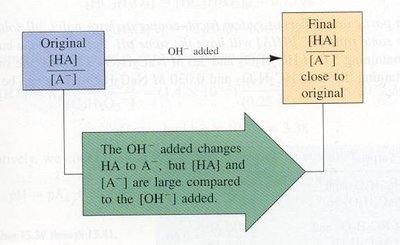
Buffer Capacity: The amount of acid or base a buffer can absorb without significant pH change. Higher concentrations of both components increase capacity.
Pure Water: Has no buffering capacity; pH changes drastically with acid/base addition.
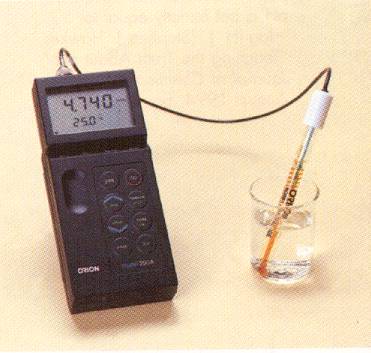
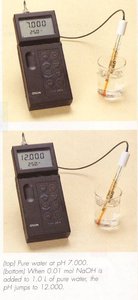
Buffer Action: When strong acid is added, the conjugate base neutralizes it; when strong base is added, the weak acid neutralizes it.
Calculating Buffer pH: The Henderson-Hasselbalch Equation
The Henderson-Hasselbalch equation provides a convenient way to calculate the pH of a buffer solution:
Optimum buffering occurs when , so .
The equation is valid for weak monoprotic acids/bases and their salts, not for very dilute or very strong acids/bases.
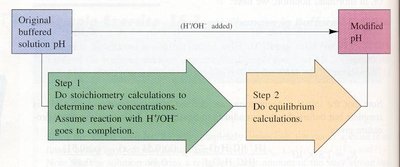
Buffer Calculations: Stepwise Approach
Identify major species present.
If a reaction occurs, perform stoichiometry in moles, then convert to molarity.
Set up the equilibrium expression (Ka or Kb) or use the Henderson-Hasselbalch equation.
Solve for the unknown and check the logic of your answer.
Acid-Base Titrations
Principles of Titration
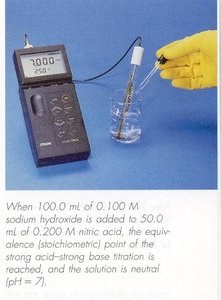
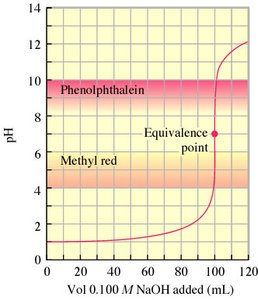
Titration is a technique where a solution of known concentration (titrant) is added to a solution of unknown concentration until the reaction reaches the equivalence point (moles acid = moles base).
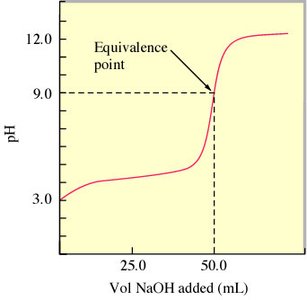
Equivalence Point: The point at which stoichiometric amounts of acid and base have reacted.
Endpoint: The point where the indicator changes color, ideally matching the equivalence point.
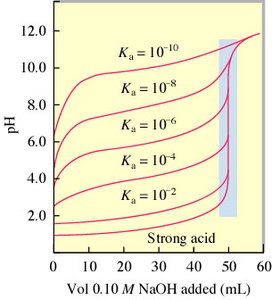
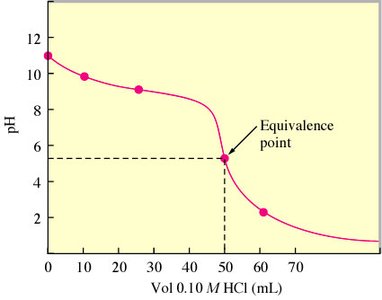
pH Curves: Graphs of pH vs. volume of titrant added, useful for visualizing titration progress.
Types of Acid-Base Titrations
Strong Acid + Strong Base: Reaction goes to completion; pH at equivalence is 7.
Weak Acid + Strong Base: Before equivalence, buffer region exists; at equivalence, pH > 7 due to basic salt.
Strong Acid + Weak Base: At equivalence, pH < 7 due to acidic salt.
Key Point: At the halfway point of a weak acid titration, and .
Acid-Base Indicators
Indicator Theory and Selection
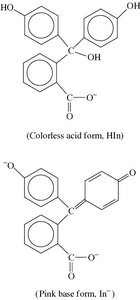
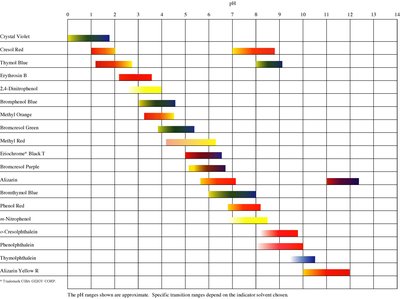
Indicators are weak acids or bases that change color over a specific pH range. The color change occurs when the ratio of the two forms (HIn and In-) shifts significantly.
Useful Range: pKa ± 1 of the indicator.
Selection: Choose an indicator with a pKa close to the expected equivalence point pH.
Solubility Equilibria (Ksp)
Solubility Product Constant (Ksp)
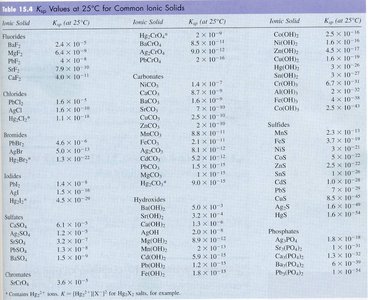
The solubility product constant () describes the equilibrium between a solid and its ions in a saturated solution. It is specific for each salt at a given temperature.
General Form: For ,
Stoichiometry: The exponents in the expression match the coefficients in the dissolution equation.
Example: For ,
Determining Ksp and Solubility
From Solubility: Use measured ion concentrations to calculate .
From Ksp: Calculate solubility in mol/L or g/L using the expression.
Common Ion Effect: Solubility decreases in the presence of a common ion.
Reaction Quotient (Q) and Precipitation
Q < Ksp: Solution is unsaturated; more solid can dissolve.
Q = Ksp: Solution is saturated; equilibrium exists.
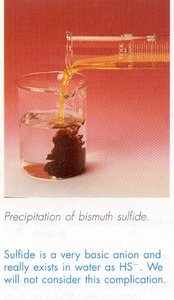
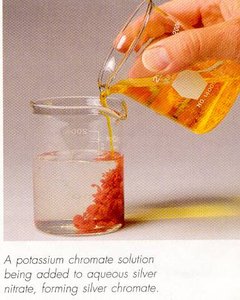
Q > Ksp: Solution is supersaturated; precipitation occurs.
Complex Ions and Solubility
Formation of Complex Ions
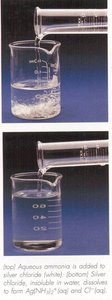
Complex ions form when metal ions react with ligands (molecules or ions with lone pairs) to create charged species. This process is characterized by formation constants ().
Example:
Effect: Formation of complex ions can increase the solubility of otherwise insoluble salts.
Solubility, Ion Separations, and Qualitative Analysis
Selective Precipitation and Qualitative Analysis
Solubility rules and values are used to separate and identify ions in mixtures by selective precipitation. For example, adding HCl can precipitate AgCl and PbCl2, while other ions remain in solution.
Application: Used in qualitative analysis to separate and identify metal ions.
Summary Table: Key Equilibrium Constants
Equilibrium Type | Expression | Key Equation |
|---|---|---|
Acid Dissociation | ||
Base Dissociation | ||
Solubility Product | ||
Formation Constant |
Additional info: These principles are foundational for understanding laboratory techniques, environmental chemistry, and biological systems where pH and solubility control are critical.
