Back
BackAqueous Equilibria: Acids and Bases – Study Notes
Study Guide - Smart Notes
 Tailored notes based on your materials, expanded with key definitions, examples, and context.
Chapter 16: Aqueous Equilibria – Acids and Bases
Acid–Base Concepts
This chapter explores the fundamental theories of acids and bases, their equilibria in aqueous solutions, and the calculations associated with their strengths and reactions.
Arrhenius Theory
Acids are substances that dissociate in water to produce hydrogen ions (H+).
Bases are substances that dissociate in water to yield hydroxide ions (OH−).
Limitations: Restricted to aqueous solutions and does not account for basicity of substances without OH groups (e.g., NH3).
Example Equations: $\mathrm{HA\ (aq) \rightleftharpoons H^+\ (aq) + A^-\ (aq)}$ $\mathrm{MOH\ (aq) \rightleftharpoons M^+\ (aq) + OH^-\ (aq)}$
Brønsted–Lowry Theory
Acids are proton (H+) donors.
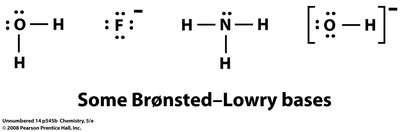
Bases are proton (H+) acceptors.
Acid–base reactions are proton-transfer reactions.
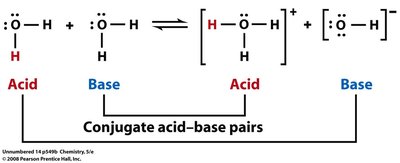
Conjugate acid–base pairs: Chemical species whose formulas differ only by one proton.
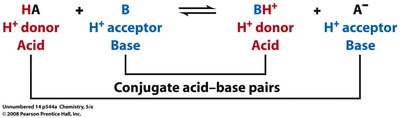
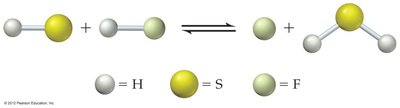
Worked Example: Identifying Brønsted–Lowry Acids, Bases, and Conjugate Pairs
Acid–Dissociation Equilibrium
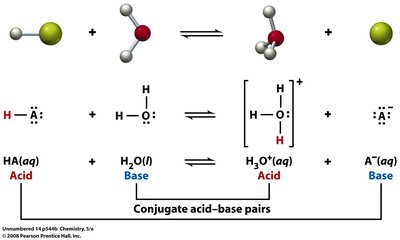
General equation for acid dissociation in water: $\mathrm{HA\ (aq) + H_2O\ (l) \rightleftharpoons H_3O^+\ (aq) + A^-\ (aq)}$
Conjugate acid–base pairs are formed in this equilibrium.
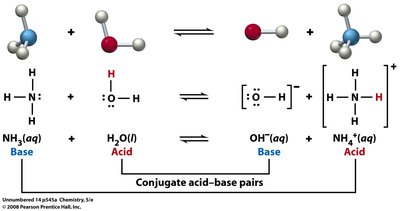
Dissociation of Ammonia in Water
Ammonia acts as a base, accepting a proton from water.
Equation: $\mathrm{NH_3\ (aq) + H_2O\ (l) \rightleftharpoons NH_4^+\ (aq) + OH^-\ (aq)}$
Acid and Base Strength
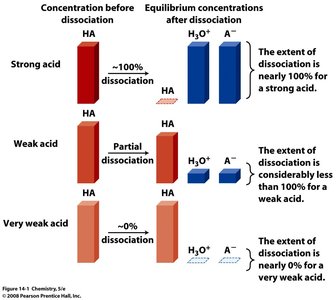
The strength of an acid or base is determined by its degree of dissociation in water.
Strong acids dissociate almost completely in water, acting as strong electrolytes.
Weak acids only partially dissociate, resulting in a mixture of undissociated acid and ions.
The equilibrium for a strong acid lies nearly 100% to the right; for a weak acid, it is far less complete.
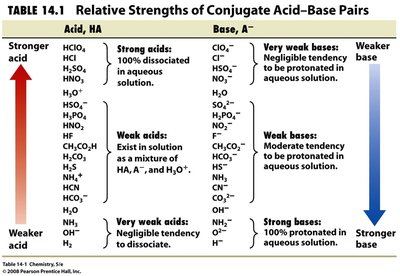
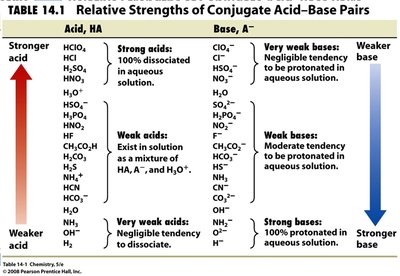
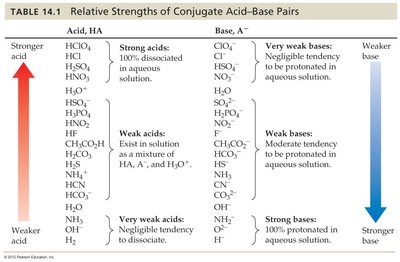
Relative Strengths of Conjugate Acid–Base Pairs
Strong acids have weak conjugate bases, and weak acids have stronger conjugate bases.
Common Strong and Weak Acids and Bases
Strong acids: HCl, HNO3, H2SO4
Weak acids: CH3COOH (acetic acid)
Strong bases: Hydroxides of Group I and II metals (e.g., NaOH, KOH, Mg(OH)2, Ca(OH)2)
Weak base: NH3 (ammonia)
Direction of Acid–Base Reactions
Proton transfer always occurs to the stronger base.
The reaction proceeds from the stronger acid and base to the weaker acid and base.
Use tables of relative strengths to predict reaction direction.
Hydrated Protons and Hydronium Ions
In aqueous solution, H+ ions are hydrated, most commonly as H3O+ (hydronium ion).
Other hydrated forms include H5O2+, H7O3+, and H9O4+.
Dissociation of Water and the Ion-Product Constant (Kw)
Water self-ionizes to a small extent: $\mathrm{2H_2O\ (l) \rightleftharpoons H_3O^+\ (aq) + OH^-\ (aq)}$
The equilibrium constant for this process is: $K_w = [H_3O^+][OH^-] = 1.0 \times 10^{-14}$ at 25°C
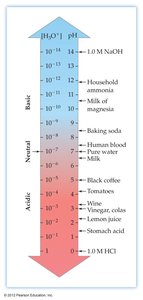
In acidic solutions: $[H_3O^+] > [OH^-]$ In neutral solutions: $[H_3O^+] = [OH^-]$ In basic solutions: $[H_3O^+] < [OH^-]$
The pH Scale
pH is a logarithmic measure of hydronium ion concentration: $\mathrm{pH = -\log[H_3O^+]}$
pH < 7: acidic; pH = 7: neutral; pH > 7: basic.
Relationship: $\mathrm{pH + pOH = 14}$
![pH scale and corresponding [H3O+] values](https://static.studychannel.pearsonprd.tech/study_guide_files/general-chemistry/sub_images/153e0a8f_image_11.png)
Acid–Base Indicators
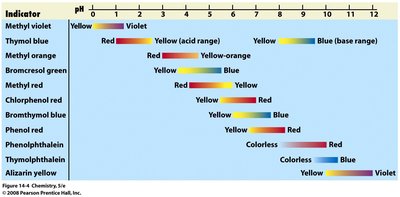
Indicators are weak acids or bases that change color depending on pH.
Each indicator has a specific pH range over which it changes color.
Acid–Dissociation Constant (Ka) and pKa
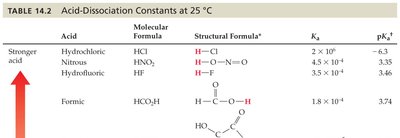
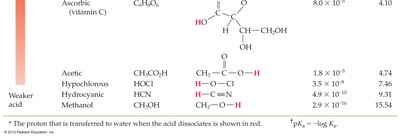
For a weak acid, the equilibrium constant is: $K_a = \frac{[H_3O^+][A^-]}{[HA]}$
pKa is defined as $\mathrm{pK_a = -\log K_a}$
The stronger the acid, the higher the Ka and the lower the pKa.
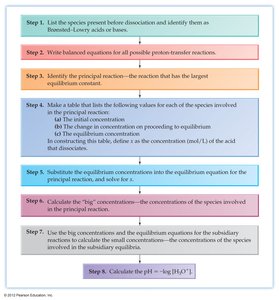
Solving Weak Acid Equilibria
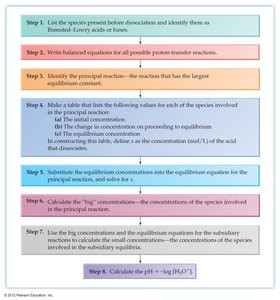
Use ICE tables (Initial, Change, Equilibrium) to solve for equilibrium concentrations.
Assume $x$ is small compared to the initial concentration if $x < 10\%$ of the initial value.
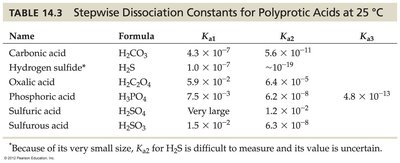
Polyprotic Acids
Acids with more than one dissociable proton (e.g., H2SO4, H3PO4).
Dissociate in a stepwise manner, each with its own Ka value (Ka1 > Ka2 > Ka3).
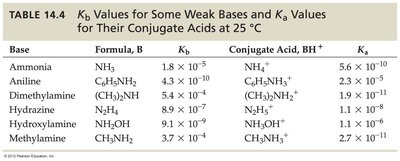
Weak Bases and Base–Dissociation Constant (Kb)
For a weak base B: $K_b = \frac{[BH^+][OH^-]}{[B]}$
Relationship between Ka and Kb for conjugate acid–base pairs: $K_a \times K_b = K_w$ $\mathrm{pK_a + pK_b = 14}$
Acid–Base Properties of Salts
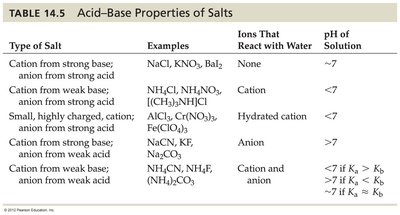
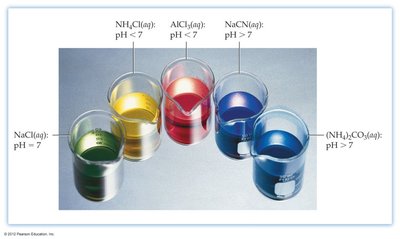
Salts can produce acidic, basic, or neutral solutions depending on the strengths of the parent acid and base.
Rules: - Strong acid + strong base → neutral salt - Strong acid + weak base → acidic salt - Weak acid + strong base → basic salt - Weak acid + weak base → depends on relative Ka and Kb
Factors Affecting Acid Strength
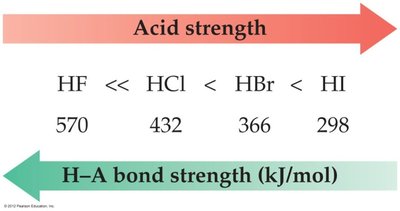
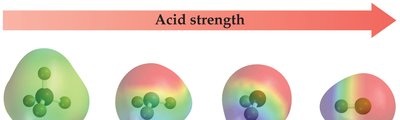
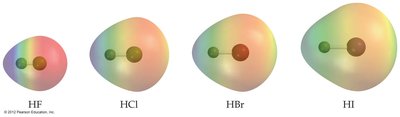
Bond strength: For binary acids in the same group, as atomic size increases, bond strength decreases, and acid strength increases.
Bond polarity: For binary acids in the same period, as electronegativity increases, acid strength increases.

Oxoacids: For acids with the same central atom, acid strength increases with the number of oxygen atoms. For the same number of O–H groups, acid strength increases with the electronegativity of the central atom.
Lewis Acids and Bases
Lewis base: Electron-pair donor.
Lewis acid: Electron-pair acceptor.
Lewis acid–base reactions involve the formation of a coordinate covalent bond.