 Back
BackAqueous Equilibria: Acids and Bases – Study Notes
Study Guide - Smart Notes
 Tailored notes based on your materials, expanded with key definitions, examples, and context.
Acid–Base Concepts
Arrhenius, Brønsted–Lowry, and Lewis Theories
Acids and bases are fundamental chemical species that participate in a variety of chemical reactions. Their definitions have evolved to encompass a broader range of chemical behavior:
Arrhenius Theory: Acids produce H+ ions in aqueous solution; bases produce OH− ions.
Brønsted–Lowry Theory: Acids are proton (H+) donors; bases are proton acceptors. Acid–base reactions are proton-transfer reactions.
Lewis Theory: Acids are electron-pair acceptors; bases are electron-pair donors.
Each theory expands the scope of acid–base chemistry, with the Lewis definition being the most general.
Brønsted–Lowry Acids and Bases
Conjugate Acid–Base Pairs
In Brønsted–Lowry theory, acids and bases exist in conjugate pairs. A conjugate acid–base pair consists of two species that differ by one proton (H+).
Acid: H+ donor
Base: H+ acceptor
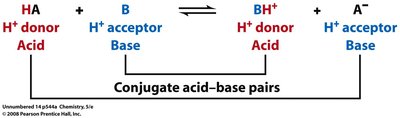
For example, in the reaction:
$ \mathrm{HA} + \mathrm{B} \rightleftharpoons \mathrm{BH}^+ + \mathrm{A}^- $
HA and A− are a conjugate acid–base pair; B and BH+ are another.
Examples of Brønsted–Lowry Acid–Base Reactions
Consider the reaction between hydrogen sulfide and hydrogen fluoride:
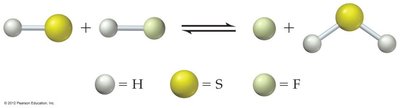
Here, H2S acts as an acid (proton donor), and F− as a base (proton acceptor).
Acid Dissociation in Water
When an acid dissolves in water, it donates a proton to water, forming hydronium ion (H3O+):
$ \mathrm{HA}(aq) + \mathrm{H}_2\mathrm{O}(l) \rightleftharpoons \mathrm{H}_3\mathrm{O}^+(aq) + \mathrm{A}^-(aq) $
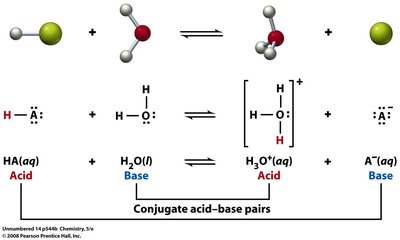
Water acts as a base, accepting a proton from the acid.
Dissociation of Ammonia in Water
Ammonia (NH3) acts as a base in water, accepting a proton to form ammonium ion (NH4+):
$ \mathrm{NH}_3(aq) + \mathrm{H}_2\mathrm{O}(l) \rightleftharpoons \mathrm{NH}_4^+(aq) + \mathrm{OH}^-(aq) $
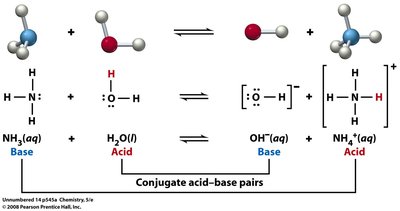
This demonstrates the Brønsted–Lowry concept of bases as proton acceptors.
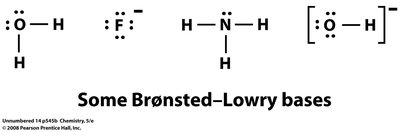
Examples of Brønsted–Lowry Bases
Common Brønsted–Lowry bases include hydroxide ion (OH−), fluoride ion (F−), ammonia (NH3), and oxide ion (O2−):
Acid and Base Strength
Strong vs. Weak Acids
The strength of an acid is determined by its degree of dissociation in water:
Strong acids: Nearly 100% dissociation; strong electrolytes.
Weak acids: Partial dissociation; weak electrolytes.
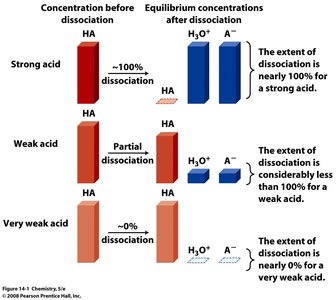
Examples of strong acids: HCl, HNO3, H2SO4. Example of a weak acid: CH3COOH (acetic acid).
Relative Strengths of Conjugate Acid–Base Pairs
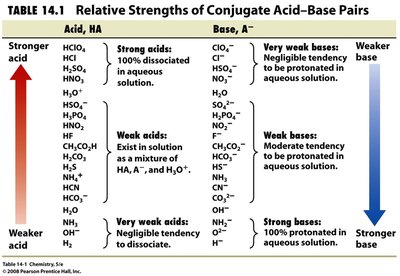
The strength of an acid is inversely related to the strength of its conjugate base. Strong acids have weak conjugate bases, and vice versa.
Acid, HA | Base, A− |
|---|---|
Strong acids (e.g., HClO4, HCl, HNO3) | Very weak bases (e.g., ClO4−, Cl−, NO3−) |
Weak acids (e.g., HCOOH, CH3COOH) | Weak bases (e.g., HCOO−, CH3COO−) |
Very weak acids (e.g., H2O, NH3) | Strong bases (e.g., OH−, NH2−) |
Acid–Base Equilibria and Calculations
Acid Dissociation Constant (Ka)
The acid dissociation constant quantifies the strength of a weak acid:
$ K_a = \frac{[\mathrm{H}_3\mathrm{O}^+][\mathrm{A}^-]}{[\mathrm{HA}]} $
The smaller the Ka, the weaker the acid. The pKa is defined as:
$ pK_a = -\log K_a $
Base Dissociation Constant (Kb)
For weak bases, the base dissociation constant is:
$ K_b = \frac{[\mathrm{BH}^+][\mathrm{OH}^-]}{[\mathrm{B}]} $
pKb is defined as:
$ pK_b = -\log K_b $
Relationship Between Ka and Kb
For a conjugate acid–base pair:
$ K_a \times K_b = K_w $
$ pK_a + pK_b = 14 $ (at 25°C)
The pH Scale
Definition and Calculation
The pH of a solution is a measure of its acidity or basicity:
$ \mathrm{pH} = -\log [\mathrm{H}_3\mathrm{O}^+] $
At 25°C:
Acidic: pH < 7
Neutral: pH = 7
Basic: pH > 7
pOH and Relationship to pH
The pOH is defined as:
$ \mathrm{pOH} = -\log [\mathrm{OH}^-] $
At 25°C:
$ \mathrm{pH} + \mathrm{pOH} = 14 $
Polyprotic Acids
Stepwise Dissociation
Polyprotic acids contain more than one dissociable proton and dissociate in a stepwise manner, each with its own Ka value. For example, carbonic acid (H2CO3):
$ \mathrm{H}_2\mathrm{CO}_3 + \mathrm{H}_2\mathrm{O} \rightleftharpoons \mathrm{HCO}_3^- + \mathrm{H}_3\mathrm{O}^+ $ (Ka1) $ \mathrm{HCO}_3^- + \mathrm{H}_2\mathrm{O} \rightleftharpoons \mathrm{CO}_3^{2-} + \mathrm{H}_3\mathrm{O}^+ $ (Ka2)
Typically, Ka1 > Ka2 > Ka3.
Acid–Base Properties of Salts
Classification of Salt Solutions
The pH of a salt solution depends on the acid–base properties of its constituent ions:
Strong acid + strong base: Neutral solution (pH ≈ 7)
Strong acid + weak base: Acidic solution (pH < 7)
Weak acid + strong base: Basic solution (pH > 7)
Weak acid + weak base: pH depends on relative strengths (Ka vs. Kb)
Factors Affecting Acid Strength
Bond Strength and Polarity
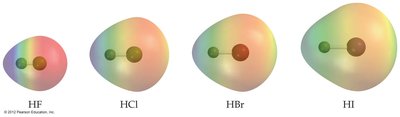
The strength of an acid is influenced by the bond strength and polarity of the H–A bond:
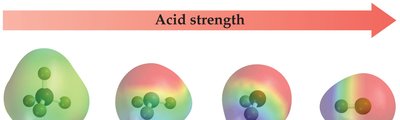
Bond strength: For binary acids in the same group, acid strength increases as bond strength decreases (down the group).
Bond polarity: For binary acids in the same period, acid strength increases with increasing electronegativity of A.
Oxoacids
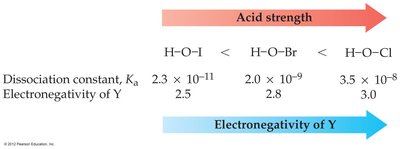
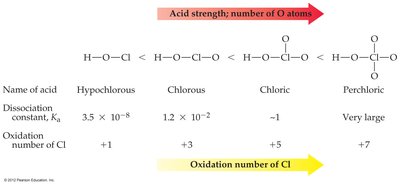
For oxoacids (HnYOm):
With the same number of O–H groups, acid strength increases with the electronegativity of Y.
With the same Y, acid strength increases with the number of oxygen atoms bonded to Y (higher oxidation state).
Lewis Acids and Bases
Definition and Examples
Lewis acids are electron-pair acceptors, and Lewis bases are electron-pair donors. This definition encompasses a wider range of reactions, including those not involving protons.
Example: $ \mathrm{Cu}^{2+} + 4\mathrm{NH}_3 \rightarrow [\mathrm{Cu}(\mathrm{NH}_3)_4]^{2+} $

Here, Cu2+ is the Lewis acid, and NH3 is the Lewis base.
Summary Table: Main Calculations in Acid–Base Equilibria
Calculate [OH−] from [H3O+] and vice versa using $ K_w = [H_3O^+][OH^-] $
Calculate pH from [H3O+]: $ \mathrm{pH} = -\log [H_3O^+] $
Calculate [H3O+] from pH: $ [H_3O^+] = 10^{-\mathrm{pH}} $
Calculate pOH from [OH−]: $ \mathrm{pOH} = -\log [OH^-] $
pH + pOH = 14 (at 25°C)
Additional info: For more advanced calculations, such as those involving polyprotic acids or buffer solutions, refer to the relevant sections in your textbook or lecture notes.
