 Back
BackAqueous Equilibria: Acids, Bases, and Buffers
Study Guide - Smart Notes
 Tailored notes based on your materials, expanded with key definitions, examples, and context.
Acids and Bases: General Properties and Definitions
Introduction to Acids and Bases
Acids and bases are fundamental classes of compounds in chemistry, characterized by their distinct chemical behaviors and roles in aqueous equilibria. Understanding their properties, definitions, and reactions is essential for mastering general chemistry.
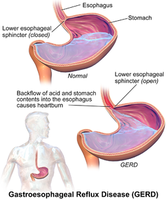
Stomach Acid and Heartburn
Hydrochloric acid (HCl) is produced by cells lining the stomach.
Functions of stomach acid include:
Killing unwanted bacteria
Breaking down food
Activating digestive enzymes
If stomach acid backs up into the esophagus, it causes irritation known as heartburn or acid reflux. Chronic cases are referred to as GERD (Gastroesophageal Reflux Disease).
General Properties of Acids
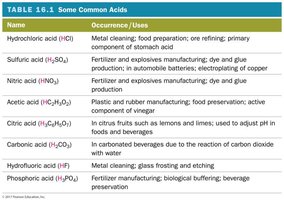
Acids are defined by their chemical reactivity, particularly their ability to donate protons (H+).
Common properties:
Sour taste
Ability to dissolve many metals
Neutralize bases
Turn blue litmus paper red
Examples: Acetic acid (in vinegar), hydrochloric acid (in stomach acid).
General Properties of Bases
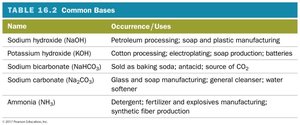
Bases are defined by their ability to accept protons or produce hydroxide ions (OH−) in solution.
Common properties:
Bitter taste
Slippery feel
Neutralize acids
Turn red litmus paper blue
Examples: Sodium hydroxide (NaOH), ammonia (NH3).
Acid and Base Definitions
Arrhenius Definition
Arrhenius acid: Produces H+ ions in aqueous solution.
Arrhenius base: Produces OH− ions in aqueous solution.
Limitation: Does not account for all acid-base reactions, especially those not involving water or hydroxide ions.
Brønsted–Lowry Definition
Brønsted–Lowry acid: Proton (H+) donor.
Brønsted–Lowry base: Proton (H+) acceptor.
This definition is broader and includes reactions outside aqueous solutions.
All Arrhenius acids and bases are also Brønsted–Lowry acids and bases.
Conjugate Acid–Base Pairs
When an acid donates a proton, it forms its conjugate base.
When a base accepts a proton, it forms its conjugate acid.
Every acid–base reaction involves two conjugate pairs.
Acid and Base Strength
Strong and Weak Acids/Bases
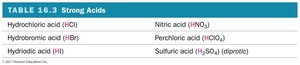
Strong acids and bases completely dissociate in water.
Weak acids and bases only partially dissociate, establishing an equilibrium.
Examples of strong acids: HCl, HNO3, H2SO4.
Examples of weak acids: HF, CH3COOH.
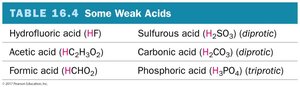
Quantifying Acid and Base Strength
The acid dissociation constant () measures the strength of an acid:
The base dissociation constant () measures the strength of a base:
The larger the or , the stronger the acid or base.
p and p are logarithmic measures:
The smaller the p or p, the stronger the acid or base.
Autoionization of Water and the pH Scale
Water is amphoteric and can act as both an acid and a base.
Autoionization:
The ion product constant for water: at 25°C.
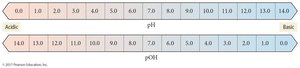
pH is defined as
pOH is defined as
Relationship:
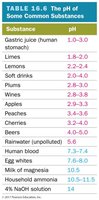
pH of Common Substances
pH values of everyday substances range from highly acidic (gastric juice, pH 1–3) to highly basic (household ammonia, pH 11–12).
Buffer Solutions
Definition and Function
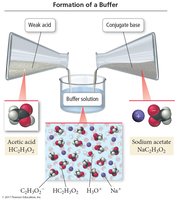
A buffer solution resists changes in pH when small amounts of acid or base are added. Buffers are typically composed of a weak acid and its conjugate base, or a weak base and its conjugate acid.
Buffer capacity depends on the ratio and concentration of the acid/base pair.
Blood plasma is an example of a natural buffer system (H2CO3/HCO3−).
Henderson–Hasselbalch Equation
The pH of a buffer can be calculated using the Henderson–Hasselbalch equation:
This equation is valid when the concentrations of acid and conjugate base are much greater than the value.
Titration and Titration Curves
Acid–Base Titration
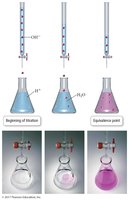
In a titration, a solution of known concentration (titrant) is added to a solution of unknown concentration until the reaction reaches the equivalence point, where stoichiometric amounts of acid and base have reacted.
An indicator is used to signal the endpoint by a color change.
Titration Curves
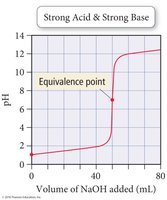
Titration curves plot pH versus volume of titrant added.
The inflection point corresponds to the equivalence point.
The pH at equivalence depends on the nature of the acid and base:
Strong acid + strong base: pH = 7 at equivalence
Weak acid + strong base: pH > 7 at equivalence
Weak base + strong acid: pH < 7 at equivalence
Summary Table: Acid–Base Properties of Salts
Anion of a | Cation of a | Aqueous Solutions Are | Example |
|---|---|---|---|
Strong acid | Strong base | Neutral | NaCl |
Strong acid | Weak base | Acidic | NH4Cl |
Weak acid | Strong base | Basic | NaF |
Weak acid | Weak base | Neutral, acidic, or basic (depends on and ) | NH4F |
Key Equations
Henderson–Hasselbalch:
