 Back
BackAqueous Equilibria: Buffers, Titrations, and Solubility
Study Guide - Smart Notes
 Tailored notes based on your materials, expanded with key definitions, examples, and context.
Chapter 17: Aqueous Equilibria – Buffers, Titrations, and Solubility
The Common-Ion Effect
The common-ion effect describes the shift in equilibrium that occurs when a solution contains two substances that share a common ion. This effect is important in solutions of weak acids or bases mixed with salts containing their conjugate ions.
Acetic acid (CH3COOH) is a weak acid, while sodium acetate (CH3COONa) is a strong electrolyte that dissociates completely, providing acetate ions (CH3COO-).
The presence of the common acetate ion shifts the acid dissociation equilibrium to the left, reducing the concentration of H+ ions and thus increasing the pH.
This is an application of Le Châtelier’s principle.
![Addition of CH3COO- shifts equilibrium concentrations, lowering [H+]](https://static.studychannel.pearsonprd.tech/study_guide_files/general-chemistry/sub_images/d732d7d0_image_1.png)
The same principle applies to weak bases. For example, adding NH4Cl to a solution of NH3 introduces NH4+, shifting the equilibrium and lowering [OH-].
![Addition of NH4+ shifts equilibrium concentrations, lowering [OH-]](https://static.studychannel.pearsonprd.tech/study_guide_files/general-chemistry/sub_images/d732d7d0_image_2.png)
Calculating pH for a Common Ion
When a solution contains both a weak acid (or base) and its conjugate base (or acid), the pH can be calculated using equilibrium expressions. The presence of the common ion suppresses the ionization of the weak acid or base, resulting in a less acidic or basic solution than if the weak acid or base were alone.
Buffers
Definition and Properties
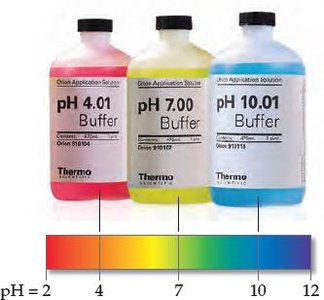
Buffers are solutions that resist drastic changes in pH when small amounts of acid or base are added. They consist of a weak acid and its conjugate base, or a weak base and its conjugate acid, in relatively high and approximately equal concentrations.
Buffers are essential in many chemical and biological systems to maintain a stable pH.
Ways to Make a Buffer
Mix a weak acid with a salt of its conjugate base, or a weak base with a salt of its conjugate acid.
Add a strong acid to partially neutralize a weak base, or add a strong base to partially neutralize a weak acid.
How a Buffer Works
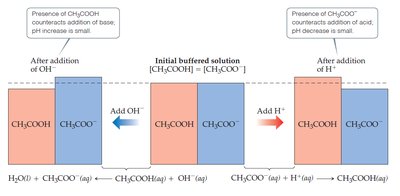
When a small amount of acid or base is added to a buffer, one component of the buffer is neutralized, but the overall pH changes only slightly. This is because the buffer components react with the added acid or base to minimize changes in [H+].
Henderson-Hasselbalch Equation
The Henderson-Hasselbalch equation provides a convenient way to calculate the pH of a buffer solution:
This equation applies to buffers and weak acid/base titrations.
If three of the four variables (pH, pKa, [A-], [HA]) are known, the fourth can be calculated.
Addition of a Strong Acid or Base to a Buffer
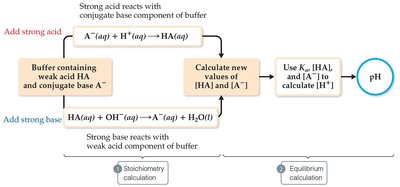
When a strong acid or base is added to a buffer, the buffer components react to neutralize the added substance, and the new concentrations are used to recalculate the pH.
Buffer Capacity and pH Range
Buffer capacity is the amount of acid or base a buffer can neutralize before the pH changes significantly. Buffers are most effective when the concentrations of acid and conjugate base are high and nearly equal. The pH range over which a buffer is effective is typically within ±1 pH unit of the pKa of the acid.
Acid–Base Titrations
Principles of Titration
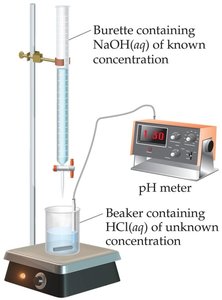
Titration is a technique in which a solution of known concentration (the titrant) is slowly added to a solution of unknown concentration until the reaction reaches the equivalence point, where stoichiometrically equivalent amounts of acid and base have reacted. The equivalence point is often detected using a pH meter or an indicator.
Titration of a Strong Acid with a Strong Base
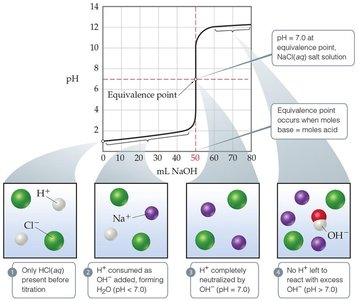
When titrating a strong acid with a strong base, the pH increases slowly at first, then rises sharply near the equivalence point (pH = 7), and then levels off as excess base is added.
Titration of a Strong Base with a Strong Acid
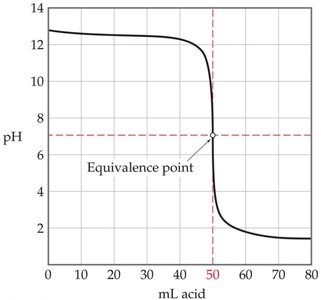
This titration produces a curve that is the mirror image of the strong acid–strong base titration. The pH starts high, drops sharply near the equivalence point (pH = 7), and then levels off as excess acid is added.
Titration of a Weak Acid with a Strong Base
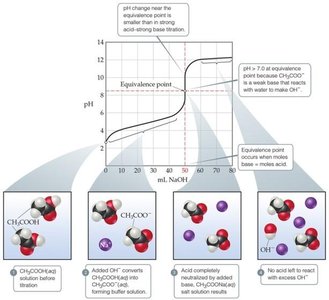
Titrating a weak acid with a strong base produces a titration curve with four distinct regions: initial pH, buffer region, equivalence point, and post-equivalence region. The pH at the equivalence point is greater than 7 due to the formation of a weakly basic conjugate base.
Differences from Strong Acid Titration
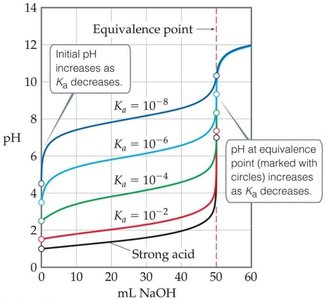
Higher initial pH for weak acid.
Smaller pH change near the equivalence point.
pH at halfway to equivalence point equals pKa.
pH at equivalence point is greater than 7.
Titration of a Weak Base with a Strong Acid
This process is analogous to the titration of a weak acid with a strong base, but the pH changes in the opposite direction. The equivalence point will be below pH 7 due to the formation of a weakly acidic conjugate acid.
Solubility Equilibria
Solubility Product Constant (Ksp)
Ionic compounds dissolve in water to a limited extent, establishing an equilibrium between the solid and its ions in solution. The equilibrium constant for this process is the solubility product constant, Ksp.
Ksp is specific for each compound at a given temperature.
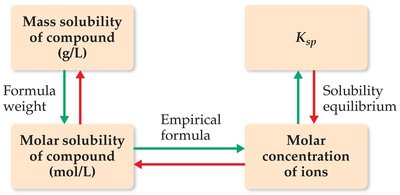
Solubility is the amount of solute that dissolves to form a saturated solution, usually expressed in g/L or mol/L.
Calculating Solubility from Ksp
To find the molar solubility of a compound, set up an equilibrium expression using Ksp and solve for the concentration of ions in a saturated solution.
Comparing Ksp Values
Ksp values can be used to compare the solubility of different compounds. A higher Ksp indicates greater solubility under the same conditions.
Factors That Affect Solubility
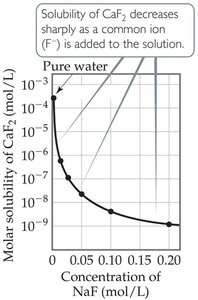
Common-ion effect: The presence of a common ion decreases the solubility of a salt. For example, adding NaF to a solution of CaF2 decreases the solubility of CaF2 due to the increased concentration of F- ions.
Other factors include pH and the presence of complexing agents, but these are not covered in detail here.
Calculating Solubility with a Common Ion
When a common ion is present, the solubility of a salt is reduced. The new solubility can be calculated by setting up the Ksp expression with the initial concentration of the common ion included.
