 Back
BackAqueous Ionic Equilibrium: Buffers, Titrations, and Solubility
Study Guide - Smart Notes
 Tailored notes based on your materials, expanded with key definitions, examples, and context.
Aqueous Ionic Equilibrium
Introduction
This chapter explores the principles of aqueous ionic equilibrium, focusing on buffer solutions, titrations, solubility equilibria, and qualitative analysis. These concepts are essential for understanding how chemical systems maintain stability and how chemists analyze and manipulate solutions in the laboratory.
Buffer Solutions
Definition and Function
Buffer solutions are mixtures that resist changes in pH when small amounts of acid or base are added.
They act by neutralizing added acids (H+) or bases (OH−).
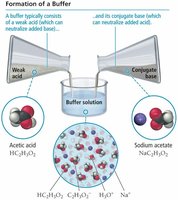
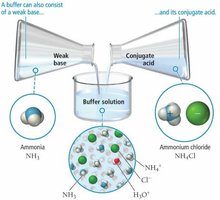
Buffers are typically made by combining a weak acid (HA) with its conjugate base (A−), or a weak base with its conjugate acid.
The common ion effect is central to buffer action, as the presence of a common ion suppresses the ionization of the weak acid or base, stabilizing the pH.
Buffer Formation and Examples
Mixing acetic acid (HC2H3O2) and sodium acetate (NaC2H3O2) forms a buffer solution.
Similarly, mixing ammonia (NH3) and ammonium chloride (NH4Cl) forms a basic buffer.
Buffer Action and the Common Ion Effect
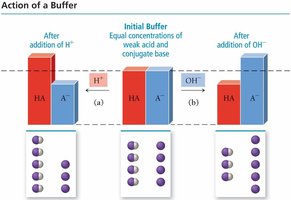
When a strong acid is added, the conjugate base in the buffer neutralizes it, forming more weak acid.
When a strong base is added, the weak acid neutralizes it, forming more conjugate base.
The equilibrium shifts according to Le Châtelier’s Principle to minimize pH changes.
Buffer Calculations and the Henderson–Hasselbalch Equation
The Henderson–Hasselbalch equation is used to calculate the pH of a buffer solution:

This equation is valid when both the acid and conjugate base are present in significant amounts.
Buffer Effectiveness: Range and Capacity
Buffer capacity is the amount of acid or base a buffer can neutralize before the pH changes significantly.
Buffer range is the pH range over which the buffer is effective, typically when .
Buffers are most effective when the concentrations of acid and base are equal and as large as possible.
Titrations and pH Curves
Acid–Base Titrations
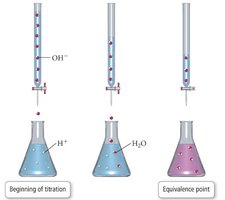
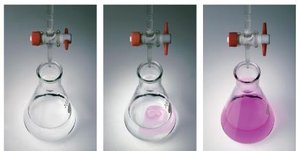
Titration is a technique where a solution of known concentration (titrant) is added to a solution of unknown concentration to determine its amount.
The equivalence point is reached when stoichiometric amounts of acid and base have reacted ().
Indicators are used to signal the endpoint of the titration by changing color.
Titration Curves
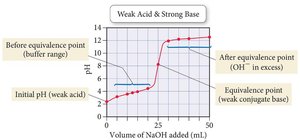
A titration curve is a plot of pH versus volume of titrant added.
For strong acid–strong base titrations, the curve shows a sharp rise at the equivalence point (pH = 7 for monoprotic acids and bases).
For weak acid–strong base titrations, the curve has a buffer region before the equivalence point and the equivalence point occurs at pH > 7.
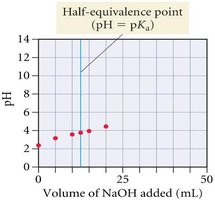
Half-Equivalence Point
At the half-equivalence point, , so .
Solubility Equilibria and the Solubility Product Constant (Ksp)
Solubility Product Constant (Ksp)
The solubility product constant, , describes the equilibrium between a solid and its ions in a saturated solution.
For AgCl:
Calculating Molar Solubility
Molar solubility is the number of moles of solute that dissolve per liter of solution to reach saturation.
To calculate, set up an ICE table and solve for the equilibrium concentrations using .
Common Ion Effect on Solubility
The presence of a common ion decreases the solubility of a slightly soluble salt (Le Châtelier’s Principle).
Precipitation and Selective Precipitation
Precipitation occurs if the ion product exceeds ().
Selectively precipitating ions is a key technique in qualitative analysis.
Effect of pH on Solubility
The solubility of salts containing basic anions increases as pH decreases (more acidic).
For insoluble hydroxides, higher pH (more basic) decreases solubility.
Complex Ion Equilibria
Complex Ion Formation
A complex ion consists of a central metal ion bonded to ligands (molecules or ions that donate electron pairs).
The formation constant, , describes the equilibrium for complex ion formation.
Complex ion formation can greatly increase the solubility of some salts (e.g., AgCl dissolves in NH3 due to formation of [Ag(NH3)2]+).
Amphoteric Metal Hydroxides
Definition and Properties
Amphoteric hydroxides can react with both acids and bases, increasing their solubility in both strongly acidic and basic solutions.
Examples include hydroxides of Al3+, Zn2+, Pb2+, Sn2+, and Cr3+.
Qualitative Chemical Analysis
Principles and Group Separation
Qualitative analysis uses selective precipitation to identify ions in a mixture.
Ions are separated into groups based on their solubility with specific reagents (e.g., Group 1 cations precipitate with Cl− as insoluble chlorides).
Further groups are separated by precipitation with sulfide, hydroxide, or phosphate ions.
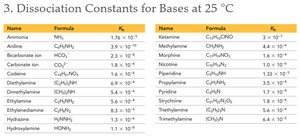
Tables: Dissociation Constants
Dissociation Constants for Acids and Bases at 25°C
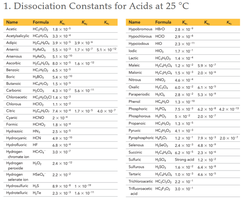
The following tables summarize the dissociation constants ( for acids, for bases) for common acids and bases at 25°C. These values are essential for buffer and equilibrium calculations.
Name | Formula | Ka |
|---|---|---|
Acetic | HC2H3O2 | 1.8 × 10⁻⁵ |
Formic | HCHO2 | 1.8 × 10⁻⁴ |
Hydrofluoric | HF | 6.8 × 10⁻⁴ |
Name | Formula | Kb |
|---|---|---|
Ammonia | NH3 | 1.8 × 10⁻⁵ |
Bicarbonate ion | HCO3− | 2.3 × 10⁻⁸ |
Summary
Buffer solutions maintain pH stability through the common ion effect and Le Châtelier’s Principle.
Titrations and pH curves are essential for analyzing acid–base reactions and determining concentrations.
Solubility equilibria and govern the dissolution and precipitation of ionic compounds.
Complex ion formation and amphoteric behavior influence solubility and qualitative analysis.
