 Back
BackAqueous Reactions and Solution Stoichiometry: Study Guide
Study Guide - Smart Notes
 Tailored notes based on your materials, expanded with key definitions, examples, and context.
Aqueous Reactions in Solutions
Electrolyte Classification
Aqueous solutions can be classified based on their ability to conduct electricity, which depends on the presence and mobility of ions.
Strong electrolytes: Substances that completely dissociate into ions in water, resulting in high electrical conductivity. Examples include strong acids (e.g., HCl, HNO3), strong bases (e.g., NaOH, KOH), and all soluble ionic compounds.
Weak electrolytes: Substances that partially dissociate in water, producing few ions and thus conducting electricity poorly. Examples include weak acids (e.g., HF, H2CO3) and weak bases (e.g., NH3).
Nonelectrolytes: Substances that do not produce ions in solution and therefore do not conduct electricity. Examples include sugars (e.g., sucrose) and ethanol (C2H5OH).
Example: NaCl is a strong electrolyte, acetic acid (CH3COOH) is a weak electrolyte, and glucose (C6H12O6) is a nonelectrolyte.
Solubility Rules
Solubility rules help predict whether an ionic compound will dissolve in water (soluble) or form a precipitate (insoluble).
Soluble salts: NaNO3, NaBr, NaCl, NaCH3COO
Insoluble salts: FeS, FeCO3, Fe3(PO4)2, Fe(OH)2
Application: Use these rules to predict the formation of precipitates in double displacement reactions.
Strong vs. Weak Acids and Bases
Acids and bases are classified by their degree of ionization in water.
Strong acids: Completely ionize in water (e.g., HCl, HBr, HI, HNO3, HClO3, HClO4, H2SO4).
Strong bases: Completely dissociate in water (e.g., NaOH, KOH, Ca(OH)2).
Weak acids: Partially ionize (e.g., HF, H2CO3).
Weak bases: Partially ionize (e.g., NH3).
Equations:
Strong acid:
Weak acid:
Chemical Equation Types
Precipitation and Neutralization Reactions
Chemical equations can be written in several forms to illustrate the behavior of substances in aqueous solutions.
Molecular equation: Shows all reactants and products as compounds.
Total (complete) ionic equation: Shows all strong electrolytes as ions; solids, liquids, gases, and weak electrolytes remain as compounds.
Net ionic equation: Shows only the species that undergo a chemical change; spectator ions are omitted.
Example:
Molecular:
Complete ionic:
Net ionic:
Steps for Writing Net Ionic Equations
Balance the molecular equation.
Convert to the total ionic equation (show strong electrolytes as ions).
Cancel spectator ions to obtain the net ionic equation.
Ensure charges are balanced on both sides.
Note: If all ions are spectator ions, write "No Reaction (NR)".
Neutralization Example:
Oxidation-Reduction (Redox) Reactions
Identifying Oxidation and Reduction
Redox reactions involve the transfer of electrons between species.
Oxidation: Loss of electrons (increase in oxidation number).
Reduction: Gain of electrons (decrease in oxidation number).
Acronyms: LEO (Lose Electrons = Oxidation), GER (Gain Electrons = Reduction), OILRIG (Oxidation Is Loss, Reduction Is Gain).
Example:
Zn(s) + 2H+(aq) → Zn2+(aq) + H2(g)
Oxidation half-reaction:
Reduction half-reaction:
Identifying Reducing and Oxidizing Agents
The substance oxidized is the reducing agent.
The substance reduced is the oxidizing agent.
Example: In Zn(s) + 2H+(aq) → Zn2+(aq) + H2(g), Zn is the reducing agent, H+ is the oxidizing agent.
Assigning Oxidation Numbers
Oxidation numbers are assigned to atoms to track electron transfer in reactions.
Element in natural form: 0 (e.g., H2, O2, Na)
Monatomic ion: Equal to its charge (e.g., Na+ = +1)
Group I: +1; Group II: +2; Fluorine: –1; Oxygen: usually –2 (–1 in peroxides); Hydrogen: +1 (–1 with metals)
Sum of oxidation numbers in a compound = 0; in a polyatomic ion = ion charge
Example: In Ca3(PO4)2, Ca = +2, O = –2, P = +5 (since 3×2 + 2×[P + 4×(–2)] = 0)
Activity Series for Redox Reactions
The activity series ranks metals by their tendency to be oxidized. A metal can only be oxidized by metals below it in the series.
Example: Zn(s) + Cu2+(aq) → Zn2+(aq) + Cu(s) is possible, but the reverse is not.
Solution Stoichiometry
Molarity
Molarity (M) is the number of moles of solute per liter of solution.
Formula:
Example: Find the molarity of 116.88 g NaCl in 1.0 L water. (Use molar mass of NaCl: 58.44 g/mol)
Molarity of Ions
Strong electrolytes dissociate completely, so the concentration of each ion depends on the formula and the initial molarity.
Example: 2.5 M Ca(NO3)2 yields 2.5 M Ca2+ and 5.0 M NO3–
Dilutions
To prepare a less concentrated solution from a stock solution, use the dilution equation:
Equation:
Where M is molarity, V is volume, c = concentrated, d = diluted
Titrations
Titrations use a solution of known concentration to determine the concentration of an unknown. Use stoichiometry to relate moles of titrant and analyte.
Example: HCl(aq) + NaOH(aq) → NaCl(aq) + H2O(l)
Use the balanced equation to find the stoichiometric ratio.
Applications and Problem Types
Precipitation Reactions and Predicting Products
Use solubility rules to predict if a precipitate will form when two solutions are mixed. Write molecular, ionic, and net ionic equations for these reactions.
Neutralization Reactions
Neutralization occurs when an acid reacts with a base to produce a salt and water. For strong acid/strong base reactions, the net ionic equation is always:
Redox Reactions and Oxidation Numbers
Assign oxidation numbers to determine which species are oxidized and reduced. Write half-reactions to show electron transfer.
Solution Stoichiometry Calculations
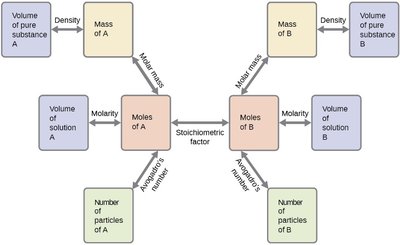
Use molarity, volume, and stoichiometry to calculate the amounts of reactants and products in solution reactions. This includes limiting reactant problems and calculations involving precipitates.
Important Equations and Concepts
Molarity:
Dilution:
Stoichiometry: Use balanced equations and conversion factors (moles, molar mass, Avogadro's number, etc.)
Additional info: The included flowchart visually summarizes the relationships between mass, volume, molarity, and number of particles for solution stoichiometry problems.
