 Back
Atomic Spectroscopy, the Bohr Model, and the Wave Nature of Matter
Study Guide - Smart Notes
 Tailored notes based on your materials, expanded with key definitions, examples, and context.
8.3 Atomic Spectroscopy and the Bohr Model
Introduction to Atomic Spectroscopy
Atomic spectroscopy is the study of the electromagnetic radiation absorbed and emitted by atoms. When atoms are energized, they emit light at specific wavelengths, producing a line spectrum unique to each element. This phenomenon provided crucial evidence for the quantized nature of energy levels in atoms.
Line Spectrum: Unlike a continuous spectrum, a line spectrum consists of discrete lines, each corresponding to a specific wavelength of light emitted by an atom.
Emission vs. Absorption: Emission spectra are produced when electrons in excited atoms return to lower energy levels, emitting photons. Absorption spectra occur when electrons absorb energy and move to higher energy levels.
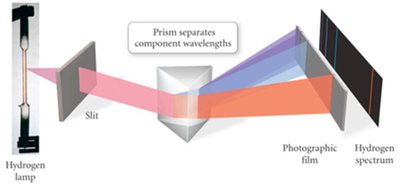
Experimental Setup: A typical atomic spectroscopy experiment involves passing light from an excited element through a slit and a prism, which separates the light into its component wavelengths, forming a spectrum on a photographic plate.
Comparison of Atomic Spectra
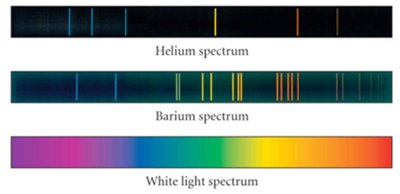
Each element has a unique emission spectrum, which can be used to identify the element. The spectra of helium, barium, and white light illustrate the differences between atomic line spectra and a continuous spectrum.
Helium Spectrum: Shows discrete lines at specific wavelengths unique to helium atoms.
Barium Spectrum: Contains more lines, each corresponding to electronic transitions in barium atoms.
White Light Spectrum: Displays a continuous range of colors, unlike the discrete lines of atomic spectra.
The Bohr Model of the Atom
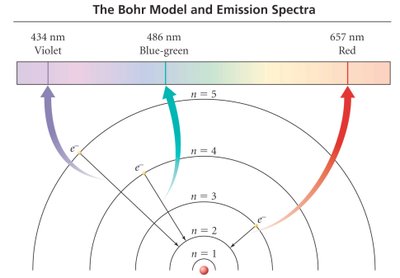
The Bohr model was developed to explain the observed line spectra of hydrogen. It postulates that electrons orbit the nucleus in quantized energy levels, and light is emitted or absorbed when an electron transitions between these levels.
Quantized Orbits: Electrons can only occupy certain allowed orbits with fixed energies.
Energy Transitions: When an electron drops from a higher energy level (n) to a lower one, it emits a photon with energy equal to the difference between the two levels.
Hydrogen Emission Lines: The visible lines in the hydrogen spectrum correspond to transitions to the n = 2 level from higher levels (Balmer series).
Key Equation: The energy of a photon emitted or absorbed during a transition is given by: where and are the initial and final energy levels, respectively.
8.4 The Wave Nature of Matter
de Broglie Hypothesis
The wave nature of matter was proposed by Louis de Broglie, who suggested that particles such as electrons exhibit wave-like properties. This concept is fundamental to quantum mechanics and explains phenomena such as electron diffraction.
de Broglie Wavelength: The wavelength () associated with a particle is given by: where is Planck's constant, is the mass of the particle, and is its velocity.
Example Calculation: For an electron traveling at m/s:
Additional info: The wave nature of matter is observable for very small particles like electrons, but not for macroscopic objects due to their much larger mass.
