 Back
Atomic Structure and Electron Configurations: Orbitals and Their Organization
Study Guide - Smart Notes
 Tailored notes based on your materials, expanded with key definitions, examples, and context.
Atomic Structure: Electron Orbitals
Heisenberg’s Uncertainty Principle
The exact position and momentum of an electron cannot be simultaneously determined with absolute precision. This fundamental concept, formulated by Werner Heisenberg in 1927, is known as the Heisenberg Uncertainty Principle.
Statement: The more precisely the position of an electron is known, the less precisely its momentum can be known, and vice versa.
Mathematical Expression:
Where is the uncertainty in position, is the uncertainty in momentum, and is Planck’s constant.
Electron Orbitals
An orbital is a three-dimensional region around the nucleus where there is a high probability of finding an electron. Orbitals are defined by quantum numbers and have specific shapes and orientations.
Each orbital can hold a maximum of two electrons.
Orbitals are described by the principal quantum number (), angular momentum quantum number (), and magnetic quantum number ().
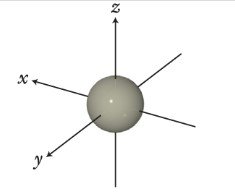
Types of Orbitals
Classification and Properties
There are four main types of atomic orbitals, each with distinct shapes and numbers of subsets (orientations):
Type of Orbital | Number of Subsets | Total Electrons it Can Hold |
|---|---|---|
s-orbital | 1 | 2 |
p-orbital | 3 | 6 |
d-orbital | 5 | 10 |
f-orbital | 7 | 14 |
s-orbitals: Spherical in shape, one per energy level.
p-orbitals: Dumbbell-shaped, three orientations (x, y, z).
d-orbitals: Cloverleaf shapes, five orientations.
f-orbitals: Complex shapes, seven orientations.
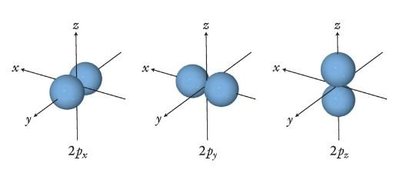
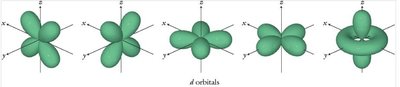

Writing Electron Configurations
The Aufbau Principle and the Rain-Drop Method
Electron configurations describe the arrangement of electrons in an atom’s orbitals. The Aufbau Principle states that electrons fill orbitals starting from the lowest energy level to the highest. The Rain-Drop Method is a visual tool to determine the order in which orbitals are filled.
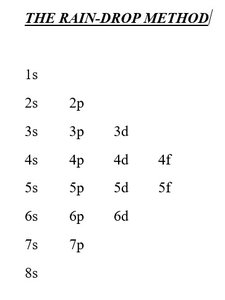
Each orbital is filled according to increasing energy: 1s, 2s, 2p, 3s, 3p, 4s, 3d, 4p, etc.
Each subset (e.g., px, py, pz) can hold 2 electrons.
Notation of Electron Configurations
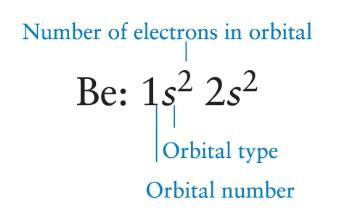
Electron configurations are written using the format: norbital typenumber of electrons. For example, the configuration for Beryllium (Be, atomic number 4) is:
Examples of Electron Configurations
Hydrogen (1H):
Helium (2He):
Carbon (6C):
Oxygen (8O):
Neon (10Ne):
Magnesium (12Mg):
Sulfur (16S):
Calcium (20Ca):
Nickel (28Ni):
Refer to the Rain-Drop Method diagram for the correct order of filling for each element.
Periodic Table and Electron Blocks
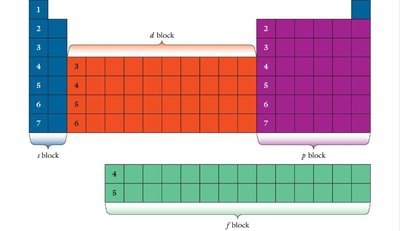
The periodic table is divided into blocks corresponding to the type of orbital being filled:
Block | Orbital Type | Groups |
|---|---|---|
s-block | s-orbital | Groups 1-2 |
p-block | p-orbital | Groups 13-18 |
d-block | d-orbital | Transition metals (Groups 3-12) |
f-block | f-orbital | Lanthanides and actinides |
Valence and Core Electrons
Definitions and Importance
Valence electrons: Electrons in the outermost shell (highest energy s and p orbitals). These electrons are involved in chemical bonding and reactions.
Core electrons: Electrons in the inner shells (lower energy levels), not usually involved in bonding.
Understanding the distinction between valence and core electrons is essential for predicting chemical reactivity and bonding behavior.
Summary Table: Types of Orbitals and Their Properties
Type of Orbital | Number of Subsets | Total # of Electrons it Can Hold |
|---|---|---|
s-orbital | 1 | 2 |
p-orbital | 3 | 6 |
d-orbital | 5 | 10 |
f-orbital | 7 | 14 |
Additional info: The shapes and orientations of orbitals are determined by quantum numbers and are crucial for understanding molecular geometry and chemical bonding.
