 Back
BackAtomic Structure and the Discovery of Subatomic Particles
Study Guide - Smart Notes
 Tailored notes based on your materials, expanded with key definitions, examples, and context.
Atomic Structure
John Dalton's Atomic Theory
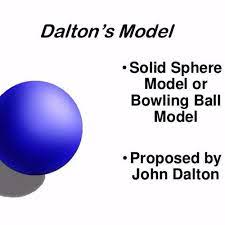
John Dalton proposed one of the earliest models of the atom, describing atoms as tiny, indivisible, solid spheres. This model, known as the Solid Sphere Model or Bowling Ball Model, laid the foundation for modern atomic theory.
Electricity and the Atom
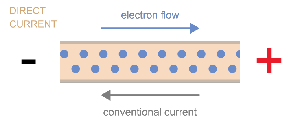
Electricity has played a crucial role in understanding atomic structure. The flow of electric current involves the movement of electrons, which are subatomic particles within atoms. The direction of electron flow is opposite to the conventional current direction.
Properties of Electrical Charges
Electrical charges exhibit specific properties that are fundamental to atomic structure:
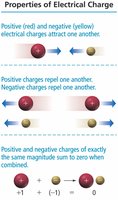
Opposite charges attract each other (positive attracts negative).
Like charges repel each other (positive repels positive, negative repels negative).
Charges are additive: The sum of positive and negative charges can result in a neutral charge.
Electrolysis and the Discovery of Subatomic Particles
Electrolysis
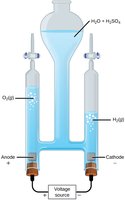
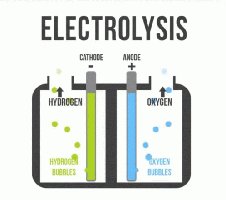
Electrolysis is a chemical process in which electrical energy causes a chemical change, such as the decomposition of water into hydrogen and oxygen gases. This process provided evidence that atoms could be broken down into smaller particles.
Discovery of the Electron
Cathode Ray Experiments
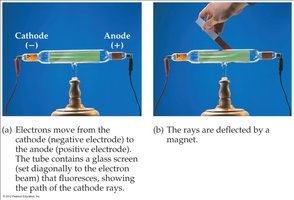
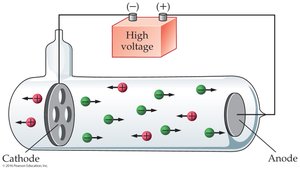
J.J. Thomson's experiments with cathode rays in 1897 led to the discovery of the electron, a negatively charged subatomic particle. Cathode rays were found to be streams of electrons, which travel from the cathode (negative electrode) to the anode (positive electrode) in a straight line. The electron's mass is about 1/2000 that of a hydrogen atom, and its charge-to-mass ratio is constant for all substances.
Measuring the Electron's Charge and Mass
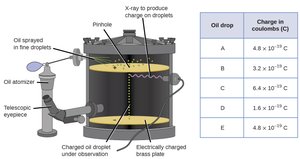
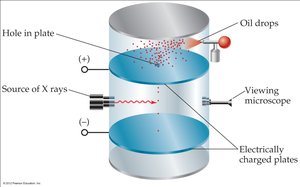
J.J. Thomson measured the charge-to-mass ratio of the electron, but the actual charge and mass were determined by Robert Millikan's oil-drop experiment. Millikan found the charge of a single electron to be coulombs. Using Thomson's ratio, the mass of the electron was calculated as grams.
Discovery of Other Subatomic Particles
Protons and Neutrons
Goldstein's experiments in 1886 led to the discovery of the proton, a positively charged subatomic particle. Neutrons, discovered by James Chadwick in 1932, are neutral particles with a mass similar to that of protons.
Radioactivity and Types of Radiation
Types of Radiation
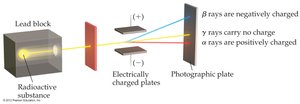
Radioactivity is the spontaneous emission of radiation by unstable atomic nuclei. Ernest Rutherford identified three types of radiation:
Alpha particles (α): Positively charged, relatively massive particles (helium nuclei).
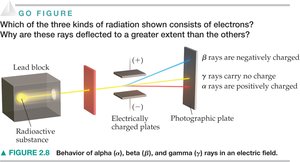
Beta particles (β): Negatively charged, high-speed electrons.
Gamma rays (γ): High-energy electromagnetic radiation with no charge.
Deflection of Radiation in Electric and Magnetic Fields
Alpha and beta particles are deflected in opposite directions by electric and magnetic fields due to their opposite charges, while gamma rays are not deflected because they are uncharged. Beta particles are deflected more than alpha particles because they are much less massive.
Atomic Models
Thomson's Plum Pudding Model
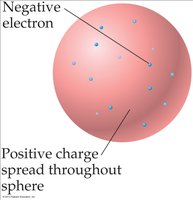
Thomson proposed the "plum pudding" model, in which the atom is a sphere of positive charge with negatively charged electrons embedded within it, like raisins in a pudding. This model explained the electrical neutrality of atoms but was later disproved by further experiments.
Rutherford's Nuclear Model
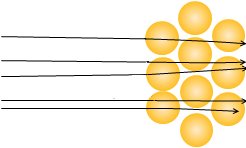
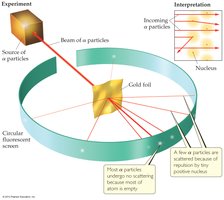
Ernest Rutherford's gold foil experiment demonstrated that atoms are mostly empty space, with a small, dense, positively charged nucleus at the center. Most alpha particles passed through the foil, but a few were deflected at large angles, indicating the presence of the nucleus.
Summary Table: Subatomic Particles
Particle | Symbol | Charge | Relative Mass | Location |
|---|---|---|---|---|
Proton | p+ | +1 | 1 | Nucleus |
Neutron | n0 | 0 | 1 | Nucleus |
Electron | e- | -1 | 1/1836 | Outside nucleus |
