 Back
BackAtomic Structure, Electron Configuration, and Periodic Trends: Study Notes
Study Guide - Smart Notes
 Tailored notes based on your materials, expanded with key definitions, examples, and context.
Atomic Structure and the Dual Nature of Light
Wave-Particle Duality
The dual nature of light refers to the fact that light exhibits both wave-like and particle-like properties. This concept is fundamental to understanding atomic structure and quantum mechanics.
Wave Properties: Light can be described by its wavelength (λ) and frequency (ν). The visible spectrum ranges from 400–750 nm. Ultraviolet (UV), X-rays, and gamma rays have shorter wavelengths and higher energies, while infrared and radio waves have longer wavelengths and lower energies.
Particle Properties: Light can also behave as a stream of particles called photons, each carrying energy quantified by the equation: where h is Planck’s constant and ν is frequency.
Energy-Wavelength Relationship: The energy of a photon is inversely proportional to its wavelength: where n is the number of photons, c is the speed of light, and λ is wavelength.
Example: Gamma rays have much higher energy than visible light due to their shorter wavelengths.
The Photoelectric Effect
The photoelectric effect demonstrates the particle nature of light. When light of sufficient frequency strikes a metal surface, electrons are ejected. The minimum energy required to remove an electron is called the work function (Φ).
Threshold Frequency (ν0): The minimum frequency needed to eject electrons.
Kinetic Energy of Ejected Electrons:
Example: If a photon with energy greater than Φ strikes the metal, the excess energy appears as the kinetic energy of the emitted electron.
Atomic Models and Quantum Mechanics
Bohr Model and Its Limitations
The Bohr model describes electrons orbiting the nucleus in fixed energy levels. It successfully explains the hydrogen atom’s emission spectrum but fails for multi-electron atoms.
Success: Accurately predicts energy levels for hydrogen.
Failure: Cannot account for electron-electron interactions in larger atoms.
Improvement: Schrödinger’s equation introduces quantum mechanics, treating electrons as wavefunctions and allowing for probability distributions (orbitals).
Additional info: Schrödinger’s equation is not typically solved directly in general chemistry, but its conceptual implications (orbitals, quantum numbers) are essential.
Quantum Numbers and Electron Configuration
Electrons in atoms are described by four quantum numbers:
Principal quantum number (n): Energy level (shell)
Angular momentum quantum number (l): Subshell (s, p, d, f)
Magnetic quantum number (ml): Orientation of orbital
Spin quantum number (ms): Electron spin (+1/2 or -1/2)
Electron configurations show the arrangement of electrons in an atom or ion. For example, the configuration for neutral oxygen is 1s2 2s2 2p4.
Paramagnetic: Atoms with unpaired electrons (attracted to magnetic fields).
Diamagnetic: Atoms with all electrons paired (repelled by magnetic fields).
Isoelectronic: Species with the same number of electrons (e.g., O2− and F−).
Heisenberg Uncertainty Principle
The uncertainty principle states that it is impossible to simultaneously know the exact position and momentum of an electron:
Where is the uncertainty in position and is the uncertainty in momentum.
de Broglie Wavelength
Particles such as electrons have wave-like properties, described by the de Broglie wavelength:
Where m is mass and v is velocity.
Periodic Trends and Properties
Atomic and Ionic Radii
Atomic and ionic sizes vary across the periodic table due to effective nuclear charge and electron shielding.
Atomic radius decreases across a period (left to right) and increases down a group.
Ionic radius: Cations are smaller than their parent atoms; anions are larger.
Example: Mg2+ is smaller than Mg, while O2− is larger than O.
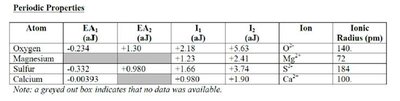
Atom | EA1 (eV) | EA2 (eV) | I1 (eV) | I2 (eV) | Ion | Ionic Radius (pm) |
|---|---|---|---|---|---|---|
Oxygen | -0.224 | +1.30 | +2.18 | +5.63 | O2− | 140 |
Magnesium | +7.23 | +2.41 | Mg2+ | 72 | ||
Sulfur | -0.332 | +0.990 | +1.66 | +3.74 | S2− | 184 |
Calcium | +0.00393 | +0.980 | +1.90 | Ca2+ | 100 |
Note: A greyed out box indicates that no data was available.
Ionization Energy and Electron Affinity
Ionization energy (IE) is the energy required to remove an electron from an atom. Electron affinity (EA) is the energy change when an atom gains an electron.
IE increases across a period and decreases down a group.
EA is generally more negative (more exothermic) for nonmetals.
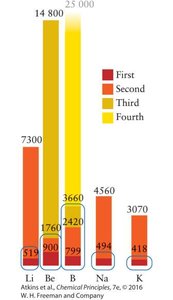
Example: The large jump in ionization energy after the removal of valence electrons indicates a stable noble gas configuration.
Photoelectron Spectroscopy (PES) and Binding Energy
PES measures the binding energy of electrons in atoms. The binding energy is the energy required to remove an electron from a specific orbital.
Binding energy can be calculated using the energy of the incident photon and the kinetic energy of the emitted electron:
Example: If an X-ray photon of known wavelength ejects an electron with a measured kinetic energy, the binding energy can be determined.
Valence Electrons and Chemical Bonding
Valence electrons are the outermost electrons and are primarily responsible for chemical bonding and reactivity.
Importance: The number of valence electrons determines the chemical properties and the types of bonds an atom can form.
Ionic Bonding and Lattice Energy
Formation of Ionic Compounds
Ionic compounds form when electrons are transferred from a metal to a nonmetal, resulting in oppositely charged ions that attract each other.
Energy of Formation: The overall energy change when forming an ionic compound from its elements includes ionization energies, electron affinities, and lattice energy.
Lattice Energy: The energy released when gaseous ions form an ionic solid. It is a measure of the strength of the ionic bond.
Example: The formation of MgO involves two ionization energies for Mg and one electron affinity for O, followed by the release of lattice energy.
Exothermic and Endothermic Processes
An exothermic process releases energy, while an endothermic process absorbs energy. The formation of most ionic compounds is exothermic due to the large lattice energy.
Electron Removal and Energy Levels
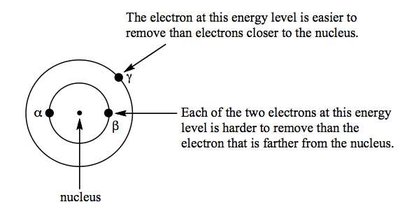
Electrons closer to the nucleus are harder to remove due to stronger electrostatic attraction. The removal of each successive electron requires more energy, especially after all valence electrons have been removed.
Practice Problems and Applications
Calculate the binding energy of an electron given the wavelength of incident light and the kinetic energy of the emitted electron.
Calculate the wavelength of an electron transition in hydrogen using the Rydberg formula: where is the Rydberg constant, and are principal quantum numbers.
Determine electron affinity from experimental data using the energy difference between incident photons and ejected electrons.
Additional info: Students are generally not required to memorize exact wavelengths for all electromagnetic radiation types or visible colors, but should know the order and relative energies.
