 Back
BackAtomic Structure, Electron Configuration, and Periodic Trends: Study Notes
Study Guide - Smart Notes
 Tailored notes based on your materials, expanded with key definitions, examples, and context.
Atomic Structure and the Dual Nature of Light
Wave-Particle Duality of Light
The dual nature of light refers to the fact that light exhibits both wave-like and particle-like properties. This concept is fundamental to understanding atomic structure and the behavior of electrons.
Wave Properties: Light can be described by its wavelength (λ) and frequency (ν). The visible spectrum ranges from 400–750 nm. Ultraviolet (UV), X-rays, and gamma rays have shorter wavelengths and higher energies, while infrared and radio waves have longer wavelengths and lower energies.
Particle Properties: Light can also behave as a stream of particles called photons, each with energy given by , where h is Planck's constant and ν is frequency.
Energy-Wavelength Relationship: The energy of a photon can also be expressed as , where n is the number of photons, c is the speed of light, and λ is wavelength.
Shorter wavelength → higher energy; higher frequency → higher energy.
Example: Gamma rays have much higher energy than visible light due to their shorter wavelength.
The Photoelectric Effect
The photoelectric effect demonstrates the particle nature of light. When light of sufficient frequency strikes a metal surface, electrons are ejected. The minimum energy required to remove an electron is called the work function (Φ).
Threshold Frequency (ν0): The minimum frequency needed to eject electrons.
Kinetic Energy of Ejected Electrons:
If the energy of the photon is less than the work function, no electrons are emitted.
Example: X-ray photons with a wavelength of 0.287 nm can eject electrons from a metal surface if their energy exceeds the binding energy of the electrons.
Atomic Models and Quantum Theory
Bohr Model and Its Limitations
The Bohr model describes electrons in fixed orbits around the nucleus with quantized energies. It successfully explains the hydrogen atom's emission spectrum but fails for multi-electron atoms.
Energy Transitions: The energy difference between orbits corresponds to the emission or absorption of photons.
Formula for Energy Levels: , where RH is the Rydberg constant and n is the principal quantum number.
Limitations: Cannot explain spectra of atoms with more than one electron.
Schrödinger Equation: The quantum mechanical model uses the Schrödinger equation to describe electron behavior as a probability distribution (wavefunction), allowing for more accurate predictions of atomic structure.
Quantum Numbers and Electron Configuration
Electrons in atoms are described by four quantum numbers:
Principal quantum number (n): Energy level
Angular momentum quantum number (l): Shape of orbital
Magnetic quantum number (ml): Orientation of orbital
Spin quantum number (ms): Electron spin direction
Electron configurations show the arrangement of electrons in an atom or ion. Paramagnetic species have unpaired electrons; diamagnetic species have all electrons paired.
Uncertainty Principle and Particle Wavelength
The Heisenberg uncertainty principle states that the position and momentum of a particle cannot both be precisely known:
Particles such as electrons have a wavelength given by the de Broglie equation:
Periodic Trends and Properties
Atomic and Ionic Radii
Atomic and ionic radii vary across the periodic table due to changes in nuclear charge and electron configuration.
Atomic radius decreases across a period (left to right) due to increased nuclear charge.
Atomic radius increases down a group due to additional electron shells.
Ionic radius: Cations are smaller than their parent atoms; anions are larger.
Isoelectronic species have the same number of electrons but different nuclear charges, affecting their radii.
Ionization Energy and Electron Affinity
Ionization energy is the energy required to remove an electron from an atom. Electron affinity is the energy change when an atom gains an electron.
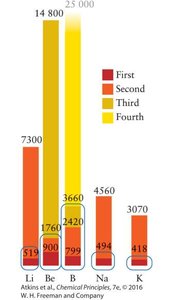
First ionization energy (I1): Energy to remove the first electron.
Second ionization energy (I2): Energy to remove the second electron, and so on.
Trends: Ionization energy increases across a period and decreases down a group.
Electron affinity: Generally becomes more negative across a period (more exothermic).
Binding Energy and Photoelectron Spectroscopy (PES)
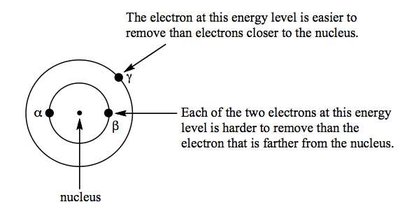
Binding energy is the energy required to remove an electron from an atom. Photoelectron spectroscopy measures the energies of electrons ejected by photons, providing information about electronic structure.
PES energy: The difference between the energy of incident photons and the kinetic energy of ejected electrons gives the binding energy.
Formula:
Ionic Bonding and Lattice Energy
Formation of Ionic Compounds
Ionic compounds form when electrons are transferred from metals to nonmetals, resulting in cations and anions held together by electrostatic forces.
Energy of formation: The total energy change when an ionic compound forms from its elements in the gas phase.
Lattice energy: The energy released when gaseous ions form an ionic solid. Higher lattice energy means a more stable ionic compound.
Example: The formation of MgO involves two ionization energies for Mg and one electron affinity for O. The overall energy of formation includes these steps plus the lattice energy.
Exothermic and Endothermic Processes
An exothermic process releases energy, while an endothermic process absorbs energy. The formation of ionic compounds is typically exothermic due to the large lattice energy released.
Summary Table: Periodic Properties
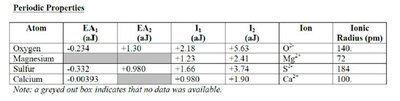
The following table summarizes key periodic properties for selected elements:
Atom | EA1 (eV) | EA2 (eV) | I1 (eV) | I2 (eV) | Ion | Ionic Radius (pm) |
|---|---|---|---|---|---|---|
Oxygen | -0.224 | +1.30 | +2.18 | +5.63 | O2− | 140 |
Magnesium | +1.23 | +2.41 | Mg2+ | 72 | ||
Sulfur | -0.332 | +0.980 | +1.66 | +3.74 | S2− | 184 |
Calcium | +0.00393 | +0.980 | +1.90 | Ca2+ | 100 |
Note: A grayed out box indicates that no data was available.
Additional Info
Students are not typically required to memorize the exact wavelengths for all electromagnetic spectrum regions, but should know the order and relative energies.
Understanding the Schrödinger equation conceptually is important, but detailed mathematical solutions are usually not required at the general chemistry level.
Valence electrons are crucial for determining chemical reactivity and bonding.
