 Back
BackAtomic Structure, Electronic Configuration, and Quantum Numbers – General Chemistry Study Guide
Study Guide - Smart Notes
 Tailored notes based on your materials, expanded with key definitions, examples, and context.
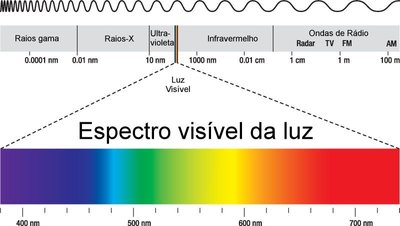
Q1. A clorofila absorve a luz nas energias de 3,056 x 10-19 J fóton-1 e 4,414 x 10-19 J fóton-1. A que cor correspondem essas absorções?
Background
Topic: Relationship between photon energy and visible light color.
This question tests your understanding of how the energy of a photon relates to its wavelength and, consequently, to the color of visible light.
Key formula:
Where:
= energy of the photon (in joules)
= Planck's constant ( J·s)
= speed of light ( m/s)
= wavelength (in meters)
Step-by-Step Guidance
Start by rearranging the formula to solve for wavelength: .
Plug in the values for and for each energy value given.
Calculate the wavelength for each energy (do not solve yet).
Compare the calculated wavelengths to the visible spectrum (400–700 nm) to determine the corresponding color.
Try solving on your own before revealing the answer!
Final Answer:
The calculated wavelengths correspond to the blue and red regions of the visible spectrum. The lower energy (3,056 x 10-19 J) is closer to red, and the higher energy (4,414 x 10-19 J) is closer to blue.
We used the energy-wavelength relationship and compared the results to the visible spectrum.
Q2. A ação protetora do ozônio na atmosfera vem através da reação do ozônio com radiação UV na faixa de comprimento de onda de 230 a 290 nm. Qual é a energia, em quilojoules por mol, associada com radiação nesta faixa de comprimento de onda?
Background
Topic: Energy of electromagnetic radiation and its relation to wavelength.
This question tests your ability to convert wavelength to energy and then to energy per mole of photons.
Key formula:
Where:
= energy per photon (in joules)
= Avogadro's number ( mol-1)
= energy per mole (in joules or kJ)
Step-by-Step Guidance
Convert the wavelength range from nanometers to meters ( m).
Use the formula to calculate the energy for both 230 nm and 290 nm.
Multiply the energy per photon by Avogadro's number to get energy per mole.
Convert the result from joules to kilojoules (divide by 1000).
Try solving on your own before revealing the answer!
Final Answer:
The energy per mole for UV radiation in this range is approximately 413–520 kJ/mol.
We calculated the energy for both endpoints and converted to kJ/mol using Avogadro's number.
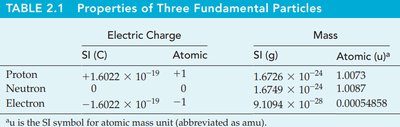
Q3. a) Qual é o comprimento de onda associado aos elétrons viajando a um décimo da velocidade da luz? b) A que velocidade um feixe de prótons deve ser acelerado para exibir um comprimento de onda de De Broglie equivalente a 10,0 pm?
Background
Topic: De Broglie wavelength and quantum behavior of particles.
This question tests your understanding of the De Broglie equation, which relates the wavelength of a particle to its momentum.
Key formula:
Where:
= wavelength (in meters)
= Planck's constant ( J·s)
= mass of the particle (electron or proton)
= velocity of the particle
Step-by-Step Guidance
For part (a), use the mass of the electron and velocity () in the De Broglie equation.
For part (b), rearrange the De Broglie equation to solve for velocity: , using the mass of the proton and the given wavelength.
Plug in the values for , , and for each case.
Set up the calculations but do not solve for the final numeric values yet.
Try solving on your own before revealing the answer!
Final Answer:
a) The wavelength for the electron is approximately 2.42 x 10⁻¹¹ m. b) The velocity for the proton is approximately 6.63 x 10³ m/s.
We used the De Broglie equation and the mass values from the table to set up the calculations.
Q4. Responda as questões abaixo e justifique suas respostas:
Background
Topic: Quantum numbers and orbital rules.
This question tests your understanding of the allowed values for quantum numbers and their physical meaning in atomic orbitals.
Key terms:
Principal quantum number (): indicates the energy level.
Angular momentum quantum number (): indicates the subshell (s, p, d, f).
Magnetic quantum number (): indicates the orientation of the orbital.
Step-by-Step Guidance
For part (a), check if the set , , is valid by reviewing the allowed values for each quantum number.
For part (b), with and , determine the possible values for (since depends on $l$).
For part (c), check if , , is valid by considering the restrictions on and for a given .
Justify each answer based on quantum number rules.
Try solving on your own before revealing the answer!
Final Answer:
a) Yes, this is a valid set for a 3s orbital. b) can be 1 or 2. c) No, $l$ cannot be 2 when .
Quantum number rules restrict the possible values for each orbital.
Q5. Quando um átomo de cobre perde um elétron para se tornar um íon de Cu+, quais são os possíveis números quânticos do elétron que foi perdido?
Background
Topic: Electronic configuration and quantum numbers for transition metals.
This question tests your understanding of which electron is lost when a transition metal forms a cation and how to assign quantum numbers to that electron.
Key terms:
Electronic configuration of copper: [Ar] 4s1 3d10
Quantum numbers: , , ,
Step-by-Step Guidance
Write the electronic configuration for neutral copper and for Cu+.
Identify which electron is removed (usually the 4s electron).
Assign the quantum numbers for the 4s electron: , , , or .
Explain why the 4s electron is lost first.
Try solving on your own before revealing the answer!
Final Answer:
The lost electron has quantum numbers , , , or .
The 4s electron is removed first due to its higher energy compared to 3d electrons.
Q6. Observe o diagrama mostrado abaixo que representa os três primeiros níveis de energia para as três primeiras camadas atômicas. Os níveis de energia são mostrados para um átomo de hidrogênio, à esquerda, e três típicos átomos multieletrônicos, à direita, Li, Na e K, com cada espécie multieletrônica apresentando seu diagrama específico. Diante do conjunto de dados, responda ao que se pede:
Background
Topic: Energy levels in hydrogen vs. multi-electron atoms.
This question tests your understanding of orbital energy degeneracy, the effect of electron-electron repulsion, and the ordering of orbital energies in multi-electron atoms.
Key terms:
Degeneracy: Orbitals with the same energy.
Electrostatic forces: Attraction and repulsion between charged particles.
Orbital energy inversion: 4s vs. 3d in potassium.
Step-by-Step Guidance
For part (a), explain why hydrogen's orbitals are degenerate (same energy) and why multi-electron atoms show splitting.
For part (b), discuss how increasing atomic number affects orbital energies, referencing electrostatic attraction and shielding.
For part (c), explain the energy inversion between 4s and 3d orbitals in potassium, considering electron repulsion and penetration.
Use diagrams or tables if available to support your explanation.
Try solving on your own before revealing the answer!
Final Answer:
a) Hydrogen's orbitals are degenerate because there is only one electron. Multi-electron atoms have splitting due to electron repulsion. b) Orbital energies decrease with increasing atomic number due to stronger nuclear attraction. c) 4s is lower in energy than 3d in potassium due to penetration and shielding effects.
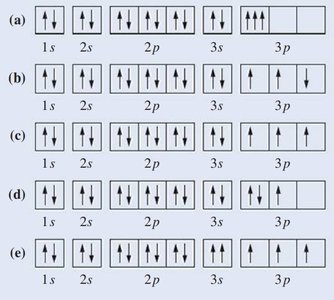
Q7. Qual(is) dos seguintes diagramas de orbitais está(ão) incorreto(s)? Qual dos diagramas corresponde a um estado excitado e qual corresponde ao estado fundamental de um átomo neutro? Explique suas respostas.
Background
Topic: Orbital diagrams, ground and excited states.
This question tests your ability to interpret orbital diagrams and identify correct electron filling according to the Aufbau principle, Hund's rule, and Pauli exclusion principle.
Key terms:
Ground state: Lowest energy configuration.
Excited state: Higher energy configuration.
Hund's rule: Maximize unpaired electrons in degenerate orbitals.
Pauli exclusion principle: No two electrons in the same orbital can have the same set of quantum numbers.
Step-by-Step Guidance
Examine each diagram for violations of the filling order, Hund's rule, or Pauli exclusion principle.
Identify which diagram(s) show electrons paired before all orbitals are singly occupied (Hund's rule violation).
Determine which diagram represents the ground state (lowest energy, correct filling).
Identify the excited state (electrons promoted to higher orbitals).
Try solving on your own before revealing the answer!
Final Answer:
Diagram (b) is incorrect (violates Hund's rule). Diagram (a) is the ground state, and diagram (c) is an excited state.
Correct filling follows the Aufbau principle and Hund's rule.
Q8. Identifique o elemento com a configuração eletrônica no estado fundamental: 1s2 2s2 2p6 3s2 3p6 4s2 3d2. Justifique sua resposta.
Background
Topic: Electronic configuration and periodic table identification.
This question tests your ability to interpret electronic configurations and identify elements based on their ground state configuration.
Key terms:
Electronic configuration: Distribution of electrons in atomic orbitals.
Periodic table: Use configuration to find atomic number and element.
Step-by-Step Guidance
Count the total number of electrons in the configuration.
Match the electron count to the atomic number on the periodic table.
Identify the element and justify based on configuration and periodic table position.
Explain why this configuration matches the element's ground state.
Try solving on your own before revealing the answer!
Final Answer:
The element is titanium (Ti), atomic number 22.
The configuration matches the ground state for Ti.
Q9. a) Use a notação spdf para mostrar a configuração eletrônica do iodo. Quantos elétrons o átomo I tem em sua subcamada 3d? Quantos elétrons desemparelhados existem em um átomo de I? b) Indique o número de elétrons de valência em um átomo de bromo. c) Mostre os elétrons de mais energéticos em um átomo de telúrio. d) Dê os elétrons desemparelhados de um átomo de índio. e) Apresente os elétrons em um átomo de prata. É necessário apresentar a configuração eletrônica de todas as espécies.
Background
Topic: Electronic configuration, valence electrons, and unpaired electrons.
This question tests your ability to write electronic configurations, identify valence and unpaired electrons, and understand the energy ordering of orbitals for various elements.
Key terms:
spdf notation: s, p, d, f subshells.
Valence electrons: Electrons in the outermost shell.
Unpaired electrons: Electrons not paired in orbitals.
Step-by-Step Guidance
Write the full electronic configuration for each element (I, Br, Te, In, Ag).
For I, count electrons in the 3d subshell and identify unpaired electrons.
For Br, identify the number of valence electrons.
For Te, show the most energetic electrons (highest energy subshell).
For In and Ag, identify unpaired electrons and present their configurations.
Try solving on your own before revealing the answer!
Final Answer:
a) Iodine: [Kr] 4d10 5s2 5p5; 3d has 10 electrons; 1 unpaired electron. b) Bromine: 7 valence electrons. c) Tellurium: 5p4 electrons. d) Indium: 1 unpaired electron. e) Silver: [Kr] 4d10 5s1.
Q10. Um elemento de número atômico par pode ser paramagnético? (Dica: tente escrever os diagramas orbitais de alguns dos elementos de transição no Período 4. Pesquisar na literatura os conceitos de paramagnético e diamagnético.)
Background
Topic: Magnetism and electron configuration.
This question tests your understanding of paramagnetism and diamagnetism, and how electron pairing affects magnetic properties.
Key terms:
Paramagnetic: Atoms with unpaired electrons.
Diamagnetic: Atoms with all electrons paired.
Transition elements: Often have unpaired electrons.
Step-by-Step Guidance
Review the definition of paramagnetism and diamagnetism.
Write orbital diagrams for transition elements with even atomic numbers in Period 4.
Check if any have unpaired electrons.
Justify your answer based on electron configuration.
Try solving on your own before revealing the answer!
Final Answer:
Yes, elements with even atomic numbers can be paramagnetic if they have unpaired electrons.
Transition metals often have unpaired electrons regardless of atomic number parity.
Q11. As distribuições eletrônicas abaixo correspondem ao estado fundamental de alguns elementos. Identifique-os e explique sua escolha.
Background
Topic: Electronic configuration and element identification.
This question tests your ability to match electronic configurations to elements and justify your reasoning.
Key terms:
Electronic configuration: Sequence of filled orbitals.
Ground state: Lowest energy configuration.
Step-by-Step Guidance
Count the total electrons in each configuration.
Match the electron count to the atomic number and element.
Justify your identification based on the configuration and periodic table position.
Explain why the configuration represents the ground state.
Try solving on your own before revealing the answer!
Final Answer:
Each configuration matches a specific element based on electron count and orbital filling.
Ground state configurations follow the Aufbau principle.
