 Back
BackAtomic Structure, Light, and Quantum Theory: Study Notes
Study Guide - Smart Notes
 Tailored notes based on your materials, expanded with key definitions, examples, and context.
Model of the Atom
Historical Development of Atomic Models
The understanding of atomic structure has evolved through a series of experiments and theoretical models. Early models attempted to explain the arrangement of subatomic particles and the behavior of atoms under various conditions.
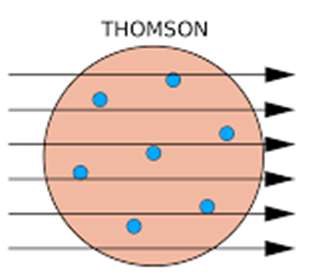
Thomson's Model: Proposed the "plum pudding" model, where electrons are embedded in a positively charged sphere.
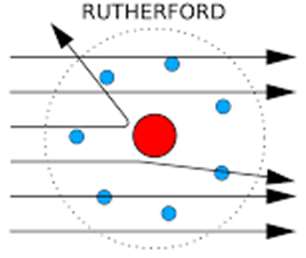
Rutherford's Model: Demonstrated that atoms have a small, dense, positively charged nucleus with electrons orbiting around it.
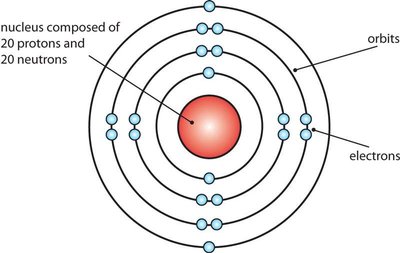
Bohr Model: Introduced quantized orbits for electrons, explaining atomic emission spectra.
Key Experiments in Atomic Structure
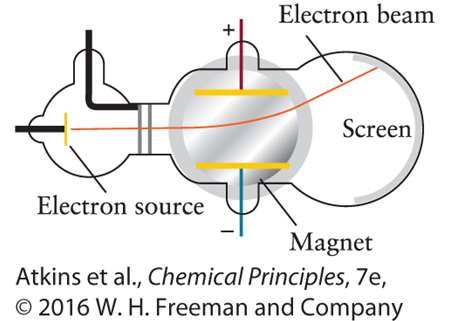
Cathode Ray Tube Experiment: Showed the existence of electrons as negatively charged particles.
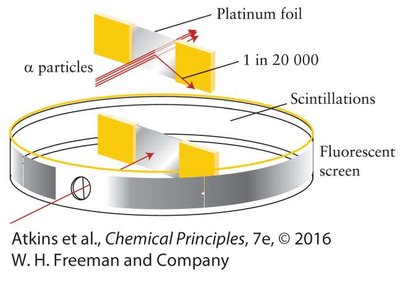
Gold Foil Experiment: Alpha particles were scattered by a thin metal foil, revealing the presence of a dense nucleus.
Light and the Electromagnetic Spectrum
Nature of Light
Light is a form of electromagnetic radiation, carrying energy through space. It exhibits both wave-like and particle-like properties.
Electromagnetic Spectrum: Includes gamma rays, X-rays, ultraviolet, visible light, infrared, microwaves, and radio waves.
Visible Light: The portion of the spectrum visible to the human eye, ranging from approximately 400 nm (violet) to 750 nm (red).


Wave Properties of Light
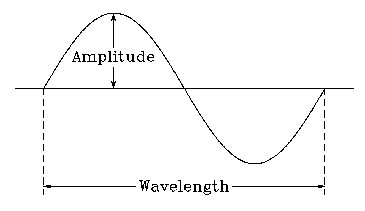
All waves, including light, are characterized by wavelength (λ), frequency (ν), and amplitude.
Wavelength (λ): The distance between two consecutive peaks of a wave (measured in meters or nanometers).
Frequency (ν): The number of wave cycles passing a point per second (measured in Hz or s-1).
Amplitude: The height of the wave crest, related to the intensity of the radiation.
The relationship between wavelength, frequency, and the speed of light (c) is given by:
where m/s (speed of light in vacuum).
Electromagnetic Spectrum Table
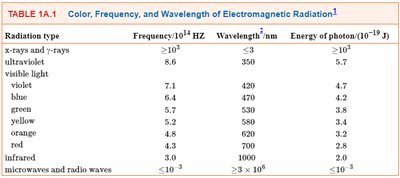
The following table summarizes the frequency, wavelength, and energy of different types of electromagnetic radiation:
Radiation type | Frequency (1014 Hz) | Wavelength (nm) | Energy of photon (10-19 J) |
|---|---|---|---|
X-rays and γ-rays | >104 | <3 | >103 |
Ultraviolet | >8.6 | <350 | 5.7 |
Visible light | 7.1–4.3 | 420–700 | 4.7–2.8 |
Infrared | 3.0 | 1000 | 2.0 |
Microwaves and radio waves | <10-3 | >3 × 10⁶ | <10-3 |
Quantization of Energy and the Dual Nature of Light
Blackbody Radiation and Planck's Hypothesis
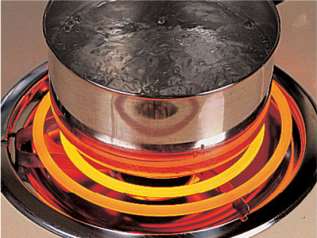
Classical physics could not explain the spectrum of radiation emitted by heated objects (blackbody radiation). Max Planck proposed that energy is quantized and can only be emitted or absorbed in discrete packets called quanta.
Planck's Constant (h): J·s
Energy of a photon:
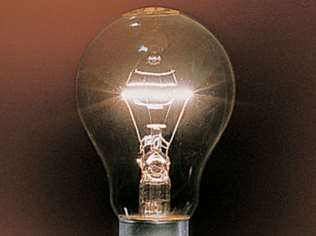
Light energy is quantized, and each quantum of light is called a photon.
The Photoelectric Effect
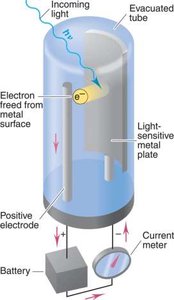
The photoelectric effect demonstrates the particle nature of light. When light of sufficient frequency strikes a metal surface, electrons are ejected. The effect cannot be explained by the wave model alone.
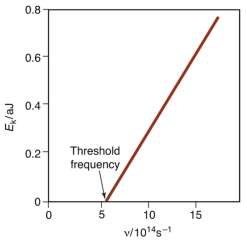
Threshold Frequency (ν0): The minimum frequency required to eject electrons from a metal surface.
Kinetic Energy of Ejected Electrons:
Atomic Emission Spectra and the Bohr Model
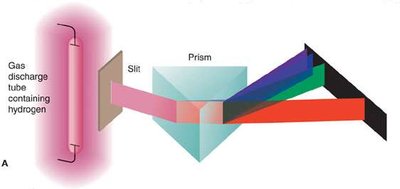
Atomic Emission Spectra
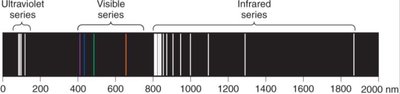
When atoms are excited, they emit light at specific wavelengths, producing a line spectrum unique to each element. This phenomenon provided evidence for quantized energy levels in atoms.

Bohr Model of the Atom
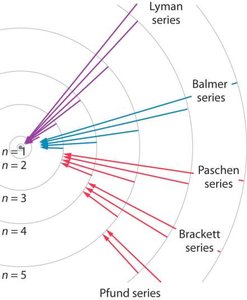
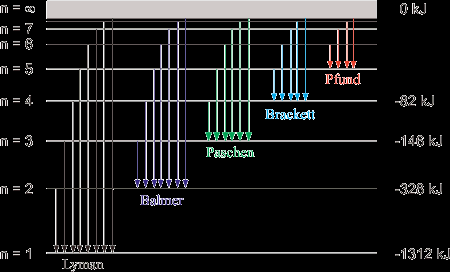
Niels Bohr proposed that electrons occupy specific energy levels (orbits) around the nucleus. Transitions between these levels result in the absorption or emission of photons with energy equal to the difference between the levels.
Energy Levels: J, where n = 1, 2, 3, ...
Energy of Transition:
Photon Energy:
Rydberg-Balmer Equation
The wavelengths of spectral lines in hydrogen can be calculated using the Rydberg formula:
, where
Balmer Series: Visible lines, ,
Quantum Mechanics and the Wave Nature of Matter
de Broglie Hypothesis
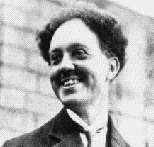
Louis de Broglie proposed that all matter exhibits wave-like properties. The wavelength associated with a particle is given by:
m: mass of the particle (kg)
v: velocity of the particle (m/s)
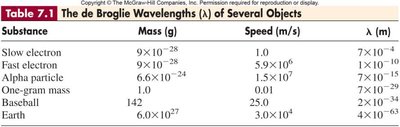
de Broglie Wavelengths Table
The table below shows the de Broglie wavelengths for various objects, illustrating that wave properties are significant only for very small particles like electrons.
Substance | Mass (g) | Speed (m/s) | λ (m) |
|---|---|---|---|
Slow electron | 9 × 10-28 | 1.0 | 7 × 10⁻⁴ |
Fast electron | 9 × 10-28 | 5.9 × 10⁶ | 1 × 10⁻¹⁰ |
Alpha particle | 6.6 × 10⁻²⁴ | 1.5 × 10⁷ | 7 × 10-15 |
One-gram mass | 1.0 | 0.01 | 7 × 10-29 |
Baseball | 142 | 25.0 | 2 × 10-34 |
Earth | 6.0 × 1027 | 3.0 × 10⁴ | 4 × 10-63 |
Summary Table: Key Equations
Concept | Equation |
|---|---|
Speed of light | |
Photon energy | |
Bohr energy levels (hydrogen) | J |
Rydberg formula | |
de Broglie wavelength |
Additional info: These notes integrate foundational experiments, theoretical models, and mathematical relationships essential for understanding atomic structure and quantum mechanics in general chemistry.
