 Back
Atomic Structure, Periodic Table, and Chemical Bonding: General Chemistry Study Notes
Study Guide - Smart Notes
 Tailored notes based on your materials, expanded with key definitions, examples, and context.
Atomic Structure & The Periodic Table
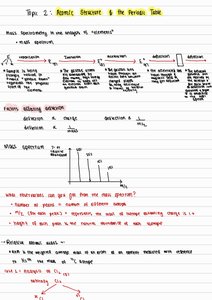
Mass Spectrometry & Isotopes
Mass spectrometry is a technique used to determine the masses and relative abundances of isotopes in a sample. Isotopes are atoms of the same element with different numbers of neutrons.
Isotope Definition: Atoms with the same number of protons but different numbers of neutrons.
Mass Spectrometry: Used to analyze isotopic composition and calculate average atomic mass.
Average Atomic Mass Formula:
Example: Chlorine has two main isotopes, Cl-35 and Cl-37, with different abundances.
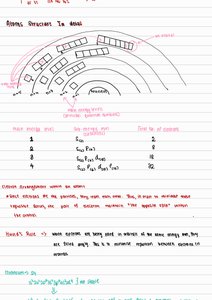
Atomic Structure in Shells
Electrons are arranged in shells around the nucleus, each shell having a specific energy level. The arrangement follows the Aufbau principle, Hund's rule, and the Pauli exclusion principle.
Shells: Principal energy levels (n = 1, 2, 3, ...).
Subshells: s, p, d, f types, each with a specific number of orbitals.
Electron Configuration: Distribution of electrons among shells and subshells.
Hund's Rule: Electrons fill degenerate orbitals singly before pairing.
Pauli Exclusion Principle: No two electrons in an atom can have the same set of quantum numbers.
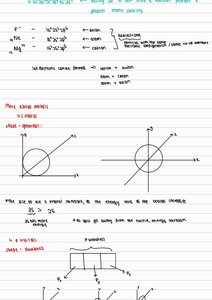
Quantum Numbers & Orbitals
Quantum numbers describe the properties of atomic orbitals and the electrons in them. The main quantum numbers are n (principal), l (angular momentum), ml (magnetic), and ms (spin).
Principal Quantum Number (n): Indicates shell/energy level.
Angular Momentum Quantum Number (l): Indicates subshell (s, p, d, f).
Magnetic Quantum Number (ml): Indicates orbital orientation.
Spin Quantum Number (ms): Indicates electron spin direction.
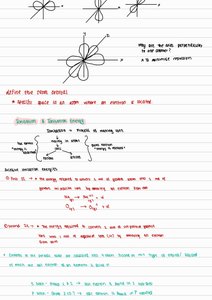
Orbital Shapes: s (spherical), p (dumbbell), d (cloverleaf), f (complex).
Bonding & Molecular Structure
Covalent Bonding
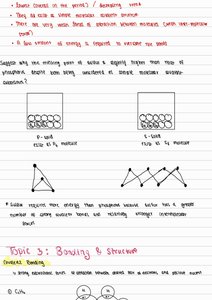
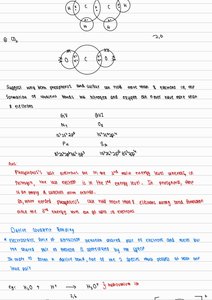
Covalent bonds are formed when atoms share electrons to achieve a stable electron configuration. The shared electrons are located between the nuclei of the bonded atoms.
Bond Formation: Atoms share pairs of electrons.
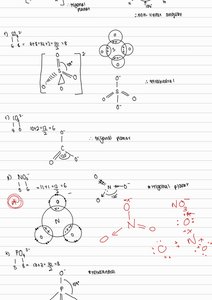
Lewis Structures: Visual representation of covalent bonds and lone pairs.
Example: Water (H2O) and methane (CH4).
Shapes of Molecules (VSEPR Theory)
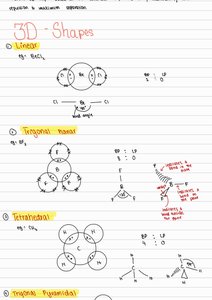
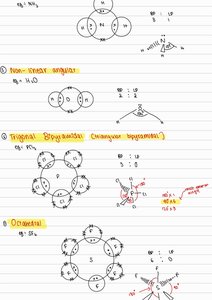
The Valence Shell Electron Pair Repulsion (VSEPR) theory predicts the 3D shapes of molecules based on the repulsion between electron pairs around a central atom.
Linear: 180° bond angle (e.g., BeCl2).
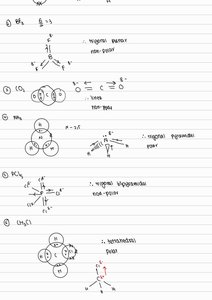
Trigonal Planar: 120° bond angle (e.g., BF3).
Tetrahedral: 109.5° bond angle (e.g., CH4).
Trigonal Pyramidal: Example: NH3.
Non-linear/Angular: Example: H2O.
Trigonal Bipyramidal: Example: PCl5.
Octahedral: Example: SF6.
Polarity of Covalent Bonds & Molecular Polarity
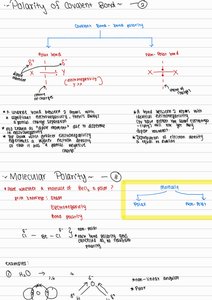
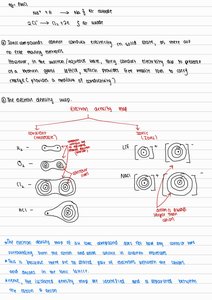
Polarity arises when there is an unequal sharing of electrons between atoms in a bond, due to differences in electronegativity. Molecular polarity depends on both bond polarity and molecular geometry.
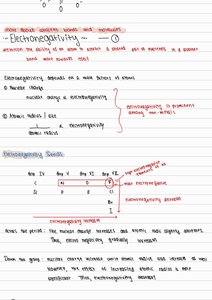
Electronegativity: The ability of an atom to attract electrons in a bond.
Bond Polarity: Occurs when atoms have different electronegativities.
Molecular Polarity: Determined by the shape and arrangement of polar bonds.
Example: H2O is polar, CO2 is nonpolar.
Ionic Bonding
Ionic bonds are formed by the electrostatic attraction between oppositely charged ions, typically between metals and nonmetals.
Formation: Transfer of electrons from one atom to another.
Example: Sodium chloride (NaCl).
Properties: High melting points, conduct electricity when molten or dissolved.
Periodic Properties of the Elements
Trends in Atomic Radius
Atomic radius is the distance from the nucleus to the outermost electron shell. It varies across periods and groups in the periodic table.
Down a Group: Atomic radius increases due to addition of electron shells.
Across a Period: Atomic radius decreases due to increased nuclear charge pulling electrons closer.
Trends in Ionic Radius
Ionic radius is the radius of an ion, which differs from the atomic radius due to loss or gain of electrons.
Cations: Smaller than their parent atoms due to loss of electrons.
Anions: Larger than their parent atoms due to gain of electrons.
Trend Down a Group: Ionic radius increases.
Trend Across a Period: Ionic radius decreases for cations and anions.

Atomic Radius vs. Ionic Radius
Comparing atomic and ionic radii helps understand the effects of electron loss or gain on the size of atoms and ions.
Atomic Radius: Neutral atom size.
Ionic Radius: Size after electron transfer (cation or anion).
Example: Na+ is smaller than Na, Cl- is larger than Cl.
Electronegativity & Bond Strength
Electronegativity Trends
Electronegativity increases across a period and decreases down a group. The most electronegative element is fluorine.
Trend Across Period: Increases due to greater nuclear charge.
Trend Down Group: Decreases due to increased atomic size.
Relative Strength of Ionic Bonds
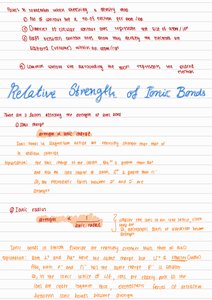
The strength of ionic bonds depends on the charges of the ions and the distance between them. Higher charges and smaller distances result in stronger bonds.
Coulomb's Law:
Factors: Charge magnitude, ionic radius, lattice energy.
Summary Table: Electron Configuration in Shells
Shell (n) | Subshells | Max # of Electrons |
|---|---|---|
1 | 1s | 2 |
2 | 2s, 2p | 8 |
3 | 3s, 3p, 3d | 18 |
4 | 4s, 4p, 4d, 4f | 32 |
Additional info:
Some explanations and diagrams were expanded for clarity and completeness.
Quantum mechanical principles (Hund's rule, Pauli exclusion) were inferred from context.
Periodic trends and bond strength equations were added for academic completeness.
