 Back
BackAtoms & Chemical Equations: Step-by-Step Study Guidance
Study Guide - Smart Notes
 Tailored notes based on your materials, expanded with key definitions, examples, and context.
Q1. Define the three subatomic particles found in an atom, including charge and location.
Background
Topic: Atomic Structure
This question tests your understanding of the basic components of an atom and their properties.
Key Terms:
Proton: Positive charge, found in the nucleus.
Neutron: No charge (neutral), found in the nucleus.
Electron: Negative charge, found outside the nucleus in electron shells.
Step-by-Step Guidance
Identify the three main subatomic particles: protons, neutrons, and electrons.
Describe the charge of each particle (positive, negative, or neutral).
Explain where each particle is located within the atom (nucleus or electron cloud).
Try describing each particle before checking the answer!
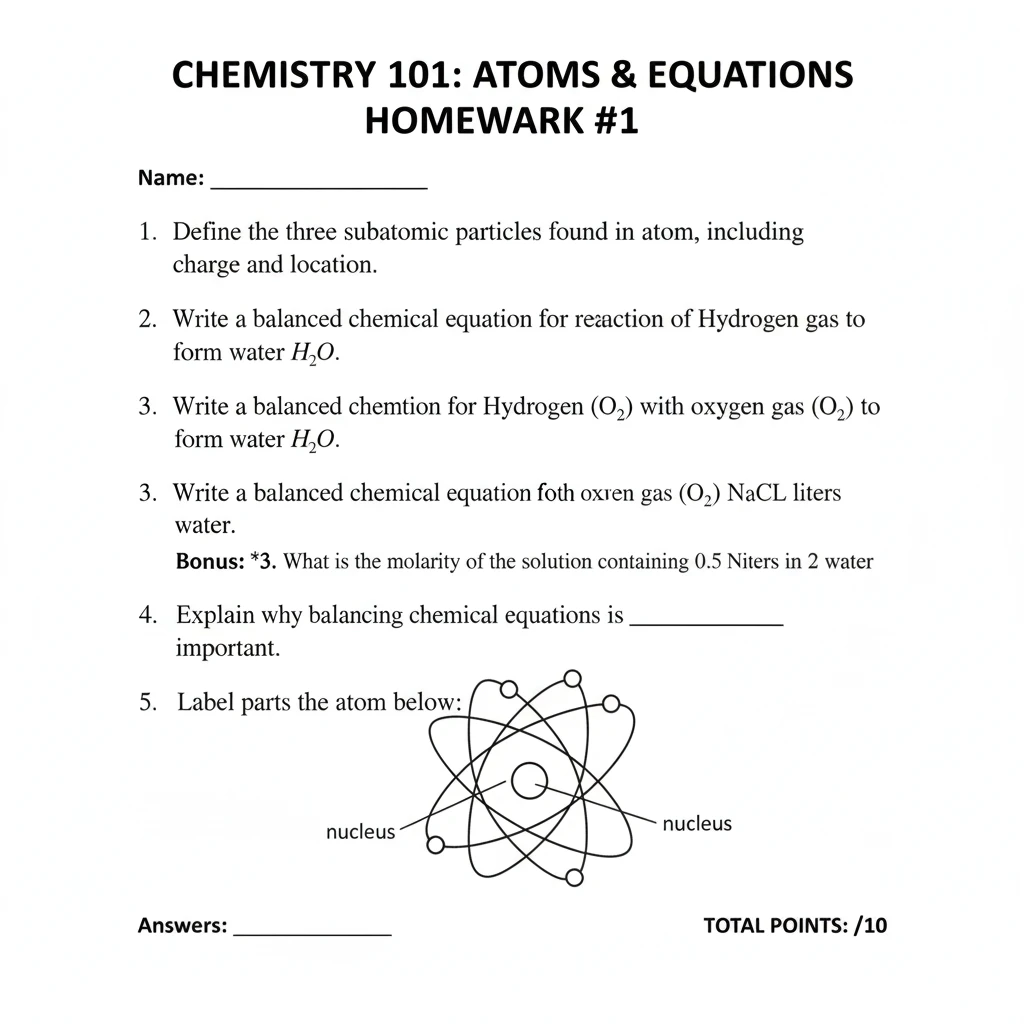
Q2. Write a balanced chemical equation for the reaction of hydrogen gas to form water H2O.
Background
Topic: Chemical Equations & Balancing
This question tests your ability to write and balance a chemical equation for the formation of water from hydrogen gas.
Key Terms and Formula:
Reactants: Hydrogen gas (H2) and oxygen gas (O2).
Product: Water (H2O).
Balanced equation: The number of atoms for each element must be equal on both sides.
Step-by-Step Guidance
Write the unbalanced equation:
Count the number of hydrogen and oxygen atoms on each side.
Adjust coefficients to balance the atoms (hint: start with hydrogen).
Try balancing the equation before checking the answer!
Q3. Write a balanced chemical equation for hydrogen (O2) with oxygen gas (O2) to form water H2O.
Background
Topic: Chemical Reactions & Balancing Equations
This question is similar to Q2, focusing on balancing the reaction between hydrogen and oxygen to form water.
Key Terms and Formula:
Reactants: Hydrogen gas (H2), Oxygen gas (O2).
Product: Water (H2O).
Balanced equation: Equal number of atoms for each element on both sides.
Step-by-Step Guidance
Write the unbalanced equation:
Count the atoms for hydrogen and oxygen on both sides.
Adjust coefficients to balance the equation.
Try balancing the equation before checking the answer!
Q4. Write a balanced chemical equation for oxygen gas (O2) and NaCl in water.
Background
Topic: Chemical Equations & Reactions
This question tests your ability to write a balanced equation involving oxygen gas and sodium chloride in water.
Key Terms and Formula:
Reactants: Oxygen gas (O2), Sodium chloride (NaCl), Water (H2O).
Products: Identify possible products based on reactants (hint: consider solubility and possible reactions).
Balanced equation: Equal number of atoms for each element on both sides.
Step-by-Step Guidance
Write the reactants and possible products.
Determine if a reaction occurs or if the substances simply dissolve.
Balance the equation if a reaction occurs.
Try writing the equation before checking the answer!
Bonus: What is the molarity of the solution containing 0.5 liters in 2 water?
Background
Topic: Solution Chemistry & Molarity
This question tests your ability to calculate molarity, which is a measure of concentration.
Key Formula:
Molarity ():
Step-by-Step Guidance
Identify the volume of the solution (in liters).
Determine the number of moles of solute present.
Plug the values into the molarity formula.
Try calculating the molarity before checking the answer!
Q5. Explain why balancing chemical equations is important.
Background
Topic: Chemical Equations & Conservation of Mass
This question tests your understanding of why chemical equations must be balanced.
Key Terms:
Law of Conservation of Mass: Matter is not created or destroyed in a chemical reaction.
Balanced Equation: Ensures equal numbers of atoms for each element on both sides.
Step-by-Step Guidance
State the law of conservation of mass.
Explain how balancing equations reflects this law.
Discuss the importance for predicting reactants and products.
Try explaining before checking the answer!
Q6. Label parts of the atom below:
Background
Topic: Atomic Structure & Diagrams
This question tests your ability to identify and label the main parts of an atom in a diagram.
Key Terms:
Nucleus: Center of the atom, contains protons and neutrons.
Electron cloud: Area surrounding the nucleus where electrons are found.
Step-by-Step Guidance
Identify the nucleus in the center of the diagram.
Locate the electron paths or shells around the nucleus.
Label the nucleus and electron cloud appropriately.
Try labeling the diagram before checking the answer!
