 Back
Atoms and Elements: Foundations of Atomic Theory and the Periodic Table
Study Guide - Smart Notes
 Tailored notes based on your materials, expanded with key definitions, examples, and context.
Atoms and Elements
Imaging Atoms: Scanning Tunneling Microscopy (STM)
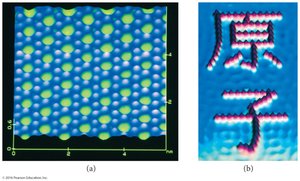
The development of scanning tunneling microscopy (STM) revolutionized our ability to observe and manipulate atoms directly. Gerd Binnig and Heinrich Rohrer discovered that an electrical tunneling current could be used to scan surfaces at the atomic scale, allowing scientists to "take pictures" of atoms and even move them individually.
STM Principle: Utilizes quantum tunneling of electrons between a sharp tip and a conductive surface.
Applications: Imaging atomic arrangements and manipulating atoms for nanotechnology.
Example: STM images can show individual atoms and even spell out characters by moving atoms.
Atomic Theory of Matter and Its Laws
Atomic theory provides the foundation for understanding chemical reactions and the nature of matter. Several key laws govern the behavior of atoms and elements:
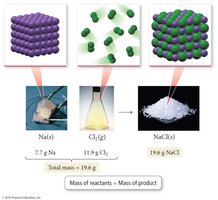
Law of Conservation of Matter: Matter is neither created nor destroyed in a chemical reaction. The total mass and number of atoms remain constant.
Dalton’s Atomic Theory: States that atoms are indivisible particles that make up elements. Atoms of the same element are identical, and compounds are formed by simple whole-number ratios of atoms.
Isotopes: Atoms of the same element with different numbers of neutrons, resulting in different masses.
Law of Definite Proportions: A compound always contains the same elements in the same proportion by mass.
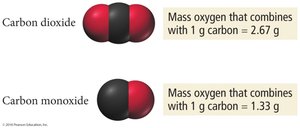
Law of Multiple Proportions: Elements can combine in different ratios to form different compounds.
Law of Definite and Multiple Proportions
The law of definite proportions states that a given compound always contains the same elements in the same ratio by mass. The law of multiple proportions explains how two elements can form more than one compound by combining in different ratios.
Example (Definite Proportions): Sodium chloride (NaCl) always has a 1:1 ratio of sodium to chlorine.
Example (Multiple Proportions): Carbon dioxide (CO2) and carbon monoxide (CO) show different ratios of oxygen to carbon.
Discovery of Subatomic Particles
Discovery of the Electron
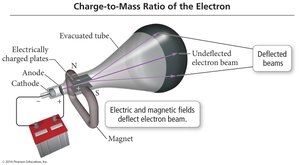
J.J. Thomson’s experiments with cathode rays led to the discovery of the electron, a fundamental particle with a negative charge. The charge-to-mass ratio of the electron was determined using electric and magnetic fields.
Charge-to-Mass Ratio:
Millikan Oil Drop Experiment: Determined the charge of the electron as and its mass as .
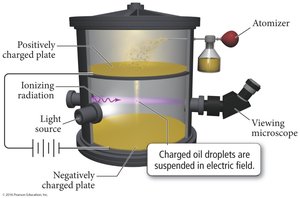
Atomic Models: Plum Pudding and Nuclear Model
Early atomic models attempted to explain the structure of the atom. The plum pudding model proposed by J.J. Thomson described the atom as a positive cloud with embedded electrons. Rutherford’s gold foil experiment disproved this model and led to the discovery of the nucleus.
Plum Pudding Model: Electrons embedded in a positively charged sphere.
Rutherford’s Gold Foil Experiment: Showed that atoms have a dense, positively charged nucleus.
Nuclear Model: Electrons orbit a central nucleus containing protons (and later, neutrons).
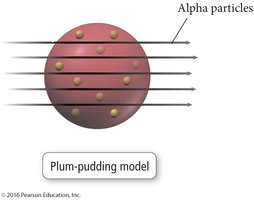
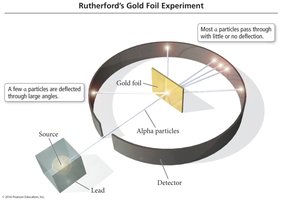
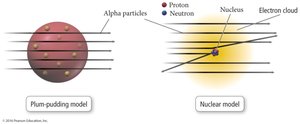
Atomic Structure and Element Identity
Protons, Neutrons, and Electrons
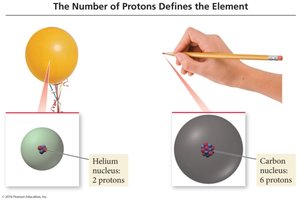
The identity of an element is determined by the number of protons in its nucleus, known as the atomic number. Neutrons contribute to the mass but not the charge, while electrons are negatively charged and orbit the nucleus.
Proton Charge:
Proton Mass:
Atomic Number (Z): Number of protons in the nucleus.
Element Symbol: Unique one- or two-letter abbreviation for each element.
Isotopes and Atomic Mass
Isotopes are atoms of the same element with different numbers of neutrons. The atomic mass of an element is a weighted average based on the natural abundance of its isotopes.
Mass Number: Sum of protons and neutrons.
Atomic Mass Calculation:
Example: Boron has two isotopes, and , with atomic mass .
Ions: Charged Atoms
Cations and Anions
Ions are atoms or groups of atoms with a net positive or negative charge. Cations are formed by losing electrons, while anions are formed by gaining electrons.
Cations: Positively charged, formed by metals losing electrons.
Anions: Negatively charged, formed by nonmetals gaining electrons.
Example: ;
The Periodic Table
Historical Development and Organization
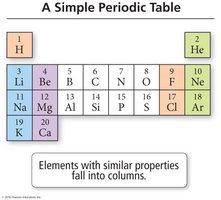
The periodic table organizes elements by increasing atomic number and groups elements with similar properties into columns called families. Dmitri Mendeleev developed the modern periodic table, recognizing the periodicity of element properties.
Rows: Called periods.
Columns: Called families or groups; elements in a group have similar properties.
Periodic Law: Properties of elements recur periodically when arranged by atomic number.
Major Divisions: Metals, Metalloids, and Nonmetals
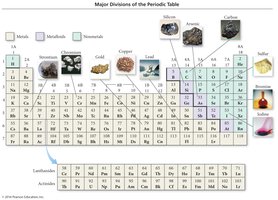
The periodic table is divided into metals, metalloids, and nonmetals, each with distinct physical and chemical properties.
Metals: Shiny, conductive, malleable, ductile, and tend to form cations.
Metalloids: Exhibit properties of both metals and nonmetals; semiconductors.
Nonmetals: Poor conductors, brittle solids, and tend to form anions.
Families of the Periodic Table
Elements within the same column (family) share similar chemical and physical properties due to having the same number of valence electrons.
Alkali Metals: Group 1A
Alkaline Earth Metals: Group 2A
Halogens: Group 7A
Noble Gases: Group 8A
Ion Formation and the Periodic Table
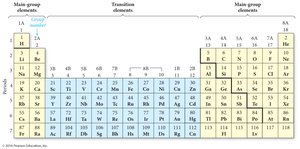
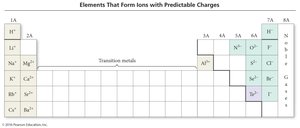
Metals, nonmetals, and metalloids form ions in predictable ways based on their position in the periodic table. Metals lose electrons to form cations, nonmetals gain electrons to form anions, and metalloids can form either.
The Mole: Quantitative Chemistry
Definition and Avogadro’s Number
The mole is the fundamental unit for counting atoms in chemistry. One mole contains units, known as Avogadro’s number.
1 mole = units
Example: 1 mole of Cu atoms has a mass of 63.55 grams and contains atoms.
Mass-Mole-Atom Conversions
Conversions between mass, moles, and number of atoms are essential for quantitative chemistry.
Mass to Moles:
Moles to Mass:
Mass to Number of Atoms:
Atoms to Mass:
Example: 24.00 grams C × (1 mole carbon/12.011 grams) = 2.00 moles of carbon atoms
Example: 45.99 g Na × (1 mol Na/22.99 g) × (6.02 × 10²³ Na atoms/1 mole) = 1.204 × 1024 Na atoms
Example: 8 atoms Am × (1 mole/6.02 × 1023 Am atoms) × (243 g/1 mol Am) = 3.23 × 10⁻²¹ grams of Am
----------------------------------------
