 Back
BackAtoms and Elements: Foundations of Matter in Chemistry
Study Guide - Smart Notes
 Tailored notes based on your materials, expanded with key definitions, examples, and context.
Atoms and Elements
Introduction to Atoms
Atoms are the fundamental building blocks of matter. Understanding their structure and properties is essential for grasping the principles of chemistry. The concept of the atom originated from the Greek word atomos, meaning "indivisible." Atoms cannot be divided further without losing their elemental identity.
Atoms compose all ordinary matter.
There are about 91 naturally occurring elements and over 20 synthetic elements.
Atoms are the smallest identifiable unit of an element.
Imaging Atoms
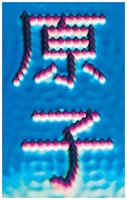
Modern techniques such as Scanning Tunneling Microscopy (STM) allow scientists to image and manipulate individual atoms and molecules, bridging the gap between the macroscopic and microscopic worlds.
Historical Development of Atomic Theory
The idea that matter is composed of small, indestructible particles was first proposed by Leucippus and Democritus. However, Plato and Aristotle believed matter had no smallest parts and was composed of fire, air, earth, and water. The scientific approach, championed by John Dalton, provided evidence for the atomic theory.
Dalton's atomic theory explained the laws of conservation of mass, definite proportions, and multiple proportions.
Atomic Laws and Their Significance
Law of Conservation of Mass
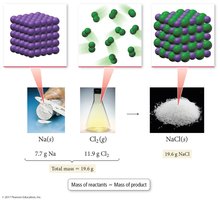
Formulated by Antoine Lavoisier, this law states that matter is neither created nor destroyed in a chemical reaction. The total mass of substances remains unchanged during a reaction.
Law of Definite Proportions
Joseph Proust observed that all samples of a given compound have the same proportions of their constituent elements, regardless of source or preparation. This is also known as the law of constant composition.
Example: Water always decomposes into 16.0 g of oxygen and 2.0 g of hydrogen for every 18.0 g sample.
Law of Multiple Proportions
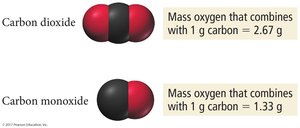
John Dalton's law states that when two elements form different compounds, the masses of one element that combine with a fixed mass of the other can be expressed as ratios of small whole numbers.
Example: Oxygen-to-carbon mass ratio in CO2 is 2.67:1, while in CO it is 1.33:1.
Structure of the Atom
Discovery of the Electron
J. J. Thomson's cathode ray experiments revealed the existence of electrons, negatively charged particles present in all atoms. He measured the charge-to-mass ratio of electrons using electric and magnetic fields.
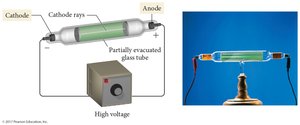
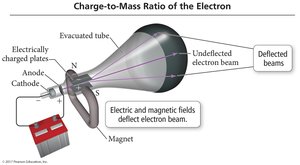
Electrons travel in straight lines, are independent of the cathode material, and carry a negative charge.
Properties of Electrical Charge
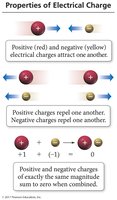
Positive and negative charges attract, while like charges repel. The sum of positive and negative charges is zero when combined.
Millikan's Oil Drop Experiment
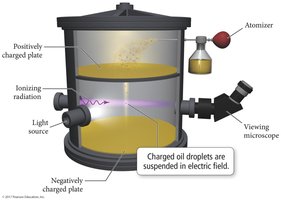
Robert Millikan determined the charge of a single electron by suspending charged oil droplets in an electric field and measuring the required field strength to halt their motion.
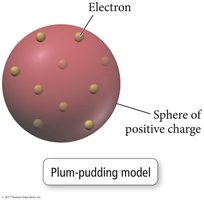
Thomson's Plum-Pudding Model
Thomson proposed that electrons were embedded within a positively charged sphere, known as the plum-pudding model.
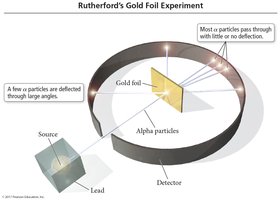
Rutherford's Gold Foil Experiment
Ernest Rutherford's experiment involved directing alpha particles at a thin gold foil. Most particles passed through, but some were deflected, leading to the nuclear model of the atom.
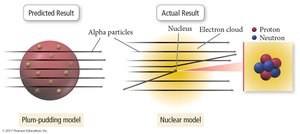
Most of the atom's mass and positive charge are in the nucleus.
Electrons are dispersed in empty space around the nucleus.
Atoms are electrically neutral.
Discovery of the Neutron
James Chadwick discovered the neutron, a neutral particle with a mass similar to the proton, accounting for the previously unexplained atomic mass.
Subatomic Particles
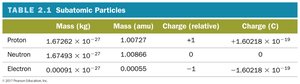
Atoms are composed of protons, neutrons, and electrons. Protons and neutrons have nearly identical masses, while electrons are much lighter.
Particle | Mass (kg) | Mass (amu) | Charge (relative) | Charge (C) |
|---|---|---|---|---|
Proton | 1.67262 × 10⁻²⁷ | 1.00727 | +1 | +1.60218 × 10⁻¹⁹ |
Neutron | 1.67493 × 10⁻²⁷ | 1.00866 | 0 | 0 |
Electron | 0.00091 × 10⁻²⁷ | 0.00055 | –1 | –1.60218 × 10⁻¹⁹ |
Elements and the Periodic Table
Atomic Number and Element Identity
The number of protons in an atom's nucleus, called the atomic number (Z), defines the element. Each element has a unique atomic number and chemical symbol.
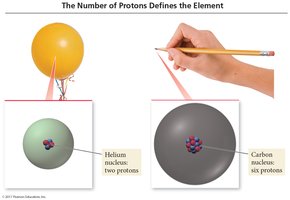
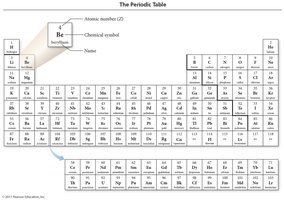
Helium: He, atomic number 2
Carbon: C, atomic number 6
Nitrogen: N, atomic number 7
Isotopes
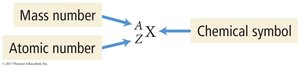
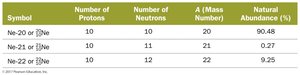
Atoms of the same element can have different numbers of neutrons, resulting in isotopes. The sum of protons and neutrons is the mass number (A).

Symbol | Number of Protons | Number of Neutrons | A (Mass Number) | Natural Abundance (%) |
|---|---|---|---|---|
Ne-20 or 20Ne | 10 | 10 | 20 | 90.48 |
Ne-21 or 21Ne | 10 | 11 | 21 | 0.27 |
Ne-22 or 22Ne | 10 | 12 | 22 | 9.25 |
Ions
Atoms can gain or lose electrons during chemical changes, forming charged particles called ions. Cations are positively charged, while anions are negatively charged.
The Periodic Table and Element Classification
Periodic Law and Table Organization
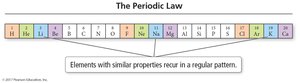
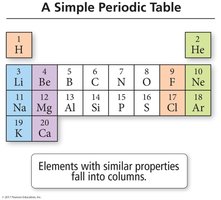
Mendeleev arranged elements by increasing mass, observing recurring properties. The modern periodic table is organized by atomic number, with elements classified as metals, nonmetals, and metalloids.
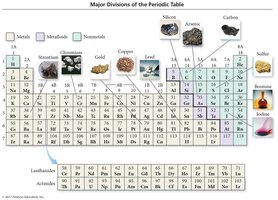
Metals: Good conductors, malleable, ductile, shiny, tend to lose electrons.
Nonmetals: Poor conductors, not ductile or malleable, tend to gain electrons.
Metalloids: Exhibit mixed properties, often semiconductors.
Main-Group and Transition Elements
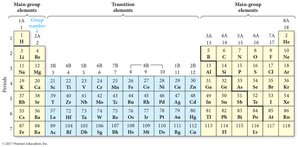
Main-group elements have predictable properties based on their position. Transition elements have less predictable properties.
Groups and Periods
Vertical columns are called groups (or families), and horizontal rows are called periods. There are 18 groups and 7 periods.
Special Groups
Noble gases (Group 8A): Mostly unreactive.
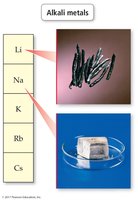
Alkali metals (Group 1A): Highly reactive.
Alkaline earth metals (Group 2A): Fairly reactive.
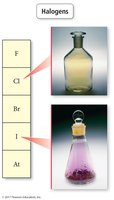
Halogens (Group 7A): Very reactive nonmetals.
Ions and the Periodic Table
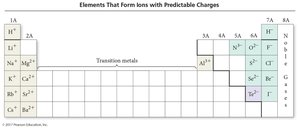
Main-group metals tend to lose electrons and form cations; main-group nonmetals tend to gain electrons and form anions. The charge of ions is predictable based on group number.
Atomic Mass and Counting Atoms
Atomic Mass
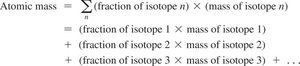
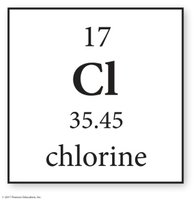
Atomic mass is the average mass of an element's isotopes, weighted by their natural abundance. It is listed beneath the element's symbol in the periodic table.
Mass Spectrometry
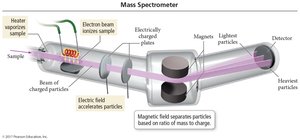
Mass spectrometry is used to measure the masses and abundances of isotopes, allowing precise determination of atomic mass.
The Mole and Avogadro's Number
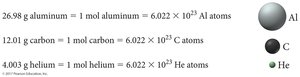
The mole (mol) is a unit representing 6.022 × 10²³ particles, known as Avogadro's number. It allows chemists to count atoms by weighing.
1 mol = 6.022 × 10²³ particles
The mass of 1 mol of atoms is the molar mass, numerically equal to the atomic mass in amu.
Converting Between Mass, Moles, and Number of Atoms
To determine the number of atoms in a sample:
Measure the mass of the sample.
Convert mass to moles using molar mass. Mass/moler mass = mole
Convert Moles to Mass : Mole x moler mass = Mass or grams
Convert moles to number of atoms(particles) using Avogadro's number. Moles x 6.022 x10^23

Example Calculation:
Atomic mass of chlorine: 35.45 amu
Atomic mass formula:
Additional info: These notes cover the foundational concepts of Chapter 2: Atoms and Elements, including atomic theory, structure, periodic table organization, isotopes, ions, and methods for counting atoms. All images included directly reinforce the explanations and are essential for visual understanding.
