 Back
BackAtoms and Elements: Foundations of Modern Atomic Theory
Study Guide - Smart Notes
 Tailored notes based on your materials, expanded with key definitions, examples, and context.
Atoms and Elements
Imaging and Moving Individual Atoms
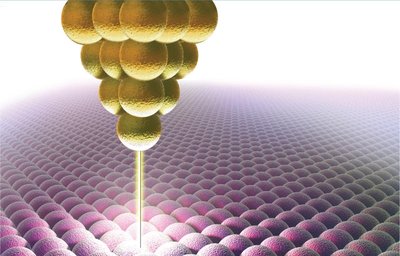
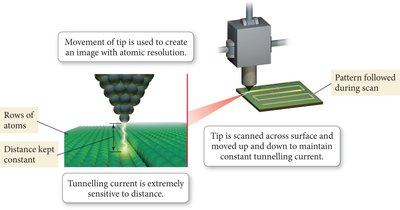
The ability to visualize and manipulate individual atoms is a significant achievement in modern chemistry. Scanning tunneling microscopy (STM) allows scientists to image surfaces at the atomic level and even move atoms to create specific patterns.
Scanning Tunneling Microscope (STM): An instrument that uses a sharp conducting tip brought very close to the surface to measure the tunneling current, which is extremely sensitive to the distance between the tip and the surface.
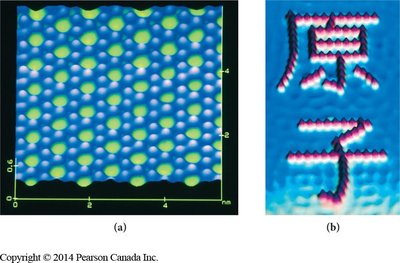
Atomic Resolution: STM can resolve individual atoms, allowing for direct observation and manipulation.
Applications: STM has been used to arrange atoms into specific patterns, such as writing characters with atoms.
Early Ideas about the Building Blocks of Matter
Historical Development of Atomic Theory
The concept of atoms has evolved over centuries, from philosophical ideas to scientific theories supported by experimental evidence.
Ancient Greece: Leucippus and Democritus proposed that matter is composed of indivisible particles called atomos.
Aristotle and Plato: Suggested that matter is made of four elements: earth, air, fire, and water.
Scientific Revolution (16th–17th Century): Advances by Copernicus, Galileo, Boyle, and Newton laid the groundwork for modern science.
John Dalton (19th Century): Formulated the first modern atomic theory based on experimental evidence.
Modern Atomic Theory and the Laws That Led to It
The Law of Conservation of Mass
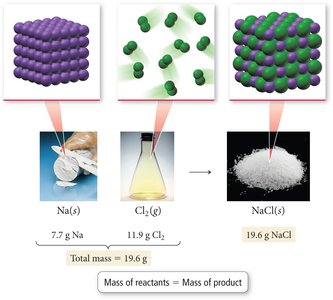
This law states that matter is neither created nor destroyed in a chemical reaction. The total mass of reactants equals the total mass of products.
Example: When sodium reacts with chlorine to form sodium chloride, the combined mass of sodium and chlorine equals the mass of sodium chloride produced.
The Law of Definite Proportions
All samples of a given compound have the same proportions of their constituent elements by mass, regardless of the sample's source or preparation method.
Example: Pure water always contains 88.8% oxygen and 11.2% hydrogen by mass.
The Law of Multiple Proportions
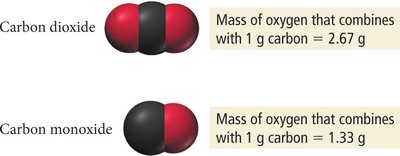
When two elements form more than one compound, the masses of one element that combine with a fixed mass of the other are in ratios of small whole numbers.
Example: Carbon monoxide (CO) and carbon dioxide (CO2) both contain carbon and oxygen, but the mass of oxygen per gram of carbon is in a simple ratio (2.67:1.33 = 2:1).
Dalton’s Atomic Theory
John Dalton proposed a theory to explain the laws of chemical combination:
Each element is composed of tiny, indestructible particles called atoms.
All atoms of a given element have the same mass and properties.
Atoms combine in simple, whole-number ratios to form compounds.
Atoms of one element cannot change into atoms of another element; they only rearrange in chemical reactions.
Atomic Structure
Discovery of the Electron
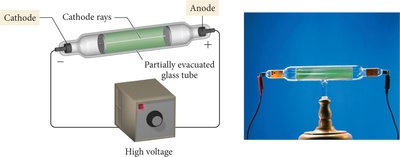
The electron was discovered through experiments with cathode ray tubes. J. J. Thomson showed that cathode rays are streams of negatively charged particles (electrons).
Cathode Ray Tube: A glass tube with electrodes at each end, partially evacuated of air. When voltage is applied, a beam (cathode ray) travels from the cathode to the anode.
Measurement of the Electron’s Charge-to-Mass Ratio
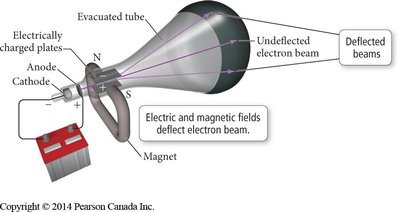
Thomson measured the charge-to-mass ratio of the electron () by observing the deflection of cathode rays in electric and magnetic fields.
Millikan’s Oil Drop Experiment
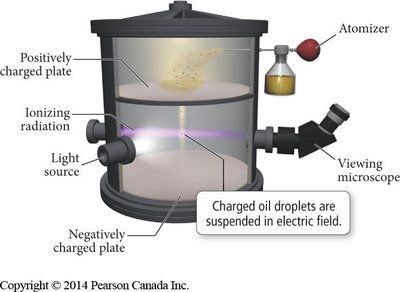
Robert Millikan measured the charge of the electron () by observing the behavior of charged oil droplets in an electric field.
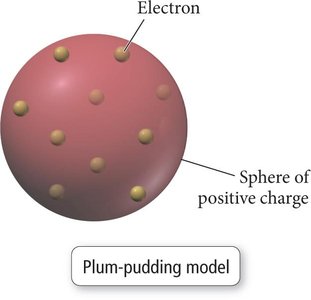
Plum-Pudding Model
Thomson proposed the "plum-pudding" model, where electrons are embedded in a sphere of positive charge.
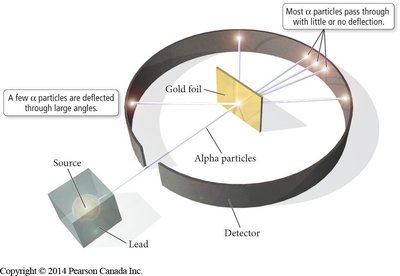
Discovery of the Nucleus: Rutherford’s Gold Foil Experiment
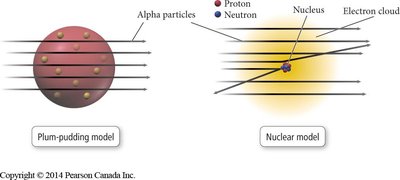
Ernest Rutherford’s gold foil experiment demonstrated that atoms have a small, dense, positively charged nucleus. Most alpha particles passed through the foil, but some were deflected at large angles, indicating a concentrated positive center.
Subatomic Particles
Atoms are composed of protons, neutrons, and electrons. Protons and neutrons are found in the nucleus, while electrons occupy the surrounding space.
Proton: Positively charged, mass ≈ 1 u
Neutron: No charge, mass ≈ 1 u
Electron: Negatively charged, mass ≈ 0.0005 u
Particle | Mass (kg) | Mass (u) | Charge (relative) | Charge (C) |
|---|---|---|---|---|
Proton | 1.67262 × 10⁻²⁷ | 1.00727 | +1 | +1.60218 × 10⁻¹⁹ |
Neutron | 1.67493 × 10⁻²⁷ | 1.00866 | 0 | 0 |
Electron | 9.10938 × 10⁻³¹ | 5.48580 × 10⁻⁴ | −1 | −1.60218 × 10⁻¹⁹ |
Atomic Number, Mass Number, and Isotopes
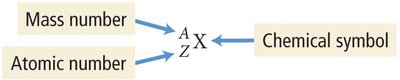
The atomic number (Z) is the number of protons in the nucleus and defines the element. The mass number (A) is the sum of protons and neutrons. Isotopes are atoms of the same element with different numbers of neutrons.
Notation: where X is the chemical symbol, A is the mass number, and Z is the atomic number.
Symbol | Number of Protons | Number of Neutrons | A (Mass Number) | Natural Abundance (%) |
|---|---|---|---|---|
Ne-20 or 20Ne | 10 | 10 | 20 | 90.48 |
Ne-21 or 21Ne | 10 | 11 | 21 | 0.27 |
Ne-22 or 22Ne | 10 | 12 | 22 | 9.25 |
Ions: Losing or Gaining Electrons
Atoms can gain or lose electrons to form ions. Cations are positively charged (loss of electrons), and anions are negatively charged (gain of electrons).
Example: Li → Li+ + e−; F + e− → F−
Atomic Mass: The Average Mass of an Element’s Atoms
Calculating Atomic Mass
The atomic mass of an element is the weighted average of the masses of its naturally occurring isotopes.
Formula: where is the fractional abundance and is the mass of isotope n.
Example (Chlorine):
Mass Spectrometry: Measuring Atomic and Molecular Masses
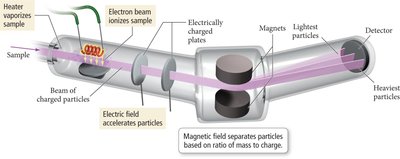
Mass spectrometry is a technique used to determine the masses and relative abundances of isotopes and molecules. It separates ions based on their mass-to-charge ratio (m/z).
The Mole: Counting Atoms by Weighing Them
Definition of the Mole and Avogadro’s Number
The mole is the SI unit for amount of substance. One mole contains exactly entities (Avogadro’s number).
1 mol C atoms = 6.022 × 10²³ C atoms = 12 g C
Converting Between Mass, Moles, and Number of Atoms
The molar mass (g/mol) of an element is numerically equal to its atomic mass in amu. Use the following relationships for conversions:
Number of moles =
Number of atoms = (number of moles) × (Avogadro’s number)
The Periodic Table of the Elements
Development and Structure of the Periodic Table
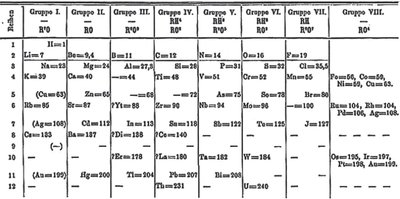
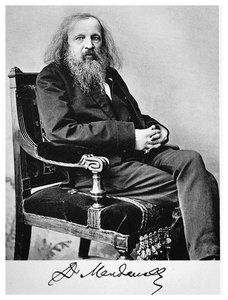
Dmitri Mendeleev organized the elements into a table based on increasing atomic mass and recurring chemical properties. The modern periodic table is arranged by increasing atomic number.
Classification of Elements
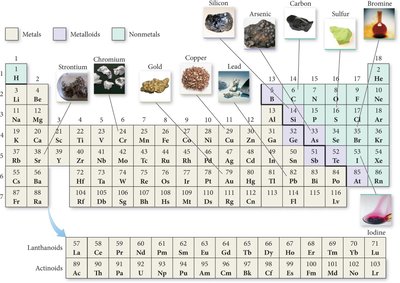
Elements are classified as metals, nonmetals, or metalloids based on their properties and position in the periodic table.
Metals: Good conductors, malleable, ductile, shiny, mostly solids.
Nonmetals: Poor conductors, can be gases, liquids, or brittle solids.
Metalloids: Properties intermediate between metals and nonmetals.
Main-Group, Transition, and Inner-Transition Elements
The periodic table is divided into main-group elements (groups 1, 2, and 13–18), transition metals (groups 3–12), and inner-transition elements (lanthanoids and actinoids).
Main-group elements: Exhibit a wide range of properties and include metals, nonmetals, and metalloids.
Transition metals: Typically form colored compounds and have variable oxidation states.
Inner-transition elements: Include the lanthanoids and actinoids, many of which are radioactive.
Ions and the Periodic Table
Elements in the same group often form ions with predictable charges. For example, alkali metals (group 1) form +1 cations, while halogens (group 17) form –1 anions.
Additional info: These notes provide a comprehensive overview of atomic theory, atomic structure, and the periodic table, suitable for general chemistry students preparing for exams.
