 Back
BackAtoms, Elements, and Chemical Bonding: Foundations of General Chemistry
Study Guide - Smart Notes
 Tailored notes based on your materials, expanded with key definitions, examples, and context.
Atoms: The Smallest Unit of Matter
Definition and Structure of Matter
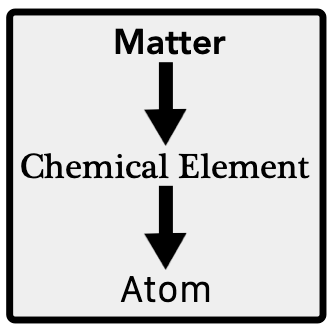
Matter is anything that takes up space and has mass, including all substances from living organisms to rocks and oceans. All matter is composed of chemical elements, which are pure substances made of only one type of atom. The atom is the smallest unit of an element and, therefore, the smallest unit of matter.
Matter: Anything with mass and volume.
Chemical Element: Pure substance consisting of one type of atom.
Atom: Smallest unit of an element, retaining its chemical properties.
Atomic Structure and Subatomic Particles
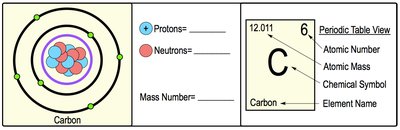
Atoms are composed of three main subatomic particles: protons, neutrons, and electrons. Each has a characteristic charge, mass, and location within the atom.
Proton: Positively charged particle found in the nucleus; mass = 1 atomic mass unit (AMU).
Neutron: Neutral particle (no charge) found in the nucleus; mass = 1 AMU.
Electron: Negatively charged particle found in electron shells/orbitals around the nucleus; mass ≈ 0 AMU.
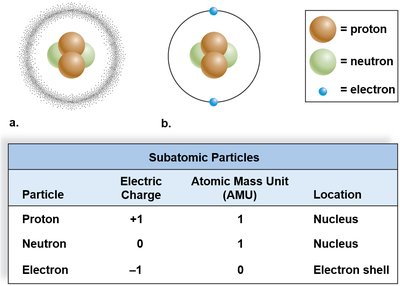
Subatomic Particle | Electric Charge | Atomic Mass Unit (AMU) | Location |
|---|---|---|---|
Proton | +1 | 1 | Nucleus |
Neutron | 0 | 1 | Nucleus |
Electron | –1 | 0 | Electron shell |
Atoms in Living and Nonliving Matter
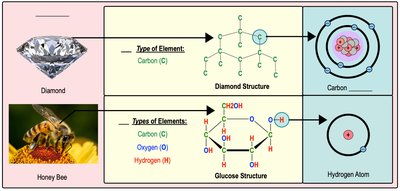
Atoms make up both living and nonliving matter. For example, a diamond (nonliving) is made entirely of carbon atoms, while glucose (a biological molecule) contains carbon, hydrogen, and oxygen atoms.
Elements of Life and the Periodic Table
Major and Trace Elements
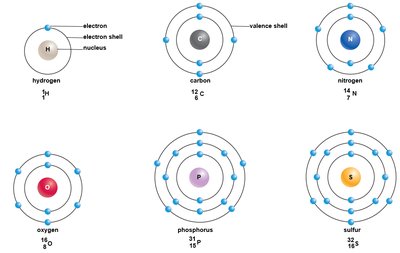
Of all known elements, only a small subset is found in living organisms. The periodic table arranges all known elements based on their chemical properties. Approximately 97% of the mass of most living organisms is composed of six elements: Carbon, Hydrogen, Nitrogen, Oxygen, Phosphorus, and Sulfur (CHNOPS). Trace elements are required in small amounts for life.
Atomic Properties
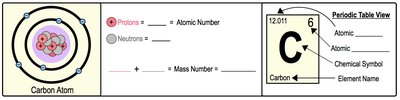
Each atom of an element has unique properties:
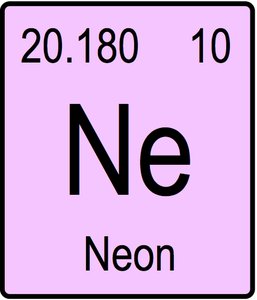
Atomic Number: Number of protons in the nucleus; defines the element.
Mass Number: Total number of protons and neutrons in the nucleus.
Atomic Mass: Weighted average mass of all isotopes of an element.
Electron Orbitals and Energy Shells
Electron Orbitals and Shells
Electrons occupy three-dimensional regions called orbitals, which are grouped into energy shells around the nucleus. Shells closer to the nucleus are lower in energy, while those farther away are higher in energy. The first shell holds up to 2 electrons, the second up to 8, and so on. Valence electrons are those in the outermost shell and are crucial for chemical bonding.
The Octet Rule
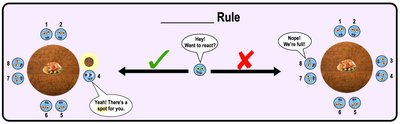
The octet rule states that atoms are more stable (less reactive) when their valence shells are fully occupied, typically with 8 electrons (except for the first shell, which is full with 2 electrons). Atoms with incomplete valence shells are more reactive.
Isotopes
Definition and Properties of Isotopes
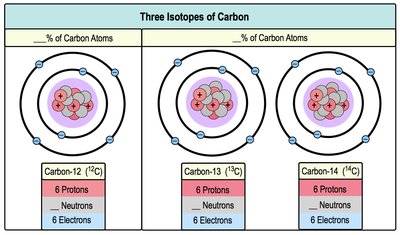
Isotopes are atoms of the same element that have the same number of protons but different numbers of neutrons, resulting in different mass numbers. The atomic mass of an element is the average mass of all its isotopes, weighted by their natural abundance.
Isotope | Protons | Neutrons | Electrons |
|---|---|---|---|
Carbon-12 | 6 | 6 | 6 |
Carbon-13 | 6 | 7 | 6 |
Carbon-14 | 6 | 8 | 6 |
Radioactive Isotopes
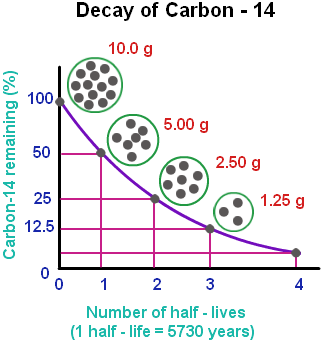
Radioactive isotopes are unstable and spontaneously break down, emitting energy in the form of rays or particles. The half-life is the time it takes for half of the radioactive atoms in a sample to decay. Radioactive isotopes are used in medicine (e.g., cancer treatment, imaging) and in radiometric dating of fossils.
Introduction to Chemical Bonding
Chemical Bonds: Types and Importance
Chemical bonds are attractive forces that hold atoms together to form molecules and compounds. A molecule contains two or more chemically bound atoms, while a compound contains two or more different elements. The chemical formula shows the types and numbers of atoms in a molecule (e.g., C6H12O6).
Intramolecular vs. Intermolecular Bonds
Bonds can be classified as intramolecular (within a molecule) or intermolecular (between molecules):
Intramolecular Bonds: Hold atoms together within a molecule (e.g., covalent bonds in H2O).
Intermolecular Bonds: Occur between different molecules (e.g., hydrogen bonds between water molecules).
Covalent Bonds
Definition and Types
Covalent bonds involve the sharing of electrons between two atoms. There are two main types:
Nonpolar Covalent Bonds: Equal sharing of electrons (atoms have similar electronegativities).
Polar Covalent Bonds: Unequal sharing of electrons (atoms have different electronegativities), resulting in partial charges (δ+ and δ–).
Electronegativity is a measure of an atom’s attraction for electrons in a bond (scale: 0–4).
Noncovalent Bonds
Types of Noncovalent Bonds
Noncovalent bonds are interactions between atoms resulting from full or partial charges, without sharing electrons. Types include:
Ionic Bonds: Attraction between oppositely charged ions.
Hydrogen Bonds: Attraction between a hydrogen atom (bonded to F, O, or N) and another electronegative atom.
Van der Waals Forces: Weak attractions due to temporary dipoles.
Ionic Bonding
Ions: Anions vs. Cations
Ions are atoms or molecules with a net electrical charge due to the gain or loss of electrons:
Anion: Negatively charged ion (gains electrons).
Cation: Positively charged ion (loses electrons).
Ionic Bonds
Ionic bonds are electrical attractions between oppositely charged ions. The transfer of electrons allows both atoms to achieve full valence shells, resulting in stable ions.
Hydrogen Bonding
Definition and Importance
A hydrogen bond is an interaction between a highly electronegative atom (F, O, or N) and a hydrogen atom covalently bonded to another electronegative atom. Individually, hydrogen bonds are weak, but collectively, they can be strong and are crucial for the properties of water and the structure of biological macromolecules.
Key Equations and Concepts
Atomic Number (Z):
Mass Number (A):
Average Atomic Mass:
Octet Rule: Atoms are most stable when their valence shell is full (usually 8 electrons).
Half-life:
