 Back
BackAtoms, Elements, and Compounds: Foundations of Modern Chemistry
Study Guide - Smart Notes
 Tailored notes based on your materials, expanded with key definitions, examples, and context.
Atoms, Elements, and Compounds
Introduction
This chapter introduces the fundamental concepts of atoms, elements, and compounds, which are the building blocks of matter. Understanding these concepts is essential for mastering general chemistry, as they form the basis for chemical reactions, the periodic table, and the calculation of chemical quantities.
Classifying Matter: Mixtures, Compounds, and Elements
Matter can be classified based on its composition and properties. The three main categories are mixtures, compounds, and elements.
Element: A pure substance consisting of only one type of atom. Examples include hydrogen (H), oxygen (O), and gold (Au).
Compound: A substance formed when two or more elements are chemically bonded in a fixed ratio. Water (H2O) and sodium chloride (NaCl) are examples.
Mixture: A physical combination of two or more substances where each retains its own properties. Mixtures can be homogeneous (solutions) or heterogeneous.
Atoms and Atomic Structure
Atoms are the smallest units of elements that retain the chemical properties of the element. Each atom consists of a nucleus (containing protons and neutrons) and electrons arranged in shells around the nucleus.
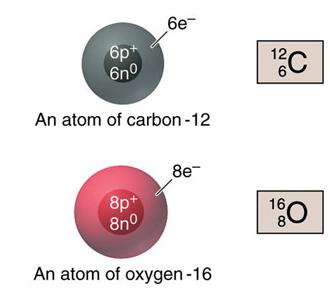
Proton (p+): Positively charged particle in the nucleus; defines the atomic number.
Neutron (n0): Neutral particle in the nucleus; contributes to atomic mass.
Electron (e-): Negatively charged particle in shells around the nucleus.
Subatomic Particles and Their Properties
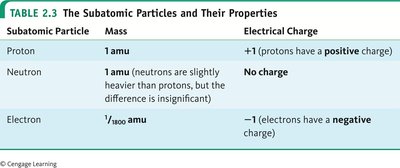
Subatomic Particle | Mass | Electrical Charge |
|---|---|---|
Proton | 1 amu | +1 |
Neutron | 1 amu | 0 |
Electron | 1/1800 amu | -1 |
Electron Shells and Valence Electrons
Electrons are arranged in shells (energy levels) around the nucleus. The arrangement of electrons determines the chemical properties of an element, especially the number of electrons in the outermost shell (valence electrons).
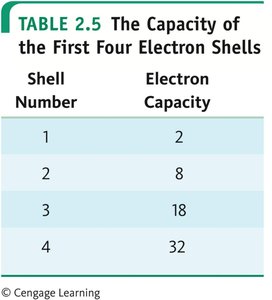
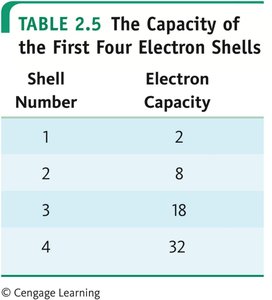
Each shell has a maximum capacity, given by where n is the shell number.
Valence electrons are responsible for chemical bonding and reactivity.
Electron Configuration
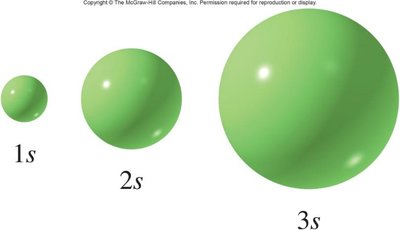
Electron configuration describes the distribution of electrons among the shells and subshells of an atom. Electrons fill the lowest energy levels first (Aufbau principle).
Shell 1: up to 2 electrons
Shell 2: up to 8 electrons
Shell 3: up to 18 electrons
Shell 4: up to 32 electrons
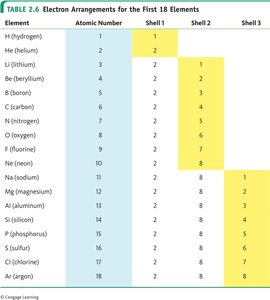
Electron Arrangements for the First 18 Elements
Element | Atomic Number | Shell 1 | Shell 2 | Shell 3 |
|---|---|---|---|---|
H | 1 | 1 | ||
He | 2 | 2 | ||
Li | 3 | 2 | 1 | |
Be | 4 | 2 | 2 | |
B | 5 | 2 | 3 | |
C | 6 | 2 | 4 | |
N | 7 | 2 | 5 | |
O | 8 | 2 | 6 | |
F | 9 | 2 | 7 | |
Ne | 10 | 2 | 8 | |
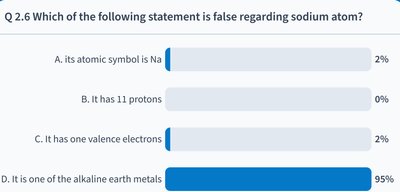
Na | 11 | 2 | 8 | 1 |
Mg | 12 | 2 | 8 | 2 |
Al | 13 | 2 | 8 | 3 |
Si | 14 | 2 | 8 | 4 |
P | 15 | 2 | 8 | 5 |
S | 16 | 2 | 8 | 6 |
Cl | 17 | 2 | 8 | 7 |
Ar | 18 | 2 | 8 | 8 |
Octet Rule and Lewis Structures
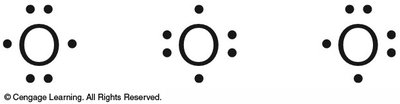
The octet rule states that atoms tend to form compounds in ways that give them eight electrons in their valence shell, achieving a noble gas configuration. Lewis structures (dot structures) visually represent valence electrons around atomic symbols.
Noble gases (Group 8A) have full valence shells and are chemically stable.
Other elements form bonds to achieve a full valence shell (usually 8 electrons, or 2 for H and He).

The Periodic Table and Periodic Properties
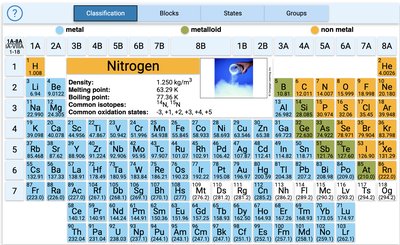
The periodic table organizes elements by increasing atomic number and similar chemical properties. Elements in the same group (vertical column) have the same number of valence electrons and similar chemical behavior.
Periods: Horizontal rows; indicate principal energy levels (shells).
Groups: Vertical columns; elements in the same group have similar valence electron configurations.
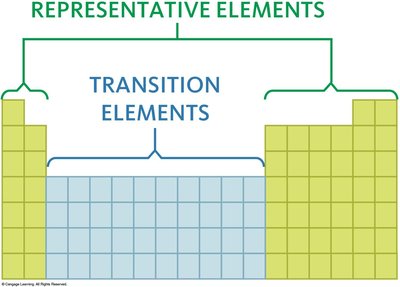
Representative elements: Groups 1A-8A (main group elements).
Transition elements: Groups 1B-8B (transition metals).
Metalloids: Elements with properties intermediate between metals and nonmetals.
Classes of Elements
Metals | Metalloids | Nonmetals |
|---|---|---|
Most are solids at room temperature (except Hg) | All are solids at room temperature | Many are gases, some solids, one liquid (Br) |
Gray or silvery, shiny | Gray, shiny | Variety of colors, not shiny |
Conduct electricity well | Poor conductors | Poor conductors (except graphite) |
Can be bent and shaped | Brittle, break instead of bending | Brittle, break instead of bending |
Isotopes and Atomic Mass
Isotopes are atoms of the same element with different numbers of neutrons, resulting in different mass numbers. The atomic mass listed in the periodic table is a weighted average of all naturally occurring isotopes.
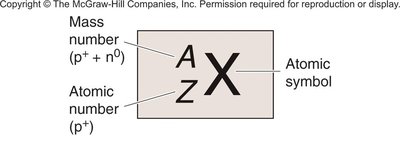
Atomic number (Z): Number of protons in the nucleus.
Mass number (A): Total number of protons and neutrons.
Isotopic notation: where X is the element symbol.
Atomic mass unit (amu): 1 amu = g.
Average atomic mass: (where is the mass of each isotope and is its fractional abundance).
The Mole and Avogadro's Number
The mole (mol) is the SI unit for the amount of substance. One mole contains entities (Avogadro's number), which can be atoms, molecules, ions, or other particles.
1 mole of 12C atoms = 12 g = atoms
Molar mass (g/mol) is numerically equal to atomic or molecular mass (amu).
Key equations:
Mass (g) = n (mol) MM (g/mol)
Number of entities = n (mol) entities/mol
n (mol) = Mass (g) / MM (g/mol)
Compounds, Chemical Formulas, and Moles
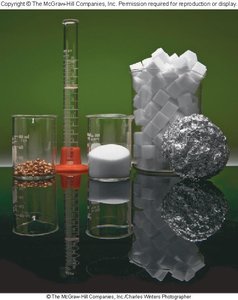
Chemical formulas represent the types and numbers of atoms in a compound. The formula provides information about the ratio of elements, the number of atoms, and the mass relationships in a compound.
Subscripts indicate the number of each type of atom in a molecule (e.g., H2O has 2 H and 1 O).
Molecular mass is the sum of atomic masses of all atoms in a molecule.
Molar mass is the mass of one mole of a substance (g/mol).
Information Contained in a Chemical Formula: Example of Glucose (C6H12O6)
Element | Atoms/molecule | Moles of atoms/mole | Atoms/mole | Mass/molecule (amu) | Mass/mole (g) |
|---|---|---|---|---|---|
C | 6 | 6 | 6(6.022x10²³) | 72.06 | 72.06 |
H | 12 | 12 | 12(6.022x10²³) | 12.10 | 12.10 |
O | 6 | 6 | 6(6.022x10²³) | 96.00 | 96.00 |
Converting Between Amount, Mass, and Number of Entities
To solve problems involving moles, mass, and number of particles, use the following relationships:
Mass (g) = n (mol) MM (g/mol)
Number of entities = n (mol)
n (mol) = Mass (g) / MM (g/mol)
Example: How many grams of Ag are in 0.0342 mol of Ag?
Solution: Mass = 0.0342 mol 107.87 g/mol = 3.69 g
Example: How many molecules are in 8.92 g of nitrogen dioxide (NO2)?
Solution:
Find moles: n = 8.92 g / 46.01 g/mol = 0.194 mol
Number of molecules = 0.194 mol = molecules
Summary Table: Mass-Mole-Number Relationships
Given | To Find | Conversion Factor |
|---|---|---|
Mass (g) | Moles (mol) | Divide by molar mass (g/mol) |
Moles (mol) | Number of entities | Multiply by Avogadro's number |
Number of entities | Moles (mol) | Divide by Avogadro's number |
Moles (mol) | Mass (g) | Multiply by molar mass (g/mol) |
