 Back
BackAtoms, Molecules, and Ions: Foundations of General Chemistry
Study Guide - Smart Notes
 Tailored notes based on your materials, expanded with key definitions, examples, and context.
Atoms, Molecules, and Ions
Concept of the Atom
The atom is the smallest unit of an element that retains its chemical properties. Atoms are composed of three main subatomic particles:
Protons: Positively charged particles found in the nucleus.
Neutrons: Neutral particles (no charge) also located in the nucleus.
Electrons: Negatively charged particles that orbit the nucleus in electron clouds.
Example: Protons and electrons have charges of the same magnitude but opposite signs.
The Nucleus
The nucleus is the dense center of the atom, containing protons and neutrons. Two major forces act within the nucleus:
Nuclear Force: Attractive force that holds protons and neutrons together.
Electrostatic Force: Repulsive force between like-charged protons.
For a stable nucleus, the nuclear force must be greater than the electrostatic force.
Subatomic Particles: Mass and Charge
Subatomic particles differ in mass and charge. The atomic mass unit (amu) is used to express these masses:
1 amu = one-twelfth the mass of a carbon-12 atom.
1 amu = 1 Dalton (Da).
1 amu = 1.66054 x 10⁻²⁷ kg.
Subatomic Particle | Actual Mass (kg) | Relative Mass (amu) | Relative Charge | Charge (Coulombs) |
|---|---|---|---|---|
Neutron | 1.67493 x 10⁻²⁷ | 1 | 0 | 0 |
Proton | 1.67262 x 10⁻²⁷ | 1 | +1 | +1.60218 x 10⁻¹⁹ |
Electron | 9.10938 x 10⁻³¹ | ~0 | -1 | -1.60218 x 10⁻¹⁹ |
Atomic Structure and Experiments
Rutherford Gold Foil Experiment
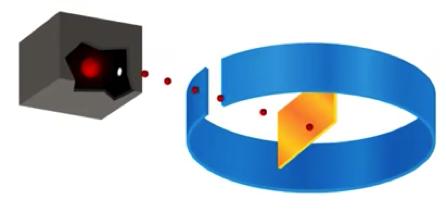
Rutherford's experiment involved bombarding a thin gold foil with alpha particles. Most particles passed through, but some were deflected, leading to the discovery of the nucleus as a small, dense, positively charged center.
Disproved Thomson's Plum Pudding Model.
Showed that most of the atom is empty space.
Millikan Oil Drop Experiment
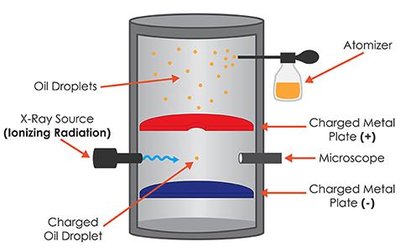
Millikan measured the charge of the electron by observing the behavior of oil droplets in an electric field. This experiment determined the fundamental charge of the electron as -1.60 x 10⁻¹⁹ C.
Isotopes and Ions
Isotopes
Isotopes are atoms of the same element with the same number of protons but different numbers of neutrons.
Atomic Number (Z): Number of protons; defines the element.
Mass Number (A): Number of protons + neutrons.
Isotope Notation: AZX (e.g., 43Ca)
Number of neutrons = Mass number (A) – Atomic number (Z)
Ions
Ions are formed when atoms gain or lose electrons:
Cation: Positively charged ion (loss of electrons).
Anion: Negatively charged ion (gain of electrons).
Isoelectronic: Species with the same number of electrons.
Atomic Mass and the Mole Concept
Atomic Mass
The atomic mass of an element is the weighted average of the masses of its isotopes, measured in amu, Da, or kg.
Atomic mass can be calculated using isotopic masses and percent abundances:
The Mole
The mole is a counting unit in chemistry, defined as the amount of substance containing as many entities as there are atoms in 12.00 g of carbon-12.
Avogadro's Number: particles per mole.
Relates mass, number of particles, and moles.
Molar Mass
Molar mass is the mass of one mole of a substance, expressed in g/mol.
The Periodic Table
Classifications
The periodic table organizes elements by increasing atomic number and recurring chemical properties. Elements are classified as:
Metals: Good conductors, malleable, ductile, lustrous.
Non-metals: Poor conductors, brittle, dull.
Metalloids: Properties intermediate between metals and non-metals.
Groups and Periods
Groups: Vertical columns; elements in the same group have similar chemical properties.
Periods: Horizontal rows.
Representative Elements: Groups 1, 2, and 13–18.
Transition Metals: Groups 3–12.
Elemental Forms and Phases
Monoatomic: Exist as single atoms (e.g., noble gases).
Diatomic: Exist as pairs (e.g., H2, O2).
Polyatomic: Exist as groups of more than two atoms (e.g., S8).
Phases at Room Temperature
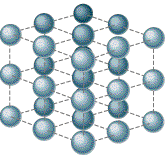
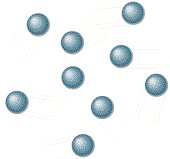
Solids: Fixed shape and volume.
Liquids: Fixed volume, shape of container.
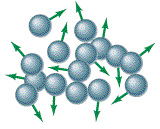
Gases: Shape and volume of container.
Chemical Bonds
Ionic Bonding
Ionic bonds form between metals (which lose electrons to become cations) and non-metals (which gain electrons to become anions). The bond is due to the electrostatic attraction between oppositely charged ions.
Covalent Bonding
Covalent bonds involve the sharing of valence electrons between non-metal atoms.
Metallic Bonding
Metallic bonds are the attraction between free-flowing valence electrons and positively charged metal ions, giving rise to properties like conductivity and malleability.
Polyatomic Ions and Nomenclature
Polyatomic Ions
Polyatomic ions are groups of covalently bonded atoms with an overall charge. Common examples include sulfate (SO42–), nitrate (NO3–), and ammonium (NH4+).
Naming Ionic Compounds
Cation (metal or polyatomic cation) is named first, followed by the anion (nonmetal or polyatomic anion).
For metals with variable charges, use Roman numerals to indicate the charge.
For nonmetals, change the ending to “-ide.”
Naming Acids
Binary acids: "Hydro-" prefix + base name of nonmetal + "-ic acid" (e.g., HCl = hydrochloric acid).
Oxyacids: If the polyatomic ion ends in "-ate," change to "-ic acid"; if "-ite," change to "-ous acid."
Naming Molecular Compounds
Use numerical prefixes to indicate the number of each atom (e.g., CO2 = carbon dioxide).
The first element keeps its name; the second element ends in “-ide.”
Atomic Theory and Laws
Dalton’s Atomic Theory
All matter is made of atoms.
Atoms of the same element are identical in mass and properties.
Atoms cannot be created or destroyed in chemical reactions.
Atoms combine in simple, whole-number ratios to form compounds.
Chemical reactions rearrange atoms.
Law of Conservation of Mass
In a chemical reaction, matter is neither created nor destroyed; the total mass of reactants equals the total mass of products.
Law of Definite Proportions
A chemical compound always contains the same proportion of elements by mass.
Law of Multiple Proportions
When two elements form more than one compound, the masses of one element that combine with a fixed mass of the other are in ratios of small whole numbers.
Summary Table: Key Laws and Concepts
Law/Concept | Description | Example |
|---|---|---|
Law of Conservation of Mass | Mass is conserved in chemical reactions | 2H2 + O2 → 2H2O |
Law of Definite Proportions | Compounds have constant composition by mass | CO2 always has 12 g C per 32 g O |
Law of Multiple Proportions | Elements combine in small whole-number ratios | CO and CO2: 1.33 g O/1 g C and 2.66 g O/1 g C |
