 Back
BackAtoms, Molecules, and Ions: Structured Study Notes for General Chemistry
Study Guide - Smart Notes
 Tailored notes based on your materials, expanded with key definitions, examples, and context.
Atomic Theory of Matter
Laws Governing Atomic Theory
The foundation of modern atomic theory is based on several key laws that describe the behavior and composition of matter:
Law of Constant Composition: Compounds have a definite composition, meaning the relative number of atoms of each element in a compound is the same in any sample.
Law of Conservation of Mass: The total mass of substances present at the end of a chemical process is the same as the mass of substances present before the process took place.
Law of Multiple Proportions: If two elements form more than one compound, the masses of one element that combine with a given mass of the other are in the ratio of small whole numbers. For example, carbon monoxide (CO) and carbon dioxide (CO2) are distinct compounds with different ratios of carbon to oxygen.
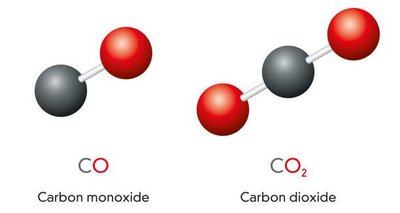
Example: CO and CO2 illustrate the law of multiple proportions, as they have different ratios of carbon to oxygen atoms.
The Modern View of Atomic Structure
Subatomic Particles
Atoms are composed of three fundamental subatomic particles:
Proton: Positively charged particle found in the nucleus.
Neutron: Neutral particle found in the nucleus.
Electron: Negatively charged particle found outside the nucleus.
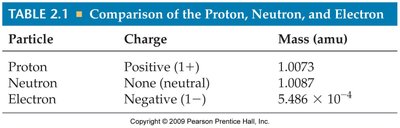
Table Purpose: Comparison of charge and mass for protons, neutrons, and electrons.
Particle | Charge | Mass (amu) |
|---|---|---|
Proton | Positive (1+) | 1.0073 |
Neutron | None (neutral) | 1.0087 |
Electron | Negative (1−) | 5.486 × 10⁻⁴ |
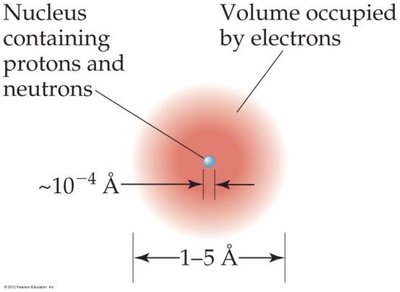
Additional info: The nucleus is extremely small compared to the overall size of the atom, which is mostly empty space occupied by electrons.
Atomic Number and Mass Number
The identity of an element is determined by its atomic number (Z), which is the number of protons in the nucleus. The mass number (A) is the sum of protons and neutrons.
Atomic Number (Z): Number of protons.
Mass Number (A): Number of protons plus neutrons.
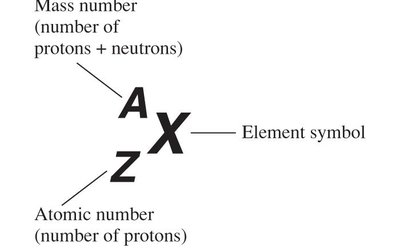
Example: For carbon-12, Z = 6, A = 12.
Isotopes
Isotopes are atoms of the same element with different numbers of neutrons, resulting in different mass numbers.
Example: Hydrogen has three isotopes: protium, deuterium, and tritium.
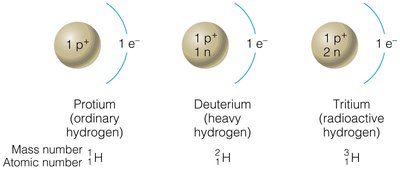
Additional info: Isotopes are important in nuclear medicine and scientific research.
Atomic Weights and Isotopic Abundance
Average Atomic Mass
Most elements occur as mixtures of isotopes. The average atomic mass (atomic weight) is calculated by weighting the mass of each isotope by its relative abundance:
Formula:
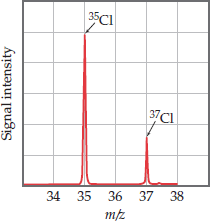
Example: Chlorine has two main isotopes, 35Cl and 37Cl, with atomic weight calculated from their abundances.
The Periodic Table
Structure and Classification
The periodic table is a systematic catalog of elements arranged by atomic number. Rows are called periods, and columns are called groups. Elements are classified as metals, nonmetals, or metalloids.
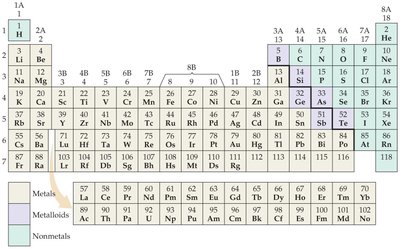
Additional info: Elements in the same group have similar chemical properties.
Names of Groups in the Periodic Table
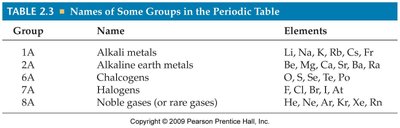
Some groups have specific names:
Group | Name | Elements |
|---|---|---|
1A | Alkali metals | Li, Na, K, Rb, Cs, Fr |
2A | Alkaline earth metals | Be, Mg, Ca, Sr, Ba, Ra |
6A | Chalcogens | O, S, Se, Te, Po |
7A | Halogens | F, Cl, Br, I, At |
8A | Noble gases | He, Ne, Ar, Kr, Xe, Rn |
Molecules and Molecular Compounds
Chemical Formulas
Chemical formulas indicate the number of atoms of each element in a compound. Molecular compounds are composed of molecules and typically contain only nonmetals.
Example: H2O (water), NH3 (ammonia), CH4 (methane).
Empirical and Molecular Formulas
Empirical formulas show the lowest whole-number ratio of atoms, while molecular formulas show the exact number of atoms.
Example: Hydrogen peroxide: Empirical formula HO, Molecular formula H2O2.
Structural Formulas
Structural formulas show the order in which atoms are attached, but not the three-dimensional shape. Ball-and-stick and space-filling models depict the 3D arrangement.
Ions and Ionic Compounds
Formation of Ions
Atoms become ions by gaining or losing electrons. Cations are positive (formed by metals), and anions are negative (formed by nonmetals).
Ionic Compounds
Ionic compounds are formed between metals and nonmetals, with electrons transferred from the metal to the nonmetal. The resulting oppositely charged ions attract each other.
Example: NaCl (sodium chloride)
Writing Formulas for Ionic Compounds
The formula unit for an ionic compound must result in a zero net charge. Subscripts are used to balance the charges.
Formula:
Naming Compounds
Naming Ionic Compounds
The cation is named first, followed by the anion. If the cation can have more than one charge, a Roman numeral is used. Anions formed from elements end in -ide; polyatomic ions retain their names.
Naming Molecular Compounds
Prefixes are used to denote the number of atoms of each element (except if the first element has a subscript of one).
mono-, di-, tri-, tetra-, penta-, hexa-, etc.
Naming Acids
If the anion ends in -ide, change the ending to -ic acid and add hydro- as a prefix. If the anion ends in -ite, change the ending to -ous acid. If the anion ends in -ate, change the ending to -ic acid.
Practice and Applications
Example: Combustion Reaction
The combustion of methane is a classic example of a chemical reaction:
Equation:
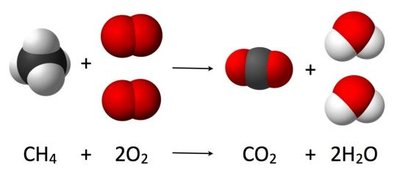
Additional info: This reaction demonstrates the law of conservation of mass and the use of chemical formulas.
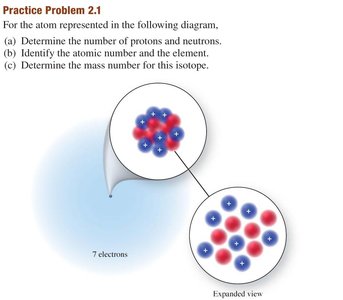
Practice Problem: Isotope Identification
Given an atom diagram, determine the number of protons, neutrons, and electrons, identify the element, and calculate the mass number.
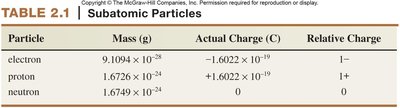
Summary Table: Subatomic Particles
Particle | Mass (g) | Actual Charge (C) | Relative Charge |
|---|---|---|---|
Electron | 9.1094 × 10⁻²⁸ | −1.6022 × 10⁻¹⁹ | 1− |
Proton | 1.6726 × 10⁻²⁴ | +1.6022 × 10⁻¹⁹ | 1+ |
Neutron | 1.6749 × 10⁻²⁴ | 0 | 0 |
Conclusion
This study guide covers the essential concepts of atomic theory, atomic structure, isotopes, the periodic table, chemical formulas, and nomenclature. Understanding these foundational topics is critical for success in general chemistry.
