 Back
Chapter 2: Atoms, Molecules, and Ions: Structured Study Notes
Study Guide - Smart Notes
 Tailored notes based on your materials, expanded with key definitions, examples, and context.
Atomic Theory of Matter
Historical Development of Atomic Theory
The concept of the atom originated with ancient Greek philosophers, such as Democritus, who proposed that matter is composed of indivisible particles called "atomos." Modern atomic theory was developed in the early 1800s by John Dalton, based on several fundamental laws:
Law of Constant Composition: Compounds have a definite composition; the relative number of atoms of each element in a compound is consistent in any sample.
Law of Conservation of Mass: The total mass of substances remains unchanged during a chemical process.
Law of Multiple Proportions: When two elements form more than one compound, the masses of one element that combine with a fixed mass of the other are in ratios of small whole numbers.
Dalton's Atomic Theory
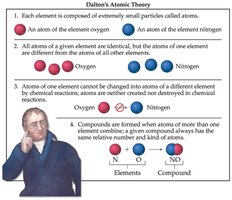
Dalton's atomic theory consists of four main postulates:
Each element is composed of extremely small particles called atoms.
All atoms of a given element are identical in mass and properties, but differ from atoms of other elements.
Atoms are not created or destroyed in chemical reactions; they are rearranged.
Atoms of different elements combine in simple ratios to form compounds.
Discovery of Subatomic Particles
The Electron and Cathode Rays
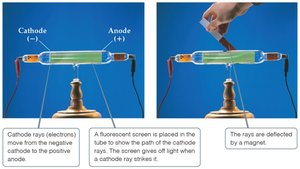
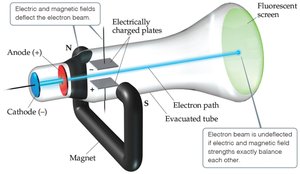
Experiments with cathode rays revealed the existence of electrons, negatively charged particles within the atom. J. J. Thomson measured the charge-to-mass ratio of the electron in 1897.
Millikan Oil-Drop Experiment
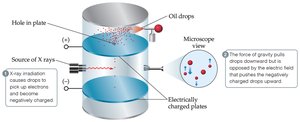
Robert Millikan determined the charge of the electron in 1909 using the oil-drop experiment, which allowed calculation of the electron's mass.
Radioactivity
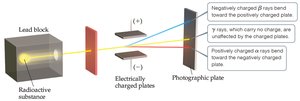
Radioactivity is the spontaneous emission of high-energy radiation by atoms, first observed by Henri Becquerel and studied by Marie and Pierre Curie. Ernest Rutherford identified three types of radiation:
Alpha (α) particles: Positively charged
Beta (β) particles: Negatively charged
Gamma (γ) rays: Uncharged
Structure of the Atom
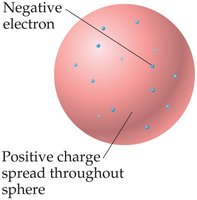
Plum Pudding Model
J. J. Thomson proposed the "plum pudding" model, where electrons are embedded in a sphere of positive charge.
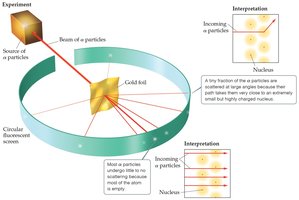
Rutherford's Nuclear Model
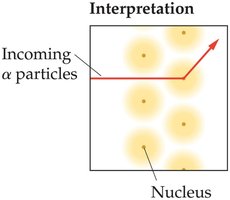
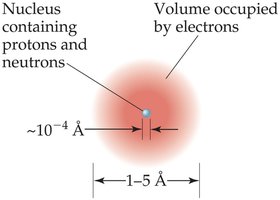
Ernest Rutherford's gold foil experiment demonstrated that atoms have a small, dense, positively charged nucleus, with electrons surrounding it. Most of the atom is empty space.
Subatomic Particles
Atoms consist of three main subatomic particles:
Protons: Positive charge (+1), mass ≈ 1 amu
Neutrons: No charge, mass ≈ 1 amu
Electrons: Negative charge (−1), mass ≈ 0 amu
Protons and neutrons are located in the nucleus; electrons move around the nucleus.
Atomic Number, Mass Number, and Isotopes
Atomic Number and Mass Number
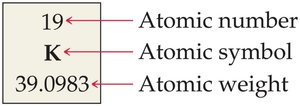
The atomic number (Z) is the number of protons in the nucleus and defines the element. The mass number (A) is the sum of protons and neutrons.
Isotopes
Isotopes are atoms of the same element with different numbers of neutrons, resulting in different mass numbers. Most elements have several naturally occurring isotopes.
Atomic Mass Unit (amu) and Atomic Weight
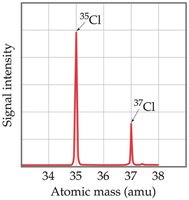
The atomic mass unit (amu) is used to express atomic and molecular masses. Atomic weight is the weighted average mass of an element's isotopes, based on their natural abundances.
Mass Spectrometry
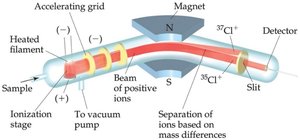
Mass spectrometry is used to measure atomic and molecular weights and determine isotope abundances.
The Periodic Table
Organization and Structure
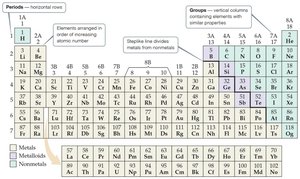
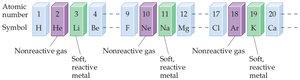
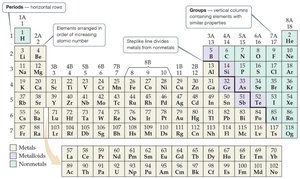
The periodic table arranges elements by increasing atomic number. Rows are called periods, and columns are called groups. Elements in the same group have similar chemical properties.
Periodicity
Elements exhibit periodicity, a repeating pattern of chemical properties and reactivity.
Classification of Elements
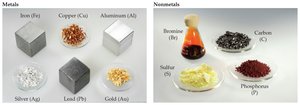
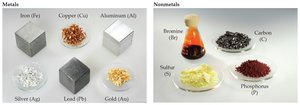
Metals: Left side of the table; shiny, conduct heat/electricity, mostly solids.
Nonmetals: Right side; can be solid, liquid, or gas.
Metalloids: Border between metals and nonmetals; properties intermediate between both.
Chemical Formulas and Molecular Models
Types of Chemical Formulas
Empirical formula: Lowest whole-number ratio of atoms.
Molecular formula: Exact number of atoms in a molecule.
Structural formula: Shows atom connectivity.

Diatomic Molecules
Seven elements naturally occur as diatomic molecules: H2, N2, O2, F2, Cl2, Br2, I2.
Ions and Ionic Compounds
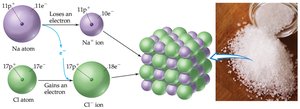
Formation of Ions
Atoms gain or lose electrons to form ions:
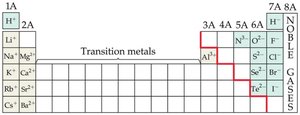
Cations: Positive ions formed by loss of electrons (usually metals).
Anions: Negative ions formed by gain of electrons (usually nonmetals).
Common Cations and Anions
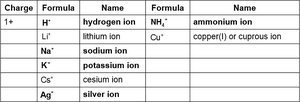
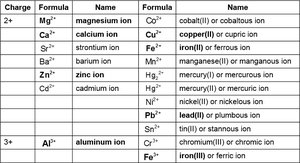
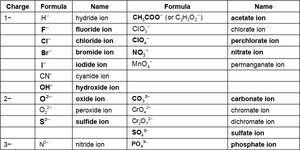
Tables of common cations and anions are essential for understanding ionic compounds.
Charge | Formula | Name |
|---|---|---|
1+ | H+ | hydrogen ion |
1+ | Li+ | lithium ion |
1+ | Na+ | sodium ion |
1+ | K+ | potassium ion |
1+ | NH4+ | ammonium ion |
2+ | Mg2+ | magnesium ion |
2+ | Ca2+ | calcium ion |
2+ | Fe2+ | iron(II) ion |
3+ | Al3+ | aluminum ion |
Charge | Formula | Name |
|---|---|---|
1− | F− | fluoride ion |
1− | Cl− | chloride ion |
1− | Br− | bromide ion |
1− | I− | iodide ion |
2− | O2− | oxide ion |
2− | S2− | sulfide ion |
3− | N3− | nitride ion |
Polyatomic Ions
Polyatomic ions are groups of atoms that carry a charge, such as NH4+ (ammonium) and SO42− (sulfate).
Ionic Compounds
Ionic compounds are formed from the electrostatic attraction between cations and anions, typically between metals and nonmetals. Their formulas are written as empirical formulas.
Writing Formulas for Ionic Compounds
To write the formula for an ionic compound:
The charge on the cation becomes the subscript for the anion.
The charge on the anion becomes the subscript for the cation.
Reduce subscripts to the lowest whole-number ratio.

Chemical Nomenclature
Inorganic Nomenclature
Rules for naming inorganic compounds:
Name the cation first; if it can have multiple charges, indicate the charge with Roman numerals.
If the anion is an element, change its ending to -ide; if it is polyatomic, use its name.
Oxyanion Nomenclature
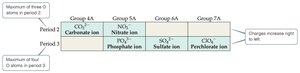
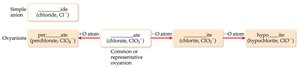
Oxyanions are named based on the number of oxygen atoms:
Fewer oxygens: -ite
More oxygens: -ate
Fewest oxygens: hypo-...-ite
Most oxygens: per-...-ate
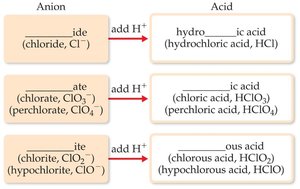
Acid Nomenclature
Acids are named based on their anions:
Anion ends in -ide: hydro-...ic acid
Anion ends in -ite: ...ous acid
Anion ends in -ate: ...ic acid
Nomenclature of Binary Molecular Compounds
Binary molecular compounds are named by:
Writing the element farther left or lower in the periodic table first.
Using prefixes to denote the number of atoms (mono-, di-, tri-, etc.).
Changing the ending of the second element to -ide.
Nomenclature of Organic Compounds
Organic compounds, such as alkanes and alcohols, have their own naming conventions. Alkanes are hydrocarbons with names based on the number of carbon atoms (meth-, eth-, prop-, etc.), ending in -ane. Alcohols are named by replacing a hydrogen with an -OH group and ending in -ol.
Summary Table: Subatomic Particles
Particle | Charge | Relative Mass | Location |
|---|---|---|---|
Proton | +1 | 1 | Nucleus |
Neutron | 0 | 1 | Nucleus |
Electron | -1 | 0 | Outside nucleus |
Additional info: These notes provide a comprehensive overview of Chapter 2: Atoms, Molecules, and Ions, suitable for General Chemistry college students. All images included are directly relevant to the adjacent content and reinforce key concepts.
