 Back
BackAtoms, Molecules, Ions, and Naming: Foundations of General Chemistry
Study Guide - Smart Notes
 Tailored notes based on your materials, expanded with key definitions, examples, and context.
Atoms and Models
Dalton's Atomic Theory
The concept of the atom as the fundamental building block of matter has evolved from ancient philosophy to modern science. Dalton's atomic theory, proposed in the early 1800s, laid the groundwork for our understanding of chemical reactions and the nature of elements.
All matter is composed of tiny, indivisible particles called atoms.
All atoms of a given element are identical in properties; atoms of different elements differ in properties.
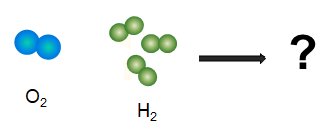
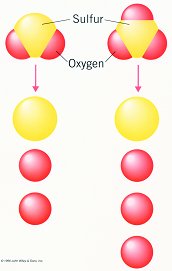
Atoms cannot be created or destroyed in chemical reactions; they are simply rearranged.
Compounds are formed by the combination of atoms of different elements in fixed, whole-number ratios.
Dalton's theory explained the conservation of mass and the constant composition of compounds, though we now know atoms are divisible into subatomic particles.
Development of Atomic Models
Key experiments and scientists contributed to the modern atomic model:
J.J. Thomson: Discovered the electron using cathode ray tubes, showing atoms contain negatively charged particles.
Robert Millikan: Measured the charge of the electron with the oil drop experiment, finding it to be C.
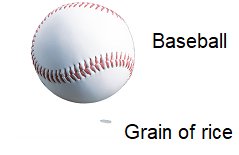
Ernest Rutherford: Discovered the nucleus by observing the deflection of alpha particles through gold foil, concluding atoms have a dense, positively charged center.
Subatomic Particles
Protons, Neutrons, and Electrons
Atoms are composed of three main subatomic particles:
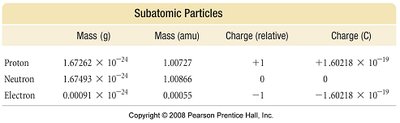
Proton: Positively charged, located in the nucleus, mass ≈ 1 amu.
Neutron: Neutral, located in the nucleus, mass ≈ 1 amu.
Electron: Negatively charged, found in the electron cloud, mass ≈ 0.00055 amu.
Atomic Number, Mass Number, and Isotopes
Atomic Number and Mass Number
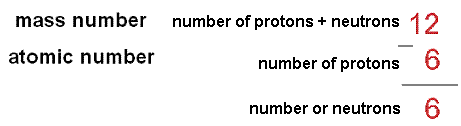
The atomic number (Z) is the number of protons in an atom and defines the element. The mass number (A) is the sum of protons and neutrons in the nucleus.
Number of neutrons = Mass number - Atomic number

Isotopes
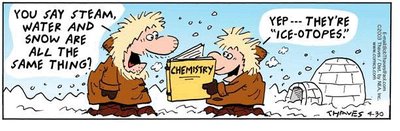
Isotopes are atoms of the same element with different numbers of neutrons, and thus different mass numbers. They have identical chemical properties but different physical properties (such as mass).
Atomic Mass and Average Atomic Mass
Calculating Average Atomic Mass
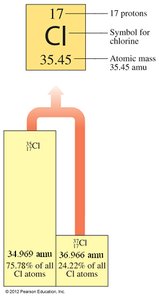
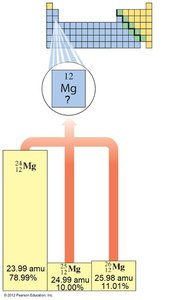
The average atomic mass of an element is the weighted average of the masses of its naturally occurring isotopes, based on their relative abundances.
The formula is:
The Periodic Table
Organization and Classification
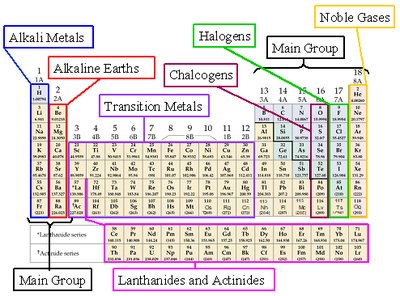
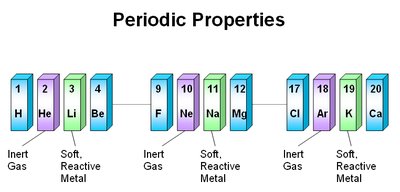
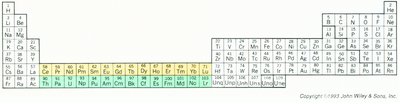
The periodic table arranges elements by increasing atomic number in rows (periods) and columns (groups or families). Elements in the same group have similar chemical and physical properties.
Metals, Nonmetals, and Metalloids
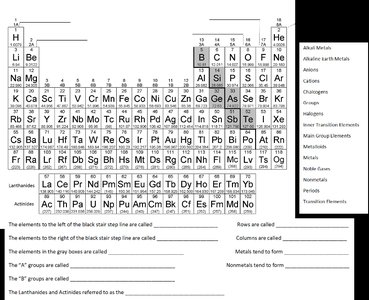
Metals: Left side, shiny, good conductors, form cations.
Nonmetals: Right side, poor conductors, form anions.
Metalloids: Along the stair-step line, properties intermediate between metals and nonmetals.
Chemical Formulas and Types of Compounds
Chemical, Molecular, Empirical, and Structural Formulas
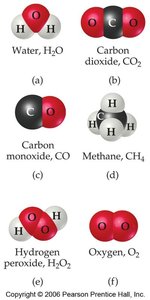
Chemical formula: Shows the types and numbers of atoms in a compound (e.g., H2O).
Molecular formula: Actual number of atoms in a molecule (e.g., C2H4O2).
Empirical formula: Simplest whole-number ratio of atoms (e.g., CH2O for C2H4O2).
Structural formula: Shows how atoms are bonded (e.g., Lewis structures).

Diatomic Elements
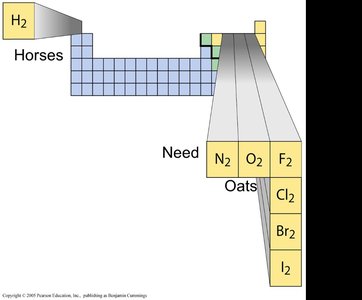
Seven elements exist naturally as diatomic molecules: H2, N2, O2, F2, Cl2, Br2, I2.
Ionic vs. Molecular Compounds
Ionic compounds: Formed from metals and nonmetals, consist of cations and anions, represented by formula units (e.g., NaCl).
Molecular compounds: Formed from nonmetals, consist of molecules with covalent bonds (e.g., CO2).
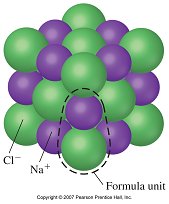
Cations and Anions
Formation and Prediction of Charges
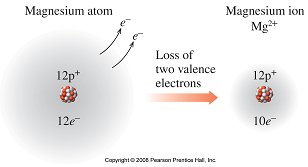
Atoms become ions by gaining or losing electrons:
Cations: Positively charged, formed by loss of electrons (typically metals).
Anions: Negatively charged, formed by gain of electrons (typically nonmetals).
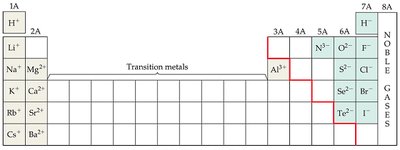
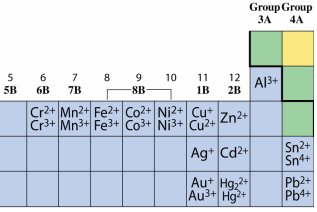
Periodic Table Patterns for Ion Charges
Main group elements form predictable charges based on their group number:
Group 1A: 1+ (e.g., Na+)
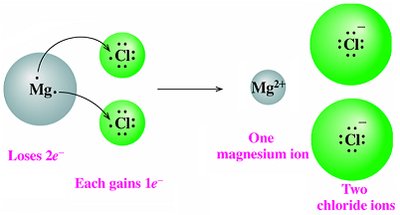
Group 2A: 2+ (e.g., Mg2+)
Group 7A: 1- (e.g., Cl-)
Group 6A: 2- (e.g., O2-)
Naming Ions and Compounds
Monatomic and Polyatomic Ions
Monatomic ions: Single atom with a charge (e.g., Na+, Cl-).
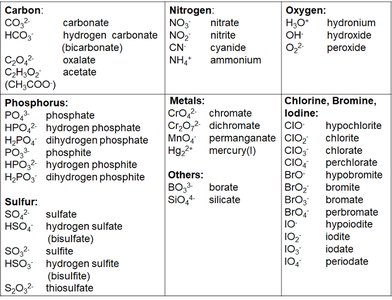
Polyatomic ions: Group of atoms with a charge (e.g., NO3-, SO42-).
Naming Rules
Cations with one possible charge: Name of element + 'ion' (e.g., sodium ion).
Cations with multiple charges: Name (Roman numeral) ion (e.g., iron(III) ion) or Latin name with -ic/-ous endings (e.g., ferric/ferrous).
Anions: Root of element + '-ide' (e.g., chloride, oxide).
Polyatomic ions: Memorize names and formulas (e.g., nitrate, sulfate).
Formulas of Ionic Compounds
Writing Empirical Formulas
Ionic compounds are written so that the total positive and negative charges balance to zero. The simplest ratio of ions is used (empirical formula).
Example: Mg2+ and Cl- combine to form MgCl2.
Swap and Drop Method
To determine the correct subscripts in an ionic compound, swap the magnitude of each ion's charge to become the subscript of the other ion, then reduce to the simplest ratio if necessary.
Naming Compounds
Ionic Compounds
Name the cation first, then the anion.
Use Roman numerals for transition metals with multiple charges.
For polyatomic ions, use the ion's name as is.
Acids
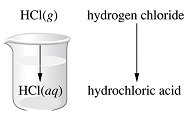
Binary acids: 'Hydro-' prefix + root + '-ic acid' (e.g., HCl is hydrochloric acid).
Oxyacids: Based on polyatomic ion name: '-ate' becomes '-ic acid', '-ite' becomes '-ous acid' (e.g., HNO3 is nitric acid, HNO2 is nitrous acid).
Molecular Compounds
Use prefixes to indicate the number of each atom (e.g., CO2 is carbon dioxide, N2O4 is dinitrogen tetroxide).
The second element ends in '-ide'.
Hydrates
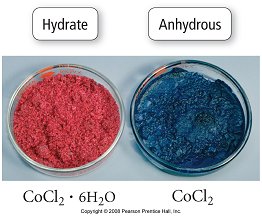
Ionic compound name + prefix for number of water molecules + 'hydrate' (e.g., CuSO4·5H2O is copper(II) sulfate pentahydrate).
Summary Table: Subatomic Particles
Particle | Mass (g) | Mass (amu) | Charge (relative) | Charge (C) |
|---|---|---|---|---|
Proton | 1.67262 × 10⁻²⁴ | 1.00727 | +1 | +1.60218 × 10⁻¹⁹ |
Neutron | 1.67493 × 10⁻²⁴ | 1.00866 | 0 | 0 |
Electron | 0.00091 × 10⁻²⁴ | 0.00055 | -1 | -1.60218 × 10⁻¹⁹ |
Additional info: Mastery of these foundational concepts is essential for understanding chemical reactions, stoichiometry, and the behavior of matter at the atomic and molecular level. Practice problems and memorization of ion names and charges are highly recommended for proficiency.
