 Back
BackLesson 9.2: Balancing Redox Reaction Equations: Methods and Applications
Study Guide - Smart Notes
 Tailored notes based on your materials, expanded with key definitions, examples, and context.
Balancing Redox Reaction Equations
Introduction to Redox Reactions
Redox (oxidation-reduction) reactions involve the transfer of electrons between chemical species, resulting in changes in oxidation numbers. Balancing these reactions is essential for quantitative chemical analysis and understanding chemical processes, especially in aqueous solutions where reactions may occur under acidic or basic conditions.
Oxidation: Loss of electrons by a substance, increasing its oxidation number.
Reduction: Gain of electrons by a substance, decreasing its oxidation number.
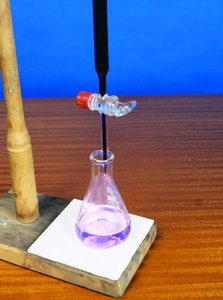
Redox reactions are commonly used in titrations, such as determining iron content in ores using potassium permanganate.
Methods for Balancing Redox Equations
Oxidation Numbers Method
The oxidation numbers method involves assigning oxidation numbers to all elements in the reaction, identifying changes, and balancing the electrons transferred. This method is systematic and useful for both simple and complex redox reactions.
Step 1: Write the unbalanced equation and assign oxidation numbers to each element.
Step 2: Identify elements whose oxidation numbers change and calculate electrons lost/gained.
Step 3: Adjust coefficients to balance the electron transfer.
Step 4: Balance remaining atoms (O by adding H2O, H by adding H+ or OH- as appropriate).
Step 5: Check that atoms and charges are balanced.
Step 6: Write the final balanced equation.
Example: Oxidation of Copper by Nitric Acid
Concentrated nitric acid oxidizes copper metal to produce nitrogen dioxide gas, copper(II) nitrate, and water. The balanced equation using the oxidation numbers method is:
Unbalanced: HNO3(aq) + Cu(s) → NO2(g) + Cu(NO3)2(aq) + H2O(l)
Balanced: 4 HNO3(aq) + Cu(s) → 2 NO2(g) + Cu(NO3)2(aq) + 2 H2O(l)
Balancing in Acidic and Basic Solutions
In acidic solutions, use H+ and H2O to balance hydrogen and oxygen.
In basic solutions, use OH- and H2O to balance hydrogen and oxygen.
Example: Permanganate and Iron(II) in Acidic Solution
Net ionic equation: MnO4-(aq) + 5 Fe2+(aq) + 8 H+(aq) → Mn2+(aq) + 5 Fe3+(aq) + 4 H2O(l)
Example: Iodate and Oxalate in Basic Solution
Balanced equation: IO3-(aq) + 3 C2O42-(aq) + 3 H2O(l) → I2(aq) + 6 CO2(g) + 6 OH-(aq)
Tables for Balancing Redox Equations
Tables are often used to check the number of atoms and charges on both sides of the equation. This ensures the equation is balanced in terms of both mass and charge.
Element | Number in Reactants | Number in Products |
|---|---|---|
Mn | 1 | 1 |
Fe | 5 | 5 |
O | 4 | 4 |
H | 8 | 8 |
Half-Reactions Method
Overview
The half-reactions method separates the overall redox reaction into two half-reactions: one for oxidation and one for reduction. Each half-reaction is balanced for mass and charge, then combined to yield the overall balanced equation.
Step 1: Write the unbalanced equation and assign oxidation numbers.
Step 2: Write unbalanced half-reactions for oxidation and reduction.
Step 3: Balance each half-reaction for all elements except H and O.
Step 4: Balance O by adding H2O, H by adding H+ (acidic) or OH- (basic).
Step 5: Balance charge by adding electrons.
Step 6: Multiply half-reactions to equalize electron transfer, then add together.
Step 7: Check that atoms and charges are balanced.
Example: Permanganate and Iron(II) in Acidic Solution (Half-Reactions)
Reduction: MnO4-(aq) + 8 H+(aq) + 5 e- → Mn2+(aq) + 4 H2O(l)
Oxidation: Fe2+(aq) → Fe3+(aq) + e-
Multiply oxidation half-reaction by 5 and add to reduction half-reaction:
Summary Table: Comparison of Methods
Method | Key Steps | When to Use |
|---|---|---|
Oxidation Numbers | Assign oxidation numbers, balance electrons, adjust coefficients, balance O/H | Simple or complex redox reactions |
Half-Reactions | Write half-reactions, balance mass and charge, combine | Complex reactions, especially in solution |
Key Points
Balanced redox equations have equal numbers of each atom and equal electron transfer on both sides.
Redox equations can be balanced using either the oxidation numbers method or the half-reactions method.
In acidic or basic solutions, add H2O, H+, and/or OH- as needed to balance the equation.
