 Back
BackBasic Concepts of Chemical Bonding
Study Guide - Smart Notes
 Tailored notes based on your materials, expanded with key definitions, examples, and context.
Basic Concepts of Chemical Bonding
Introduction to Chemical Bonds
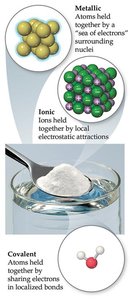
Chemical bonds are the attractive forces that hold atoms together in compounds. The three primary types of chemical bonds are ionic, covalent, and metallic bonds. Each type of bond arises from different interactions between electrons and nuclei.
Ionic bonds: Formed by the transfer of electrons from one atom to another, resulting in oppositely charged ions held together by electrostatic attraction.
Covalent bonds: Formed by the sharing of electrons between atoms, typically between nonmetals.
Metallic bonds: Involve a 'sea of electrons' that are delocalized over a lattice of metal nuclei.
Lewis Symbols and the Octet Rule
Lewis Symbols
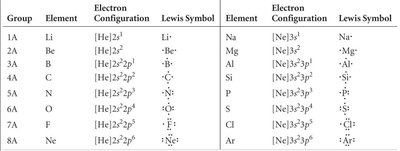
Lewis symbols (or Lewis electron-dot symbols) represent the valence electrons of an atom as dots placed around the element's symbol. These symbols help visualize the electrons involved in bonding.
Each dot represents a valence electron.
Electrons are placed on four sides of the symbol before pairing.


The Octet Rule
The octet rule states that atoms tend to gain, lose, or share electrons until they are surrounded by eight valence electrons, achieving a noble gas configuration. This rule is central to understanding the formation of most chemical bonds.
Thermodynamics: Enthalpy and Bond Formation
Enthalpy (H)
Enthalpy is a thermodynamic quantity defined as the sum of the internal energy (E) and the product of pressure and volume (PV):
Only changes in enthalpy () are measurable:
Endothermic reaction: (system absorbs heat)
Exothermic reaction: (system releases heat)
Example: , kJ (exothermic)
Ionic Bonding
Formation of Ionic Compounds
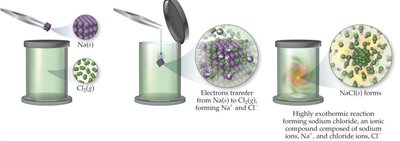
Ionic bonds form when electrons are transferred from a metal to a nonmetal, creating cations and anions that are held together by electrostatic forces. For example, sodium reacts with chlorine to form sodium chloride:
, kJ/mol

Structure of Ionic Compounds
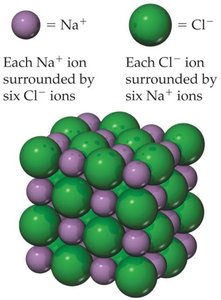
Ionic compounds, such as NaCl, form crystalline lattices where each ion is surrounded by oppositely charged ions. This regular arrangement contributes to their high melting points and brittleness.
Lattice Energy
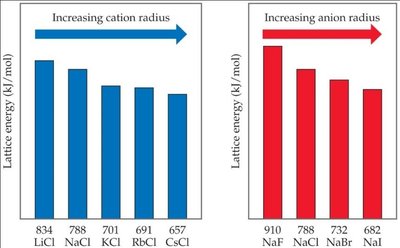
Lattice energy () is the energy required to separate one mole of a solid ionic compound into its gaseous ions. It is a measure of the strength of the ionic bonds in a crystal lattice and depends on the charges and sizes of the ions:
As the magnitude of the charges (, ) increases, lattice energy increases.
As the distance () between ions increases (larger ions), lattice energy decreases.
Covalent Bonding
Nature of Covalent Bonds
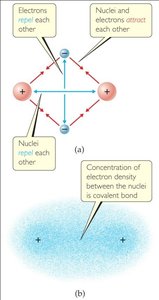
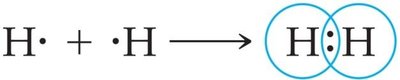
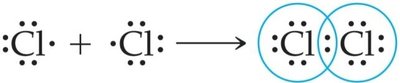
A covalent bond is formed when two atoms share one or more pairs of electrons. The shared electrons are attracted to both nuclei, resulting in a stable bond. Covalent bonds can be single, double, or triple, depending on the number of shared electron pairs.
Single bond: One pair of shared electrons (e.g., H–H)
Double bond: Two pairs of shared electrons (e.g., O=O)
Triple bond: Three pairs of shared electrons (e.g., N≡N)
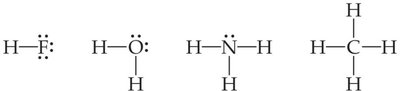

Bond Polarity and Electronegativity
Bond Polarity
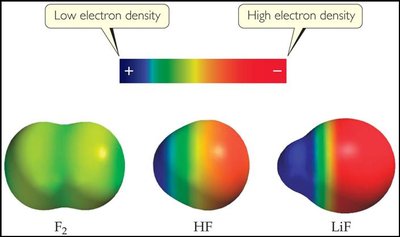
Bond polarity describes the distribution of electron density in a covalent bond. If electrons are shared equally, the bond is nonpolar; if shared unequally, the bond is polar. The difference in electronegativity between the bonded atoms determines the bond's polarity.
Nonpolar covalent bond: Electronegativity difference < 0.5
Polar covalent bond: Electronegativity difference between 0.5 and 1.9
Ionic bond: Electronegativity difference > 2.0
Electronegativity
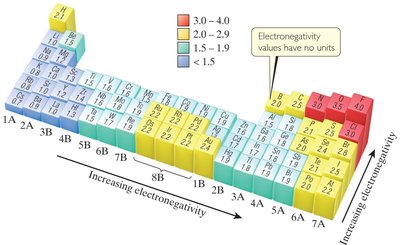
Electronegativity is the ability of an atom to attract shared electrons in a chemical bond. The Pauling scale is commonly used, with values increasing across a period and decreasing down a group. Fluorine is the most electronegative element (4.0).
Dipole Moment
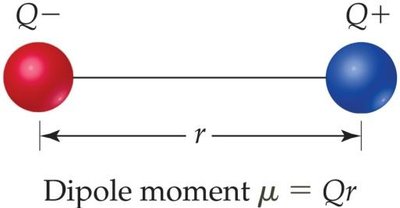
A dipole moment () is a measure of the separation of positive and negative charges in a molecule:
where is the magnitude of the charge and is the distance between charges.
Drawing Lewis Structures
Guidelines for Lewis Structures
Lewis structures are diagrams that show the bonding between atoms and the arrangement of valence electrons. The steps for drawing Lewis structures are:
Sum the valence electrons from all atoms (add for anions, subtract for cations).
Write the symbols for the atoms and connect them with single bonds.
The central atom is usually the least electronegative.
Complete the octets for all atoms bonded to the central atom (except H, which only needs two electrons).
Place any leftover electrons on the central atom.
If the central atom lacks an octet, form multiple bonds as needed.
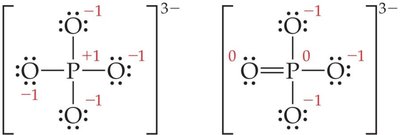
Calculate formal charges to determine the most stable structure.
Formal Charge
Formal charge helps identify the most stable Lewis structure. It is calculated as:
The best Lewis structure has formal charges closest to zero and places negative charges on the most electronegative atoms.
Resonance Structures
Concept of Resonance
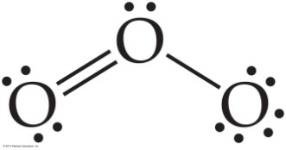
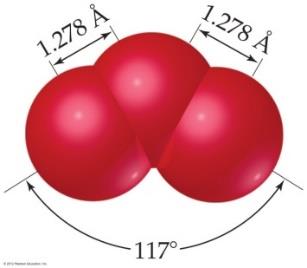
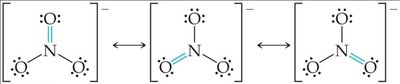
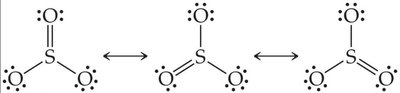
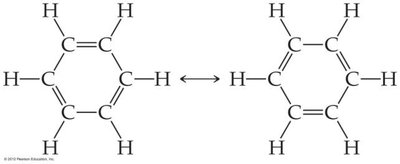
Some molecules cannot be adequately represented by a single Lewis structure. Resonance structures are two or more valid Lewis structures for the same molecule, differing only in the placement of electrons. The actual structure is a resonance hybrid, an average of all resonance forms.


Exceptions to the Octet Rule
Odd Number of Electrons
Molecules with an odd number of electrons cannot achieve an octet for all atoms. The most electronegative atom usually gets the full octet. Examples include ClO2, NO, and NO2.

Less Than an Octet
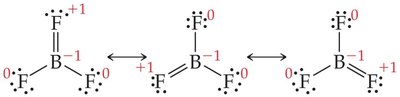
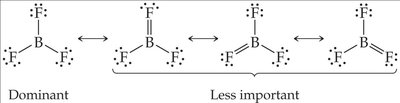
Some molecules, especially those with Group 1A, 2A, or 3A elements, have less than an octet. A common example is BF3.
More Than an Octet
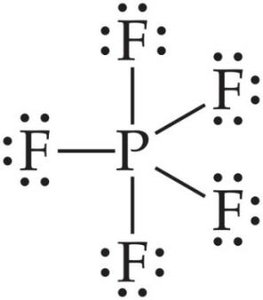
Atoms from the third period and beyond can have more than eight electrons (expanded octet) due to available d orbitals. Examples include PF5, SF4, and PO43–.
Strengths of Covalent Bonds: Bond Enthalpy
Bond Enthalpy
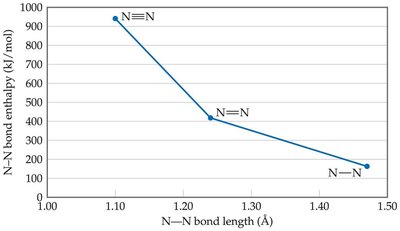
Bond enthalpy (D) is the energy required to break one mole of a specific bond in a gaseous molecule. It is a measure of bond strength. Multiple bonds (double, triple) are stronger and shorter than single bonds.
Bond enthalpy increases with the number of shared electrons.
Bond length decreases as bond order increases.
The enthalpy change of a reaction can be estimated using average bond enthalpies:
Summary Table: Types of Chemical Bonds
Bond Type | Formation | Example | Key Properties |
|---|---|---|---|
Ionic | Electron transfer | NaCl | High melting point, crystalline, conducts when molten |
Covalent | Electron sharing | H2O | Low melting point, discrete molecules, poor conductor |
Metallic | Delocalized electrons | Na | Malleable, ductile, conducts electricity |
