 Back
Basic Concepts of Chemical Bonding (Chapter 8) – General Chemistry Study Notes
Study Guide - Smart Notes
 Tailored notes based on your materials, expanded with key definitions, examples, and context.
Introduction to Chemical Bonds
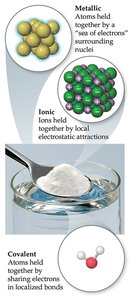
Chemical bonds are the attractive forces that hold atoms or ions together in compounds. The three primary types of chemical bonds are ionic, covalent, and metallic bonds. Each type of bond arises from different interactions between electrons and nuclei.
Ionic Bonds: Formed by the electrostatic attraction between oppositely charged ions (typically between metals and nonmetals).
Covalent Bonds: Involve the sharing of electron pairs between atoms (usually nonmetals).
Metallic Bonds: Involve a 'sea' of delocalized electrons surrounding positive metal ions, giving rise to unique metallic properties.
Lewis Symbols and the Octet Rule
Lewis Symbols
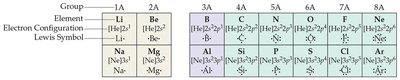
Lewis symbols (or electron dot diagrams) represent the valence electrons of an atom as dots around the element's symbol. This notation helps visualize the electrons available for bonding.
Main Group Elements: Number of valence electrons equals the group number.
Transition Metals: Valence electrons include both the outermost s and d electrons.
The Octet Rule
Atoms tend to gain, lose, or share electrons to achieve a stable configuration with eight valence electrons, similar to noble gases. This is known as the octet rule.
Ionic Bonding
Formation of Ionic Bonds
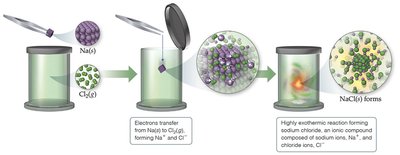
Ionic bonds form when electrons are transferred from a metal (low ionization energy) to a nonmetal (high electron affinity), resulting in the formation of cations and anions. The resulting electrostatic attraction holds the ions together.
Metals tend to lose electrons and become cations.
Nonmetals tend to gain electrons and become anions.
Properties of Ionic Substances
Brittle
High melting points
Crystalline structure
Cleave along smooth lines
Energetics of Ionic Bonding and the Born–Haber Cycle
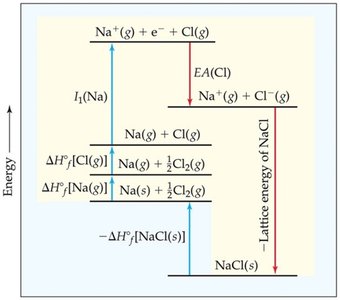
The formation of ionic compounds involves several energetic steps, including ionization energy, electron affinity, and lattice energy. The Born–Haber cycle is used to calculate the overall energy change in the formation of an ionic solid.
Lattice Energy
Lattice energy is the energy required to completely separate one mole of a solid ionic compound into its gaseous ions. It is a measure of the stability of the ionic solid.
Lattice energy increases with increasing ionic charge and decreasing ionic radius.
Covalent Bonding
Nature of Covalent Bonds
Covalent bonds involve the sharing of electron pairs between atoms, primarily nonmetals. The stability of the bond depends on the balance between attractive and repulsive forces among electrons and nuclei.
Lewis Structures
Lewis structures are diagrams that show the arrangement of valence electrons among atoms in a molecule. They help visualize bonding pairs (shared electrons) and lone pairs (unshared electrons).
Multiple Bonds
Single bond: One pair of shared electrons
Double bond: Two pairs of shared electrons
Triple bond: Three pairs of shared electrons
Polarity of Bonds and Electronegativity
Bond Polarity
Bond polarity refers to the unequal sharing of electrons in a covalent bond. If electrons are shared equally, the bond is nonpolar; if not, it is polar.
Electronegativity
Electronegativity is the ability of an atom in a molecule to attract electrons to itself. It generally increases across a period and decreases down a group in the periodic table.
Dipole Moment
A dipole moment arises when there is a separation of charge in a molecule due to differences in electronegativity. The dipole moment (μ) is calculated as:
Drawing Lewis Structures
Steps for Drawing Lewis Structures
Sum the valence electrons from all atoms (adjust for overall charge).
Write the symbols for the atoms, connect them with single bonds.
Complete the octets of the surrounding atoms.
Place any remaining electrons on the central atom.
If necessary, form multiple bonds to satisfy the octet rule.
Assign formal charges to determine the most stable structure.
Resonance Structures
Some molecules cannot be adequately represented by a single Lewis structure. Resonance structures are multiple valid Lewis structures for the same molecule, differing only in the placement of electrons. The actual structure is a resonance hybrid, an average of all resonance forms.
Exceptions to the Octet Rule
Odd number of electrons: Molecules with an odd number of valence electrons (e.g., NO).
Fewer than eight electrons: Elements like B and Be can be stable with less than an octet.
More than eight electrons (expanded octet): Elements in period 3 or higher can have more than eight valence electrons due to available d-orbitals (e.g., SF6, PCl5).
Bond Strength and Bond Length
Bond Enthalpy
Bond enthalpy (bond energy) is the energy required to break a bond in a molecule. Multiple bonds (double, triple) are stronger and shorter than single bonds.
As the number of bonds increases, bond length decreases and bond strength increases.
Coulomb’s Law and Lattice Energy
Coulomb’s Law describes the force and potential energy between two charged particles:
Potential energy is directly proportional to the product of the charges and inversely proportional to the distance between them.
Lattice energy increases with higher charges and smaller ionic radii, leading to stronger ionic bonds.
Summary Table: Lattice Energies for Selected Ionic Compounds
Compound | Lattice Energy (kJ/mol) |
|---|---|
LiF | 1030 |
NaCl | 788 |
MgO | 3795 |
CaO | 3414 |
ScN | 7547 |
CsI | 600 |
SrCl2 | 2127 |
Key Equations
Dipole Moment:
Coulomb’s Law:
Formal Charge:
Conclusion
Understanding chemical bonding is fundamental to predicting the structure, properties, and reactivity of compounds. Mastery of Lewis structures, the octet rule, resonance, bond energies, and lattice energies provides a strong foundation for further study in chemistry.
