 Back
Basic Concepts of Chemical Bonding: General Chemistry Study Notes
Study Guide - Smart Notes
 Tailored notes based on your materials, expanded with key definitions, examples, and context.
Basic Concepts of Chemical Bonding
Types of Chemical Bonds
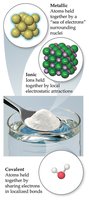
Chemical bonds are the forces that hold atoms together in compounds. There are three primary types of chemical bonds: ionic, covalent, and metallic.
Ionic Bonds: Formed by electrostatic attraction between ions, typically between metals and nonmetals.
Covalent Bonds: Formed by the sharing of electrons between atoms, usually between nonmetals.
Metallic Bonds: Involve a 'sea of electrons' that are free to move around, holding metal atoms together.
Lewis Symbols and the Octet Rule
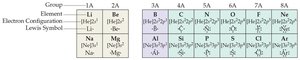
Lewis symbols are a method developed by G. N. Lewis to represent valence electrons as dots around the element symbol. The octet rule states that atoms tend to gain, lose, or share electrons until they are surrounded by eight valence electrons, achieving the electron configuration of a noble gas.
Ionic Bonding
Formation of Ionic Bonds
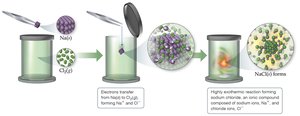
Ionic bonds are formed through the transfer of electrons from a metal (low ionization energy) to a nonmetal (high electron affinity). This process is highly exothermic and results in the formation of ions.

Properties of Ionic Substances
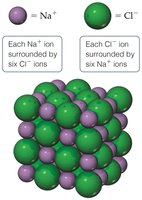
Ionic compounds exhibit well-defined three-dimensional structures. Their properties include:
Brittleness
High melting points
Crystalline structure
Cleave along smooth lines
Energetics of Ionic Bonding: Born–Haber Cycle
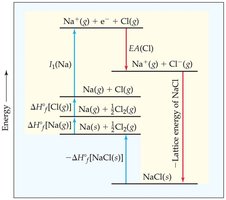
The Born–Haber cycle is used to analyze the energetics of ionic bond formation. It involves several steps, including atomization, ionization, electron affinity, and lattice energy.
Energy is required to convert elements to atoms (endothermic).
Energy is required to create cations (endothermic).
Energy is released when anions are formed (exothermic).
Formation of the solid releases a large amount of energy (exothermic).
Lattice Energy
Lattice energy is the energy required to completely separate one mole of a solid ionic compound into its gaseous ions. It is released during the formation of the ionic compound.
Trends in Lattice Energy
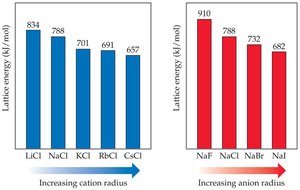
Lattice energy increases with increasing charge on the ions and decreasing size of the ions.
Electron Configuration of Ions
Main group metals lose electrons to achieve the electron configuration of the previous noble gas, while nonmetals gain electrons to achieve the configuration of the nearest noble gas. Transition metals do not follow the octet rule and lose valence electrons first, then d-electrons as needed.
Covalent Bonding
Nature of Covalent Bonds
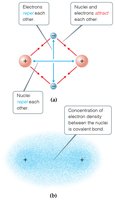
Covalent bonds involve the sharing of electrons between atoms. The stability of these bonds depends on the balance between attractions (electrons to nuclei) and repulsions (electron-electron and nucleus-nucleus).
Lewis Structures
Lewis structures are used to represent the sharing of electrons in covalent bonds. The goal is to give each atom the same number of electrons as the nearest noble gas.

Number of Bonds for Nonmetals
The group number indicates the number of valence electrons. The number of bonds needed to complete the octet is equal to the number of electrons required to reach eight.
Lone Pairs and Bonding Pairs
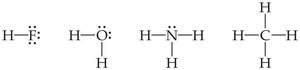
Lone pairs are electrons located on only one atom, while bonding pairs are shared between atoms. Bonding pairs can be represented by two dots or a line, but not both.
Multiple Bonds
Single bonds involve one pair of shared electrons, double bonds involve two pairs, and triple bonds involve three pairs.


Bond Polarity and Electronegativity
Polarity of Bonds
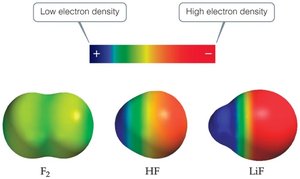
Bond polarity measures how equally electrons are shared in a covalent bond. Nonpolar bonds share electrons equally, while polar bonds have unequal sharing, resulting in partial charges.
Electronegativity
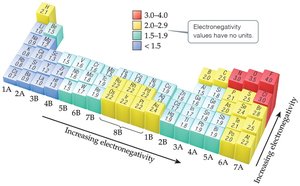
Electronegativity is the ability of an atom to attract electrons in a molecule. It increases from left to right across a period and from bottom to top within a group.
Electronegativity and Polar Covalent Bonds
When two atoms share electrons unequally, a polar covalent bond forms. The more electronegative atom gains a partial negative charge, while the other becomes partially positive.
Polar Covalent Bonds
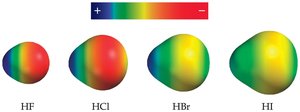
The greater the difference in electronegativity, the more polar the bond. Dipole moments and bond lengths can be compared for hydrogen halides.
Dipoles and Dipole Moment
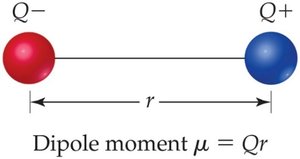
A dipole is formed when two equal but opposite charges are separated by a distance. The dipole moment () is calculated as:
where is the charge and is the distance between charges. Dipole moments are measured in debyes (D).
Determining Bond Type and Writing Lewis Structures
Is a Compound Ionic or Covalent?
Metal + nonmetal compounds are generally ionic; nonmetal + nonmetal compounds are covalent. Exceptions exist, especially with transition metals and varying oxidation states. Properties such as melting point can help distinguish bond types.
Steps for Writing Lewis Structures
To write Lewis structures for covalent molecules:
Sum the valence electrons from all atoms, adjusting for overall charge.
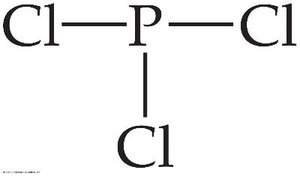
Write the symbols for the atoms, connect them with single bonds.
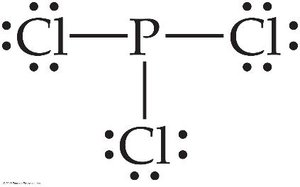
Complete the octets around atoms bonded to the central atom.
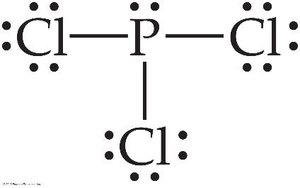
Place any remaining electrons on the central atom.
If the central atom lacks an octet, try multiple bonds.
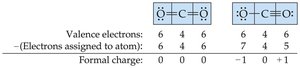
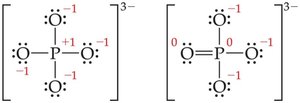
Assign formal charges to determine the dominant structure.


Resonance and Exceptions to the Octet Rule
Resonance Structures
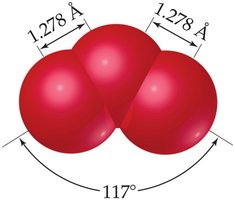
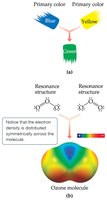
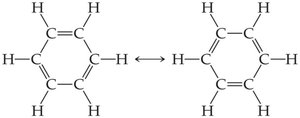
Some molecules cannot be accurately depicted by a single Lewis structure. Resonance structures are used to represent delocalized electrons. The actual molecule is a hybrid of these structures.

Exceptions to the Octet Rule
Three types of exceptions exist:
Ions or molecules with an odd number of electrons
Ions or molecules with less than an octet
Ions or molecules with more than eight valence electrons (expanded octet)

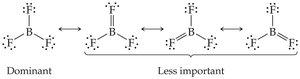
Fewer Than Eight Electrons
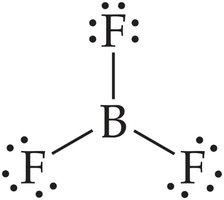
Elements in the second period before carbon can form stable compounds with fewer than eight electrons. For example, boron in BF3 does not achieve a full octet.
Expanded Octets
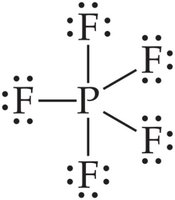
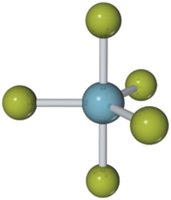
Elements in periods 3 through 6 can use d-orbitals to form more than four bonds, resulting in hypervalent molecules. Examples include PF5 and phosphate.
Bond Enthalpy and Bond Length
Average Bond Enthalpies
Bond enthalpy is the energy required to break a bond and is always positive (endothermic). These values are averages over many compounds.
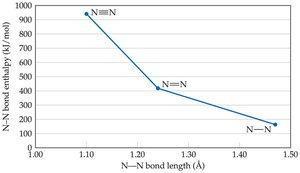
Bond Enthalpy and Bond Length
Multiple bonds are stronger and shorter than single bonds. As the number of bonds increases, bond length decreases.
 Additional info: These notes provide a comprehensive overview of Chapter 8, "Basic Concepts of Chemical Bonding," suitable for General Chemistry college students. All images included are directly relevant to the adjacent content and reinforce key concepts.
