Back
BackChemistry Chapter 8
Study Guide - Smart Notes
 Tailored notes based on your materials, expanded with key definitions, examples, and context.
Basic Concepts of Chemical Bonding
Types of Chemical Bonds
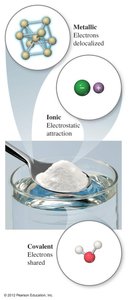
Chemical bonds are the attractive forces that hold atoms or ions together in compounds. The three primary types of chemical bonds are metallic, ionic, and covalent bonds.
Metallic Bonds: Formed by the delocalization of electrons among a lattice of metal atoms. Electrons are free to move, giving rise to properties such as electrical conductivity and malleability.
Ionic Bonds: Result from the electrostatic attraction between oppositely charged ions, typically formed when one atom donates electrons (low ionization energy) and another atom accepts electrons (high electron affinity).
Covalent Bonds: Involve the sharing of electron pairs between atoms, usually nonmetals, to achieve stable electron configurations.
Ionic Bonding
Formation of Ionic Bonds
Ionic bonds are formed when electrons are transferred from one atom to another, resulting in the formation of cations and anions. For example, sodium (Na) donates an electron to chlorine (Cl), forming Na+ and Cl- ions.

Each ion achieves a stable electron configuration, often resembling the nearest noble gas (octet rule).
Structure of Ionic Compounds
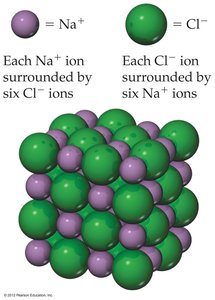
Ionic compounds, such as NaCl, form crystalline lattices where each ion is surrounded by oppositely charged ions. This arrangement maximizes attractive forces and minimizes repulsive forces, contributing to the stability of the solid.
Properties of Ionic Substances: Brittle, high melting points, usually crystalline, and can be cleaved along specific planes.
Lattice Energy
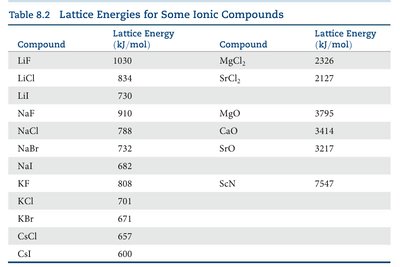
Lattice energy is the energy required to completely separate one mole of a solid ionic compound into its gaseous ions. It is a measure of the stability of the ionic solid.
Lattice energy increases with higher ionic charges and decreases with larger ionic radii.
Compound | Lattice Energy (kJ/mol) | Compound | Lattice Energy (kJ/mol) |
|---|---|---|---|
LiF | 1030 | MgCl2 | 2326 |
LiCl | 834 | SrCl2 | 2127 |
LiI | 730 | MgO | 3795 |
NaF | 910 | CaO | 3414 |
NaCl | 788 | SrO | 3217 |
NaBr | 732 | ScN | 7547 |
NaI | 682 | ||
KF | 808 | ||
KCl | 701 | ||
KBr | 671 | ||
CsCl | 657 | ||
CsI | 600 |
Qualitative Determination of Lattice Energy
The lattice energy can be estimated using the following equation, which is based on Coulomb's law:
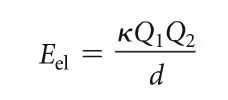
Q1 and Q2: Charges of the ions
d: Distance between ion centers
κ: Proportionality constant
Lattice energy increases with greater ionic charge and decreases with larger ionic radius.
Covalent Bonding
Nature of Covalent Bonds
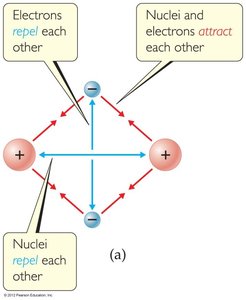
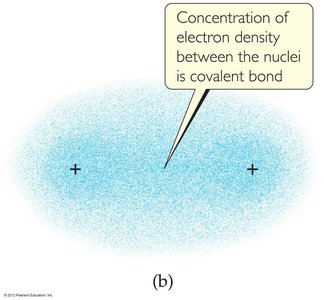
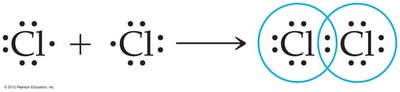
Covalent bonds are formed by the sharing of electron pairs between atoms. The shared electrons are attracted by the nuclei of both atoms, resulting in a stable molecule.
Lewis Symbols and the Octet Rule
Lewis Electron-Dot Symbols
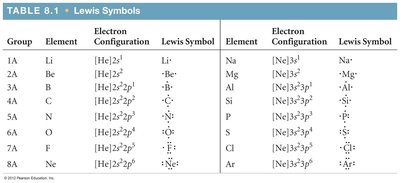
Lewis symbols represent the valence electrons of an atom as dots around the chemical symbol. Only main-group (s- and p-block) elements are typically represented this way.

Group | Element | Electron Configuration | Lewis Symbol |
|---|---|---|---|
1A | Li | [He]2s1 | Li· |
2A | Be | [He]2s2 | Be·· |
5A | N | [He]2s22p3 | ·N··· |
6A | O | [He]2s22p4 | ··O·· |
7A | F | [He]2s22p5 | ···F·· |
8A | Ne | [He]2s22p6 | ····Ne···· |
The Octet Rule
The octet rule states that atoms tend to gain, lose, or share electrons until they are surrounded by eight valence electrons, achieving a noble gas configuration. There are exceptions, but the rule is a useful guideline for many compounds.
Drawing Lewis Structures
Steps for Drawing Lewis Structures
Lewis structures help visualize the arrangement of electrons in molecules. The general steps are:
Sum the valence electrons for all atoms.
Write the symbols for the atoms and connect them with single bonds.
Complete the octets of the outer atoms.
Place any leftover electrons on the central atom.
If the central atom lacks an octet, form multiple bonds as needed.
Bond Polarity and Electronegativity
Bond Polarity
Bond polarity describes the distribution of electron density in a bond. In a nonpolar covalent bond, electrons are shared equally (e.g., Cl2), while in a polar covalent bond, electrons are shared unequally (e.g., HF).
Electronegativity
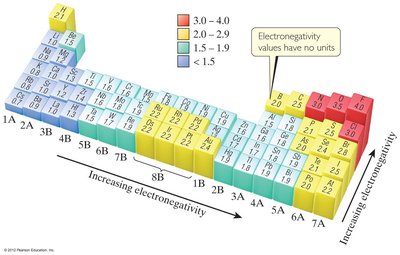
Electronegativity is the ability of an atom in a molecule to attract electrons to itself. The difference in electronegativity between two atoms determines the bond type:
ΔEN < 0.5: Nonpolar covalent
0.5 ≤ ΔEN ≤ 1.6: Polar covalent
1.6 < ΔEN ≤ 2.0: Polar covalent (if both are nonmetals); Ionic (if a metal is present)
ΔEN > 2.0: Ionic

Formal Charge and Resonance
Formal Charge
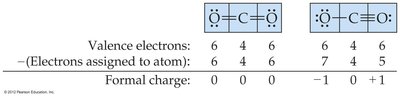
Formal charge is a bookkeeping tool to help determine the most stable Lewis structure. It is calculated as:
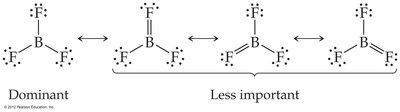
The dominant Lewis structure has formal charges closest to zero and places negative charges on the most electronegative atoms.
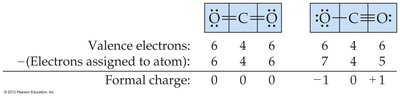
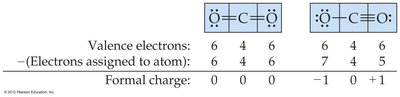
Resonance Structures
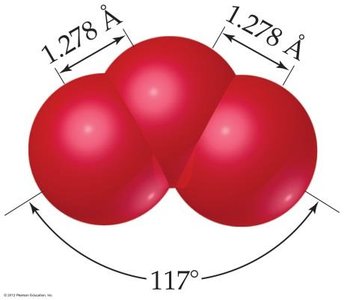
Some molecules cannot be adequately represented by a single Lewis structure. Resonance structures are multiple valid Lewis structures that differ only in the placement of electrons, not atoms. The actual molecule is a hybrid of these structures.

Exceptions to the Octet Rule
Odd-Electron Molecules
Some molecules have an odd number of electrons, making it impossible for all atoms to achieve an octet (e.g., NO).

Electron-Deficient Molecules
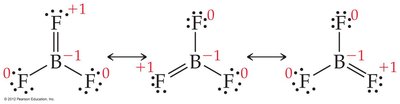
Certain elements, such as boron and beryllium, can be stable with fewer than eight electrons (e.g., BF3, BeF2).
Expanded Octets (Hypervalency)
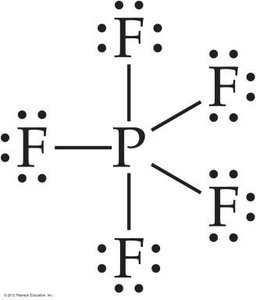
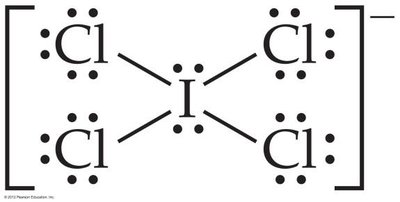
Atoms from period 3 and beyond can accommodate more than eight electrons, forming hypervalent molecules (e.g., PF5, XeF2).