 Back
BackBasic Concepts of Chemical Bonding: Ionic, Covalent, and Molecular Geometry
Study Guide - Smart Notes
 Tailored notes based on your materials, expanded with key definitions, examples, and context.
Basic Concepts of Chemical Bonding
Types of Chemical Bonds
Chemical bonds are the forces that hold atoms together in compounds. There are three primary types of chemical bonds:
Ionic Bonds: Electrostatic attraction between oppositely charged ions, typically formed between metals and nonmetals.
Covalent Bonds: Sharing of electron pairs between atoms, usually between nonmetals.
Metallic Bonds: Metal atoms bonded to several other atoms, with electrons delocalized throughout the structure.
Energetics of Ionic Bonding
The formation of ionic compounds involves several energetic steps:
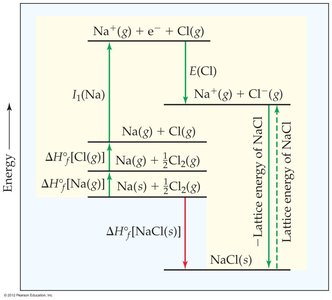
Ionization Energy: Energy required to remove an electron from an atom (e.g., sodium).
Electron Affinity: Energy released when an atom gains an electron (e.g., chlorine).
Lattice Energy: Energy released when gaseous ions form a solid ionic compound. This is governed by Coulomb's law:
Lattice energy increases with the charge on the ions and decreases with the size of the ions.
By accounting for ionization energy, electron affinity, and lattice energy, we can understand the energetics of ionic compound formation.
Lewis Symbols and the Octet Rule
Valence electrons are the electrons involved in bonding. Lewis symbols (electron-dot symbols) are used to represent valence electrons around an element's symbol.
Octet Rule: Atoms tend to gain, lose, or share electrons until they are surrounded by eight valence electrons, achieving a noble gas configuration (s2p6).
Exceptions to the octet rule occur for elements in periods 3-7, which can have more than eight electrons in their valence shell.


Lewis Structures and Covalent Bonding
Lewis structures represent the formation of covalent bonds by showing shared electron pairs as lines and unshared pairs as dots.
Bonding Pair: Shared pair of electrons.
Lone Pair: Unshared pair of electrons.
Multiple bonds (double, triple) are formed when atoms share more than one pair of electrons.

Bond Strength and Bond Enthalpy
The strength of a covalent bond is measured by the bond enthalpy, which is the energy required to break the bond.
Bond enthalpy increases with the number of bonds between atoms (single < double < triple).
Bond length decreases as bond order increases.
Bond enthalpy can be used to estimate the enthalpy change for a chemical reaction:
Bond Polarity and Electronegativity
Bond polarity describes the sharing of electrons in a covalent bond:
Non-polar Covalent Bond: Electrons are shared equally (e.g., Cl2).
Polar Covalent Bond: One atom attracts electrons more strongly (e.g., HCl).
Electronegativity is the ability of an atom to attract electrons in a molecule. It increases from left to right across a period and from bottom to top in a group.

Writing Lewis Structures
Steps for constructing Lewis structures:
Add up all valence electrons for the molecule or ion.
Identify the central atom (usually the least electronegative, except hydrogen).
Connect outer atoms to the central atom with single bonds.
Fill the octets of the outer atoms.
Fill the octet of the central atom.
If electrons run out before the central atom has an octet, form multiple bonds.
Formal Charge and Resonance Structures
Formal charge helps determine the most reasonable Lewis structure:
Formal charge = (number of valence electrons in isolated atom) – (number of electrons assigned in the structure).
The best structure has the smallest formal charges and places negative charges on the most electronegative atoms.
Resonance structures represent molecules where more than one valid Lewis structure exists. The actual structure is a blend of these possibilities.
Exceptions to the Octet Rule
There are three classes of exceptions:
Molecules with an odd number of electrons (e.g., NO, ClO2).
Molecules where one atom has less than an octet (e.g., BF3).
Molecules where one atom has more than an octet (e.g., SF4, PCl5).
Bonding Theories and Molecular Geometry
Bonding Theories
Lewis Structures: Show atomic connectivity and electron pairs.
VSEPR Theory: Predicts 3D arrangement of atoms based on electron pair repulsion.
Valence Bond Theory: Describes bonding as overlap of atomic orbitals.
Molecular Orbital Theory: Describes electrons in molecular orbitals delocalized over the molecule.
VSEPR Theory and Molecular Geometry
The Valence Shell Electron Pair Repulsion (VSEPR) model predicts the shape of molecules by minimizing repulsions between electron domains:
Electron Domain: Region where electrons are concentrated (bonding pair, lone pair, or multiple bond).
Electron domains are arranged to minimize repulsion.
Electron-domain geometry describes the arrangement of all electron domains; molecular geometry describes the arrangement of atoms only.
Bond angles and bond lengths define the shape and size of a molecule. Lone pairs and multiple bonds exert greater repulsive forces, affecting bond angles.
Molecular Polarity
Molecular polarity depends on both the polarities of individual bonds and the geometry of the molecule:
Bond dipoles are vector quantities; their orientation determines the overall dipole moment.
Charge separation affects physical and chemical properties.
To determine molecular polarity:
Draw the Lewis structure.
Determine electron domain geometry.
Determine molecular geometry.
Identify bond dipoles.
Determine overall polarity.
Tables
Table: Successive Ionization Energies (Partial)
Element | I1 (kJ/mol) |
|---|---|
Na | 495 |
Mg | 738 |
Additional info: Other elements omitted for brevity. |
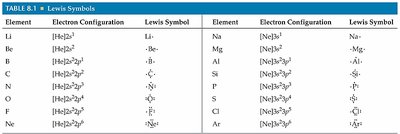
Table: Lewis Symbols for Elements
Element | Electron Configuration | Lewis Symbol |
|---|---|---|
Li | [He]2s1 | Li• |
Be | [He]2s2 | Be•• |
B | [He]2s22p1 | B••• |
C | [He]2s22p2 | C•••• |
N | [He]2s22p3 | N••••• |
O | [He]2s22p4 | O•••••• |
F | [He]2s22p5 | F••••••• |
Ne | [He]2s22p6 | Ne•••••••• |
Na | [Ne]3s1 | Na• |
Mg | [Ne]3s2 | Mg•• |
Al | [Ne]3s23p1 | Al••• |
Si | [Ne]3s23p2 | Si•••• |
P | [Ne]3s23p3 | P••••• |
S | [Ne]3s23p4 | S•••••• |
Cl | [Ne]3s23p5 | Cl••••••• |
Ar | [Ne]3s23p6 | Ar•••••••• |
Examples and Applications
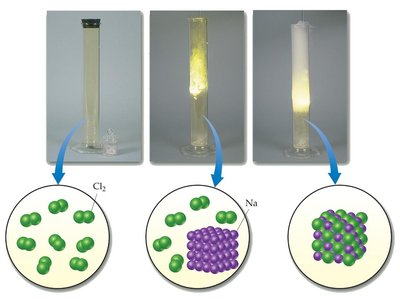
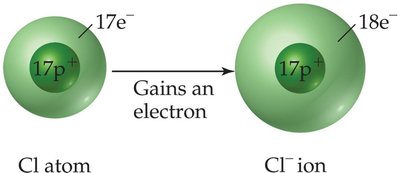
Formation of NaCl: Sodium loses an electron to become Na+, chlorine gains an electron to become Cl-. The resulting ions are held together by electrostatic attraction.
Lewis Structure of Cl2: Each Cl atom shares one electron, forming a single covalent bond and achieving an octet.
Bond Polarity in HF: Fluorine is more electronegative than hydrogen, resulting in a polar covalent bond.




Additional info: The notes cover the main concepts of chemical bonding, including ionic and covalent bonds, Lewis structures, bond polarity, and molecular geometry, as outlined in Chapter 8 and 9 of a general chemistry course.
