 Back
Bond Length, Bond Strength, Molecular Geometry & VSEPR Theory: General Chemistry Study Notes
Study Guide - Smart Notes
 Tailored notes based on your materials, expanded with key definitions, examples, and context.
Bond Length & Bond Strength
Bond Strength: Measurement and Significance
The strength of a chemical bond is a fundamental property that determines the stability and reactivity of molecules. Bond strength is experimentally measured by the energy required to break a bond, known as bond enthalpy or bond energy. This value is always positive, as breaking bonds is an endothermic process.
Bond enthalpy (ΔH): The energy needed to break one mole of a specific bond in a gaseous molecule.
Example: For Cl2(g), breaking the Cl–Cl bond requires 242 kJ/mol.
Bond formation: Exothermic (energy released).
Bond breaking: Endothermic (energy absorbed).
Formula:
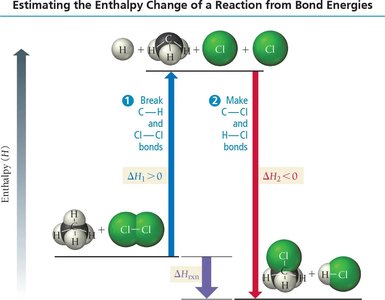
Example: Estimating reaction enthalpy for CH4(g) + Cl2(g) → CH3Cl(g) + HCl(g):
Breaking C–H and Cl–Cl bonds: +657 kJ
Forming C–Cl and H–Cl bonds: –770 kJ
ΔHrxn = 657 kJ – 770 kJ = –113 kJ
Bond Length & Bond Order
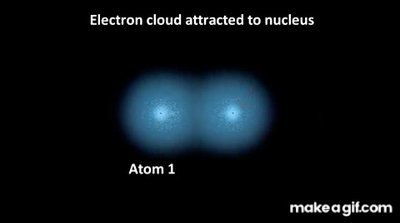
Bond length is the distance between the nuclei of two bonded atoms. It is typically measured in picometers (pm) or angstroms (Å). Bond length and bond strength are inversely related: as bond order increases, bond length decreases and bond strength increases.
Bond order: Single, double, triple bonds (e.g., C–C, C=C, C≡C).
Typical bond lengths: 100–200 pm (1–2 Å).
Typical bond strengths: 150–1,000 kJ/mol (1.6–10 eV).
Example: C2H6 (single bond): 153.5 pm; C2H4 (double bond): 133.9 pm; C2H2 (triple bond): 120.3 pm.

Bond Strength & Valence Orbital Overlap
The strength of covalent bonds depends on the overlap between the valence orbitals of the bonded atoms. Greater overlap results in stronger bonds.
Bond strength increases: With greater orbital overlap.
Bond length decreases: With greater bond order and overlap.
Bond Length and Strength Table
The following table summarizes typical bond lengths and energies for common bonds:
Bond | Length (pm) | Energy (kJ/mol) |
|---|---|---|
H–H | 74 | 436 |
C–C | 154 | 348 |
C=C | 134 | 614 |
C≡C | 120 | 839 |
N≡N | 110 | 945 |
O=O | 121 | 498 |
Cl–Cl | 199 | 243 |
Br–Br | 228 | 193 |
I–I | 267 | 151 |
H–F | 92 | 568 |
Lewis Structures, Resonance, and Expanded Octets
Lewis Structures and Resonance
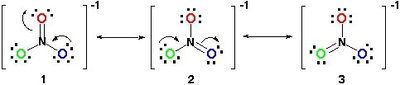
Lewis structures represent the arrangement of atoms and electrons in a molecule. Some molecules have resonance structures, which are multiple valid Lewis structures differing only in the placement of electrons. The actual molecule is a resonance hybrid, a blend of these structures, resulting in electron delocalization and increased stability (resonance stabilization).
Resonance stabilization: Delocalization lowers potential energy.
Example: Nitrate ion (NO3–) has three equivalent resonance structures.
Expanded Octets
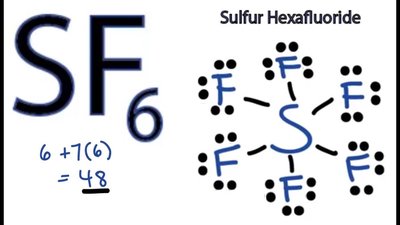
Some elements, especially those with principal quantum number n ≥ 3, can accommodate more than eight electrons in their valence shell, forming expanded octets. This is possible when energetically accessible d orbitals are available for bonding.
Expanded octets: Only possible for n ≥ 3 (e.g., P, S, Cl).
Example: SF6 (Sulfur hexafluoride) and PCl5 (Phosphorus pentachloride).
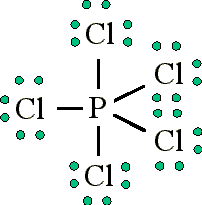
Electron configuration: Shows available orbitals for expanded octets.

Molecular Geometry & VSEPR Theory
Introduction to Molecular Geometry
The three-dimensional arrangement of atoms in a molecule, known as molecular geometry, profoundly affects its chemical and physical properties. Lewis structures do not show spatial arrangements, so models like VSEPR are used to predict geometry.
VSEPR theory: Valence-Shell Electron Pair Repulsion theory predicts molecular shapes based on electron group repulsions.
Applications: Enzyme-substrate interactions, molecular polarity (e.g., water vs. carbon dioxide).
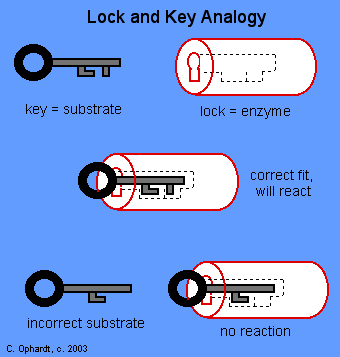
VSEPR Concept
VSEPR theory states that electron groups (lone pairs, single, double, and triple bonds) around a central atom repel each other, adopting a geometry that minimizes repulsion. Molecular geometry is defined by the arrangement of atoms (bonding pairs), while electron geometry includes both bonding and lone pairs.
Electron geometry: Spatial arrangement of all electron groups.
Molecular geometry: Arrangement of atoms (bonding pairs) only.
Repulsion strength: bp-bp < bp-lp < lp-lp
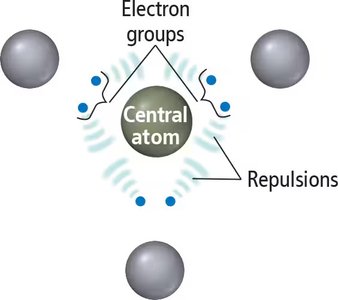
Fundamental Electron Geometries
There are five fundamental shapes for electron group geometries, determined by the steric number (SN):
Steric Number (SN): SN = (number of atoms bonded to central atom) + (number of lone pairs on central atom)
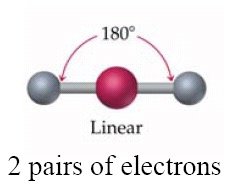
SN = 2: Linear (180°)
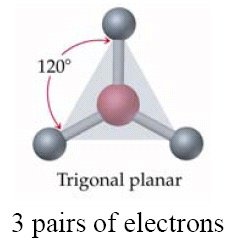
SN = 3: Trigonal planar (120°)
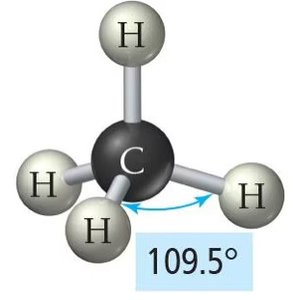
SN = 4: Tetrahedral (109.5°)
SN = 5: Trigonal bipyramidal (90°, 120°)
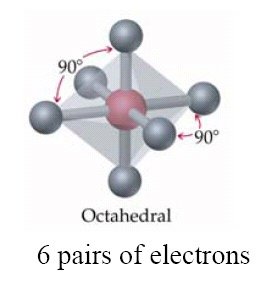
SN = 6: Octahedral (90°)
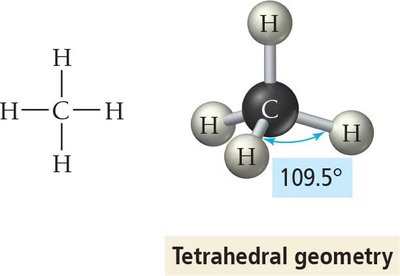

Predicting Molecular Geometry
To predict molecular geometry:
Draw the Lewis structure.
Count the number of bonding pairs and lone pairs on the central atom (steric number).
Assign electron geometry based on SN.
Determine molecular geometry by considering only bonding pairs.
Example: BF3 (SN = 3): Trigonal planar
Example: CSe2 (SN = 2): Linear
Example: CCl4 (SN = 4): Tetrahedral
Electron Geometry vs. Molecular Geometry
Electron geometry considers all electron groups, while molecular geometry considers only the arrangement of atoms. Lone pairs affect the actual shape and bond angles.
Example: NH3 (SN = 4): Electron geometry is tetrahedral, molecular geometry is trigonal pyramidal.
Summary Table: Fundamental Electron Geometries
Steric Number | Electron Geometry | Bond Angle | Example |
|---|---|---|---|
2 | Linear | 180° | CO2, CSe2 |
3 | Trigonal Planar | 120° | BF3 |
4 | Tetrahedral | 109.5° | CH4, CCl4 |
5 | Trigonal Bipyramidal | 90°, 120° | PCl5 |
6 | Octahedral | 90° | SF6 |
