 Back
BackBonding and Properties of Solids and Liquids: Lewis Structures, Resonance, and Molecular Shapes
Study Guide - Smart Notes
 Tailored notes based on your materials, expanded with key definitions, examples, and context.
Bonding and Properties of Solids and Liquids
Introduction
This chapter explores the fundamental concepts of chemical bonding in solids and liquids, focusing on Lewis structures, resonance, and the three-dimensional shapes of molecules. Understanding these concepts is essential for predicting molecular properties and reactivity.
Lewis Structures for Molecules and Polyatomic Ions
Lewis Electron-Dot Symbols for Atoms
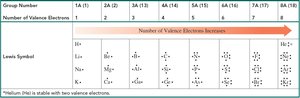
Lewis symbols are a convenient way to represent the valence electrons of an atom. Each dot represents a valence electron, and they are placed around the chemical symbol of the element.
Valence electrons are the electrons in the outermost shell of an atom and are involved in bonding.
Lewis symbols help visualize the number of valence electrons and predict bonding behavior.
For example, magnesium (Mg) has two valence electrons, represented as two dots around the symbol.

Lewis Symbols for Selected Elements
The number of valence electrons increases across a period in the periodic table. Lewis symbols for main group elements in periods 1 to 4 show this trend.
Lewis Structures for Ionic Compounds
Ionic compounds form when electrons are transferred from a metal to a nonmetal, resulting in the formation of cations and anions. The Lewis structure for an ionic compound shows the transfer of electrons and the resulting ions.
Example: Sodium (Na) transfers one electron to chlorine (Cl), forming Na+ and Cl-.
The chloride ion is shown in brackets with its negative charge.

Lewis Structures for Molecular Compounds
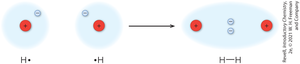
Molecular compounds are formed when atoms share electrons to achieve stable electron configurations. The shared electrons are represented as bonding pairs (lines or pairs of dots) between atoms, while nonbonding electrons are shown as lone pairs.
Hydrogen (H2) is the simplest molecule, formed by sharing two electrons between two H atoms, resulting in a covalent bond.

Single, Double, and Triple Bonds
Atoms can share one, two, or three pairs of electrons, forming single, double, or triple covalent bonds, respectively.
Single bond: One pair of electrons shared (e.g., H2).
Double bond: Two pairs of electrons shared (e.g., O2).
Triple bond: Three pairs of electrons shared (e.g., N2).
Atoms such as C, O, N, and S commonly form multiple bonds, while H and halogens do not.
Electron-Dot Lewis Structures
Electron-dot structures show the arrangement of bonded atoms, bonding pairs, and lone pairs in a molecule or polyatomic ion. The central atom is typically the least electronegative or the atom that appears least frequently in the formula (except H, which is never central).
Elements That Exist as Diatomic Molecules
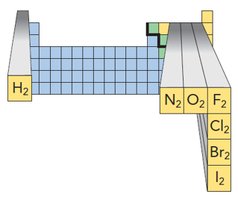
Some elements naturally exist as diatomic molecules, meaning two atoms of the same element are bonded together. These are often referred to as the "Magnificent 7": H2, N2, O2, F2, Cl2, Br2, and I2.
Steps for Drawing Lewis Structures
To draw a Lewis structure for a molecule or polyatomic ion, follow these steps:
Sum the valence electrons for all atoms in the formula. Add one electron for each negative charge and subtract one for each positive charge.
Select the central atom (never H; usually the least electronegative or the atom that appears least).
Connect the central atom to outer atoms with single bonds.
Fill the octet (or duet for H) on outer atoms using remaining electrons.
Assign any remaining electrons to the central atom to complete its octet.
If the central atom lacks an octet, move lone pairs from outer atoms to form double or triple bonds as needed.
Verify the structure to ensure the correct number of electrons and that all atoms (except H) have octets.
Resonance Structures
Definition and Importance
Resonance structures are alternative Lewis structures for a molecule or polyatomic ion that differ only in the position of electrons, not atoms. They are used when more than one valid Lewis structure can be drawn, typically for species with multiple bonds.
Resonance structures are connected by a double-headed arrow (↔).
The true structure is a hybrid, or average, of all resonance forms.
Example: The carbonate ion (CO32-) and ozone (O3) both exhibit resonance.
Drawing Resonance Structures
To draw resonance structures:
Draw all possible Lewis structures by moving electrons (not atoms).
Place a double-headed arrow between the structures.
Ensure all structures obey the octet rule and have the correct number of electrons.
Valence Shell Electron-Pair Repulsion (VSEPR) Theory and Molecular Shapes
VSEPR Theory Overview
VSEPR theory predicts the three-dimensional shape of molecules based on the repulsion between electron groups (bonding pairs and lone pairs) around a central atom. Electron groups arrange themselves as far apart as possible to minimize repulsion.
Each single, double, or triple bond, and each lone pair, counts as one electron group.
Common Electron-Group Geometries and Molecular Shapes
Two electron groups: Linear geometry, 180° bond angle (e.g., CO2).
Three electron groups: Trigonal planar geometry, 120° bond angle (e.g., H2CO).
Four electron groups: Tetrahedral geometry, 109° bond angle (e.g., CH4).
Lone pairs affect the molecular shape but are not counted as "atoms" in the shape name (e.g., NH3 is trigonal pyramidal, H2O is bent).
Examples of Molecular Shapes
PF3: 4 electron groups, 3 bonded atoms, 1 lone pair → trigonal pyramidal
H2S: 4 electron groups, 2 bonded atoms, 2 lone pairs → bent
CCl4: 4 electron groups, 4 bonded atoms, 0 lone pairs → tetrahedral
Summary Table: Electron Groups, Bonded Atoms, Lone Pairs, and Shapes
Electron Groups | Bonded Atoms | Lone Pairs | Shape | Bond Angle |
|---|---|---|---|---|
2 | 2 | 0 | Linear | 180° |
3 | 3 | 0 | Trigonal planar | 120° |
3 | 2 | 1 | Bent | 120° |
4 | 4 | 0 | Tetrahedral | 109° |
4 | 3 | 1 | Trigonal pyramidal | 109° |
4 | 2 | 2 | Bent | 109° |
Key Terms and Concepts
Lewis structure: Diagram showing the arrangement of valence electrons among atoms in a molecule or ion.
Resonance: The concept that some molecules can be represented by two or more valid Lewis structures.
VSEPR theory: A model used to predict the geometry of molecules based on electron group repulsions.
Bonding pair: A pair of electrons shared between two atoms.
Lone pair: A pair of valence electrons not involved in bonding.
Practice Problems
Draw the Lewis structure for CH4, CO2, and NH3.
Identify all resonance structures for SO2 and NO2-.
Predict the molecular shape of H2O, PF3, and CCl4 using VSEPR theory.
