 Back
BackBuffer Solutions and the Common Ion Effect: Structure, Function, and Calculations
Study Guide - Smart Notes
 Tailored notes based on your materials, expanded with key definitions, examples, and context.
Buffer Solutions and the Common Ion Effect
Definition and Properties of Buffer Solutions
Buffer solutions are essential in chemistry for maintaining a stable pH when small amounts of strong acids or bases are added. They are composed of a weak acid or weak base and its conjugate salt, allowing them to neutralize added acids or bases through equilibrium reactions.
Buffer Solution: A mixture that resists changes in pH upon addition of small amounts of acid or base.
Composition: Contains a weak acid/base and its conjugate salt (e.g., acetic acid and sodium acetate).
Mechanism: The acidic component reacts with added strong bases, and the basic component reacts with added strong acids.
Example: CH3COOH (acetic acid) and NaCH3COO (sodium acetate).
Common Ion Effect
The common ion effect occurs when a solution of a weak electrolyte is altered by adding one of its ions from another source, suppressing the ionization of the weak electrolyte.
Definition: The suppression of ionization of a weak electrolyte by the addition of a common ion.
Example: Adding sodium acetate to acetic acid solution increases acetate ion concentration, shifting equilibrium and reducing ionization of acetic acid.
Buffer Action and Equilibrium Shifts
Buffer solutions maintain pH by shifting equilibrium when acids or bases are added. The weak acid neutralizes added base, and the conjugate base neutralizes added acid.
Acid Addition: The conjugate base component reacts with added H+ to form the weak acid.
Base Addition: The weak acid component reacts with added OH- to form the conjugate base.
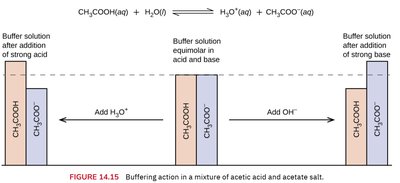
Figure: Buffering action in a mixture of acetic acid and acetate salt. The diagram shows how the concentrations of acetic acid and acetate change after addition of strong acid or base, illustrating the buffer's resistance to pH change.
Types of Buffer Solutions
There are two main types of buffer solutions:
Weak Acid + Salt of Weak Acid: Example: Acetic acid and sodium acetate.
Weak Base + Salt of Weak Base: Example: Ammonia and ammonium nitrate.
Comparison of Acidity and Basicity
Buffer solutions are always less acidic or basic than solutions containing only the weak acid or base.
Solution | [H+] | pH |
|---|---|---|
0.15 M CH3COOH | 1.6 x 10⁻³ | 2.80 |
0.15 M CH3COOH & 0.15 M NaCH3COO | 1.8 x 10⁻⁵ | 4.74 |
Key Point: The [H+] is much greater in pure acetic acid than in the buffer solution.
Solution | [OH-] | pH |
|---|---|---|
0.15 M NH3 | 1.6 x 10⁻³ | 11.20 |
0.15 M NH3 & 0.15 M NH4NO3 | 9.0 x 10⁻⁶ | 8.95 |
Key Point: The [OH-] in aqueous ammonia is much greater than in the buffer.
Henderson-Hasselbalch Equation and Buffer Calculations
Derivation of the Henderson-Hasselbalch Equation
The Henderson-Hasselbalch equation relates the pH of a buffer solution to the concentrations of the acid and its conjugate base.
General Ionization:
Ionization Constant:
Solving for [H+]:
Henderson-Hasselbalch Equation:
For bases:
Calculating pH of a Buffer Solution
To calculate the pH of a buffer, use the Henderson-Hasselbalch equation and the concentrations of the acid and its salt.
Example: For 0.15 M acetic acid and 0.15 M sodium acetate,
Calculate pKa:
Apply equation:
Calculating pH After Addition of Acid or Base
When a strong acid or base is added to a buffer, use an ICE chart to determine new concentrations and recalculate pH.
Example: Adding 0.020 mole HCl to 1.00 L buffer (0.100 M NH3, 0.200 M NH4Cl),
ICE Chart: Subtract moles of acid from base, add to conjugate acid.
New concentrations: NH3: 0.08 M, NH4Cl: 0.22 M
Calculate pOH:
Convert to pH:
Buffer Capacity and Buffer Range
Buffer Capacity and Range
Buffer capacity is the ability of a buffer to maintain pH after addition of acid or base. The buffer range is typically within ±1 pH unit of the pKa or pKb of the acid/base component.
Buffer Capacity: Buffers are most effective when the ratio of [A-]/[HA] is close to 1.
Buffer Range:
Preparation: Choose acid/base pair with pKa/pKb near desired pH, calculate concentrations, mix, and adjust pH as needed.
Preparing a Buffer Solution
To prepare a buffer, select a conjugate acid-base pair with a pKa or pKb near the desired pH, calculate the required ratio and concentrations, and mix the components.
Example: To prepare a buffer with pH 9.10 using NH3 and NH4Cl:
Convert Kb to Ka:
Calculate pKa:
Use Henderson-Hasselbalch:
Solve for NH4Cl: moles, g/mol g
Summary Table: Buffer Solution Types and Examples
Type | Acid/Base | Salt | Example |
|---|---|---|---|
Weak Acid + Salt | CH3COOH | NaCH3COO | Acetic acid/sodium acetate |
Weak Base + Salt | NH3 | NH4NO3 | Ammonia/ammonium nitrate |
Additional info: Buffer systems are critical in biological and industrial processes, such as blood plasma (H2CO3/HCO3-) and internal cell buffers (H2PO4-/HPO42-).
