 Back
Buffer Solutions, Titrations, and Solubility: Step-by-Step General Chemistry II Guidance
Study Guide - Smart Notes
 Tailored notes based on your materials, expanded with key definitions, examples, and context.
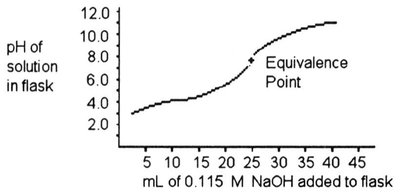
Q13. A 25.0 mL sample of a solution of an unknown compound is titrated with a 0.115 M NaOH solution. The titration curve above was obtained. The unknown compound is ________.
Background
Topic: Acid-Base Titration Curves
This question tests your ability to interpret titration curves and identify the nature of the unknown compound (acid or base, strong or weak) based on the pH changes during titration.
Key Terms:
Equivalence Point: The point in a titration where the amount of titrant added exactly neutralizes the analyte.
Titration Curve: A plot of pH versus volume of titrant added, used to analyze acid-base reactions.
Strong Acid/Strong Base: Completely dissociates in water.
Weak Acid/Weak Base: Partially dissociates in water.
Step-by-Step Guidance
Examine the starting pH of the solution before any NaOH is added. Is it low (acidic), high (basic), or neutral?
Observe the shape of the titration curve. Does the pH rise gradually or sharply as NaOH is added?
Identify the pH at the equivalence point. Is it below 7, around 7, or above 7?
Consider the initial pH and the equivalence point pH to determine if the unknown is a strong acid, weak acid, strong base, or weak base.
Use the information from the curve to match the characteristics to the possible answer choices.
Try solving on your own before revealing the answer!
Final Answer: C) a weak acid
The titration curve starts at a moderately low pH, rises gradually, and the equivalence point is above pH 7, which is characteristic of titrating a weak acid with a strong base.
The initial pH is not extremely low (not a strong acid), and the equivalence point is above 7, indicating the production of a weak conjugate base at equivalence.
