 Back
BackBuffers: Capacity, pH, and Applications in General Chemistry
Study Guide - Smart Notes
 Tailored notes based on your materials, expanded with key definitions, examples, and context.
Buffers: Capacity, pH, and Applications
Introduction to Buffers
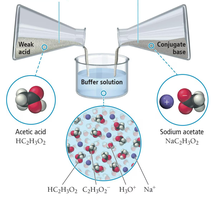
Buffers are essential solutions in chemistry that resist rapid changes in pH when small amounts of strong acids or bases are added. They are crucial in biological and chemical systems, such as maintaining blood pH within a narrow range. Buffers typically consist of a weak acid and its conjugate base or a weak base and its conjugate acid.
Key Buffer Concepts
Buffer Definition: A buffer is a solution that contains significant amounts of both a weak acid and its conjugate base (or a weak base and its conjugate acid), allowing it to neutralize added acids or bases.
Examples: Acetic acid and sodium acetate; ammonia and ammonium chloride.
Buffer Preparation: Buffers can be prepared by mixing a weak acid with its salt or by titrating half of a weak acid/base with a strong base/acid.
Buffer in Blood: Blood pH (7.36–7.42) is maintained by the carbonic acid/bicarbonate buffer system. Deviations can lead to acidosis or alkalosis, affecting oxygen transport.
Conjugate Acid-Base Pairs
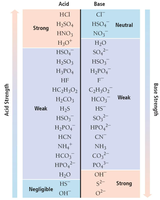
Understanding conjugate acid-base pairs is fundamental to buffer chemistry. The conjugate base (CB) of a weak acid is a weak base, while the CB of a strong acid is typically a neutral ion.
Buffer Action and Mechanism
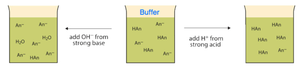
Buffers work by intercepting added H+ or OH- ions, converting them into weak acids or bases, thus minimizing pH changes. If the buffer components are overwhelmed by excess strong acid or base, the buffer loses effectiveness.
When base is added: The weak acid neutralizes the base, forming more conjugate base.
When acid is added: The conjugate base neutralizes the acid, forming more weak acid.
Buffer Capacity
Buffer capacity refers to the amount of acid or base a buffer can neutralize before a significant pH change occurs. A buffer is most effective when the concentrations of acid and conjugate base are high and nearly equal. The buffer is reasonably effective when the ratio of acid to base does not differ by more than a factor of 10.
High Capacity: Large, nearly equal concentrations of acid and base.
Low Capacity: Low concentrations or highly unequal ratios.
pH Range of an Effective Buffer
The effective pH range of a buffer is typically within one pH unit above or below the pKa of the weak acid:
Effective Range: pH = pKa ± 1
Henderson-Hasselbalch Equation
The Henderson-Hasselbalch equation provides a convenient way to calculate the pH of a buffer solution:
Equation:
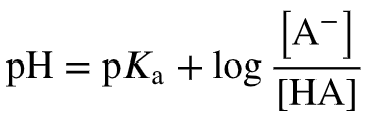
This equation assumes that the concentrations of acid and conjugate base do not change significantly upon addition of small amounts of acid or base.
Calculating Buffer pH: Stepwise Algorithm
Write the chemical reaction and equilibrium expression.
Determine initial concentrations of weak acid/base and conjugate base/acid.
Calculate the change in concentration after addition of acid or base (stoichiometry).
Determine the final concentration of H+ (or OH-).
Convert to pH using .
Examples and Applications
Example 1: Calculate the pH of a buffer solution that is 0.100 M in acetic acid and 0.100 M in sodium acetate.
Example 2: Calculate the pH after adding a strong acid or base to a buffer, using stoichiometry and the Henderson-Hasselbalch equation.
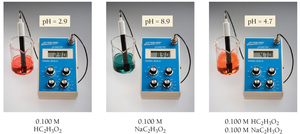
Buffer Calculations: Stoichiometry and ICE Tables
When a strong acid or base is added to a buffer, use stoichiometry to determine how much of the buffer components are consumed or produced. Then, use an ICE (Initial, Change, Equilibrium) table to find the new equilibrium concentrations and calculate the new pH.
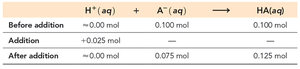
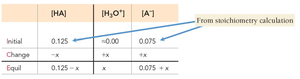
Buffer Effectiveness and Capacity: Worked Examples
Buffer effectiveness is demonstrated by calculating the percent change in pH after adding a strong acid or base. The smaller the percent change, the more effective the buffer.
Initial Moles (HA:A-) | Added Strong Base (mol) | Final pH | % Change |
|---|---|---|---|
0.1 : 0.1 | 0.01 | 5.09 | 1.8% |
0.18 : 0.02 | 0.01 | 4.25 | 4.9% |
0.5 : 0.5 | 0.01 | 5.01 | 0.2% |
0.05 : 0.05 | 0.01 | 4.70 | 6.0% |
Additional info: The buffer is most effective when the ratio of acid to base is close to 1 and the concentrations are high.
Summary Table: Physiological pH Values
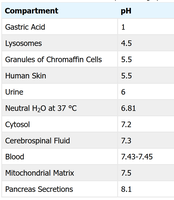
Buffers are critical in biological systems. The following table summarizes the pH of various biological compartments:
Compartment | pH |
|---|---|
Gastric Acid | 1 |
Lysosomes | 4.5 |
Granules of Chromaffin Cells | 5.5 |
Human Skin | 5.5 |
Urine | 6 |
Neutral H2O at 37°C | 6.81 |
Cytosol | 7.2 |
Cerebrospinal Fluid | 7.3 |
Blood | 7.43–7.45 |
Mitochondrial Matrix | 7.5 |
Pancreas Secretions | 8.1 |
Summary
Buffers are vital for maintaining stable pH in chemical and biological systems.
The Henderson-Hasselbalch equation is a powerful tool for buffer calculations.
Buffer capacity depends on the absolute and relative concentrations of acid and base.
Buffers are most effective when the acid and base concentrations are high and nearly equal.
