 Back
BackBuffers: Properties, Calculations, and Titration Applications
Study Guide - Smart Notes
 Tailored notes based on your materials, expanded with key definitions, examples, and context.
Buffers of Aqueous Acids and Bases
Introduction to Buffers
A buffer is a solution that resists significant changes in pH when small amounts of strong acid or base are added. Buffers are essential in many chemical and biological systems to maintain a stable pH environment.
Composition: Buffers contain relatively large amounts of a weak acid (HA) and its conjugate base (A-).
Action: When H3O+ (strong acid) is added, it reacts with the conjugate base. When OH- (strong base) is added, it reacts with the weak acid.
pH Determination: The pH is determined by the equilibrium between the weak acid and its conjugate base.
How Buffers Work: Visual Representation
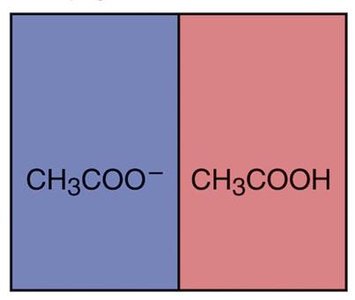
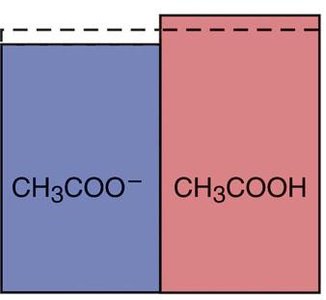
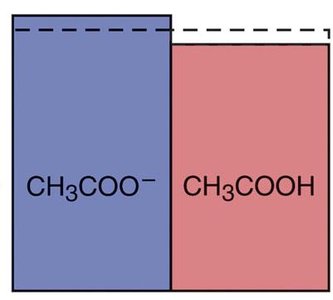
The following diagrams illustrate the effect of adding strong acid or base to a buffer composed of acetic acid (CH3COOH) and its conjugate base (CH3COO-):
Initial Buffer: Equal concentrations of CH3COOH and CH3COO-.
After Addition of H3O+: The added acid reacts with CH3COO-, decreasing its concentration and increasing CH3COOH.
After Addition of OH-: The added base reacts with CH3COOH, decreasing its concentration and increasing CH3COO-.
Buffer Capacity
Buffer capacity is the measure of a buffer's ability to resist pH change. It increases as the concentrations of the buffer components increase (assuming equal volumes).
High buffer capacity means the solution can neutralize more added acid or base without a significant pH change.
The Henderson-Hasselbalch Equation
The Henderson-Hasselbalch equation is used to calculate the pH of a buffer solution:
pKa is the negative logarithm of the acid dissociation constant (Ka).
This equation is especially useful for buffer calculations and when preparing buffer solutions of a desired pH.
Buffer Calculations: Example Problems
Consider a buffer made from 0.50 M CH3COOH and 0.50 M CH3COONa (Ka = 1.8 × 10⁻⁵):
Initial pH: Use the Henderson-Hasselbalch equation with equal concentrations of acid and base.
pH = 4.74
After Adding 0.020 mol NaOH to 1.0 L Buffer:
NaOH reacts with CH3COOH, converting it to CH3COO-.
New concentrations: CH3COOH = 0.48 M, CH3COO- = 0.52 M
Apply Henderson-Hasselbalch equation:
After Adding 0.020 mol HCl to 1.0 L Buffer:
HCl reacts with CH3COO-, converting it to CH3COOH.
New concentrations: CH3COOH = 0.52 M, CH3COO- = 0.48 M
Apply Henderson-Hasselbalch equation:
Preparing Buffers of Desired pH
To prepare a buffer of a specific pH, use the Henderson-Hasselbalch equation to determine the required ratio of conjugate base to acid. Then, calculate the amounts or volumes needed based on the desired total volume and concentrations.
Example: To prepare a carbonate buffer (CO32- and HCO3-) at pH 10.00, use the Ka of HCO3- and solve for the required moles of Na2CO3 to add to a given volume of NaHCO3.
Buffers in Titration
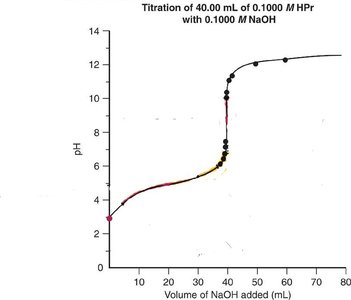
During the titration of a weak acid with a strong base (or vice versa), a buffer is formed in the region before the equivalence point. The solution contains both the weak acid and its conjugate base, which resists drastic pH changes.
At half-equivalence (Ve/2): The concentrations of acid and conjugate base are equal, so pH = pKa.
Equivalence point (Ve): All weak acid has been converted to its conjugate base.
Key Equations and Constants
at 25°C
at 25°C
Quadratic formula for equilibrium calculations:
Summary Table: Buffer Properties and Calculations
Concept | Key Points |
|---|---|
Buffer Composition | Weak acid + conjugate base (or weak base + conjugate acid) |
Buffer Capacity | Increases with higher concentrations of buffer components |
Henderson-Hasselbalch Equation | |
pH at Half-Equivalence | pH = pKa (when [acid] = [base]) |
Buffer in Titration | Exists before equivalence point; resists pH change |
