 Back
BackCalculating Internal Energy Change (ΔE) for a Balloon Expansion
Study Guide - Smart Notes
 Tailored notes based on your materials, expanded with key definitions, examples, and context.
Q1. A balloon is inflated by heating the air inside. The volume changes from L to L with the addition of J of energy as heat. The balloon expands against a constant pressure of 1.0 atm. Calculate for the process. (Use for unit conversion.)
Background
Topic: Thermodynamics – Internal Energy, Heat, and Work
This question tests your understanding of the First Law of Thermodynamics, specifically how to calculate the change in internal energy () when a system absorbs heat and does work against an external pressure.
Key Terms and Formulas
Internal Energy Change ():
Heat (): Energy added to the system (positive if absorbed)
Work (): For expansion against constant pressure:
Pressure (): External pressure (in atm)
Volume Change (): (in L)
Unit Conversion:
Step-by-Step Guidance
Identify the known values: J, atm, L, L.
Calculate the change in volume: .
Calculate the work done by the system: . Plug in the values for and (in L·atm).
Convert the work from L·atm to Joules using .
Set up the equation for : . Substitute the values for and (both in Joules).
Try solving on your own before revealing the answer!
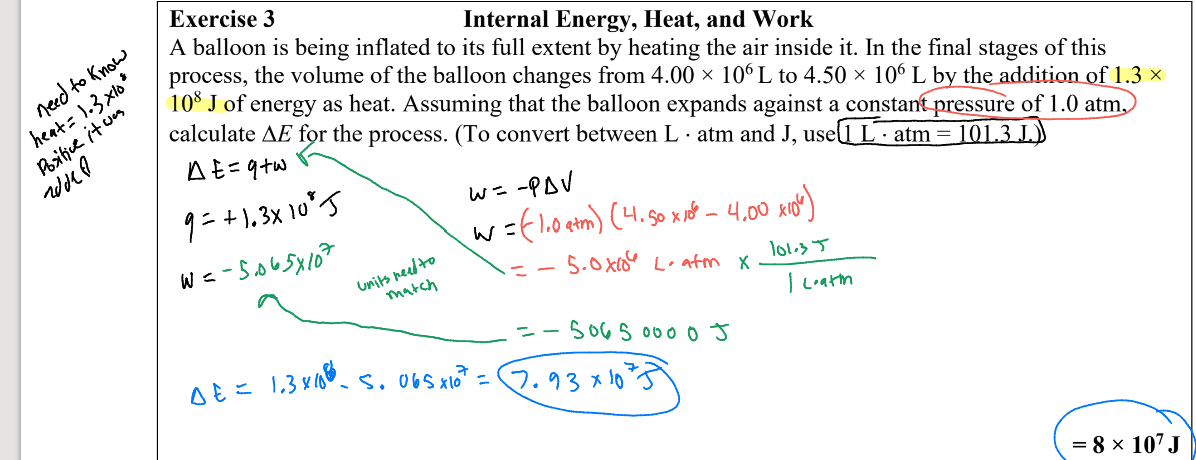
Final Answer: J
First, calculate L. The work done is .
Convert work to Joules: J.
Now, J J.
This result shows the net change in internal energy after accounting for both heat added and work done by the system.
