 Back
BackCalculating the Energy Change for the Formation of LiCl(s) from Its Elements
Study Guide - Smart Notes
 Tailored notes based on your materials, expanded with key definitions, examples, and context.
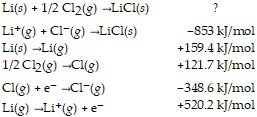
Q15. Calculate the energy change for the formation of LiCl(s) from its elements in their standard states using the provided tabulated information.
Background
Topic: Thermochemistry – Born-Haber Cycle
This question tests your understanding of the Born-Haber cycle, which is used to calculate the lattice energy and overall enthalpy change for the formation of an ionic compound from its elements.
Key Terms and Formulas
Born-Haber Cycle: A stepwise method to analyze the formation of ionic compounds using enthalpy changes.
Lattice Energy: The energy released when ions combine to form an ionic solid.
Ionization Energy: Energy required to remove an electron from an atom.
Electron Affinity: Energy change when an atom gains an electron.
Enthalpy of Formation (): The total energy change for forming a compound from its elements.
General formula for the Born-Haber cycle:
Step-by-Step Guidance
Identify the target reaction:
List all the relevant steps and their enthalpy changes from the table:
(sublimation)
(ionization energy)
(bond dissociation)
(electron affinity)
(lattice energy)
Write out the enthalpy values for each step (from the table):
Sublimation of Li: kJ/mol
Ionization of Li: kJ/mol
Dissociation of Cl: kJ/mol
Electron affinity of Cl: kJ/mol
Lattice energy: kJ/mol
Set up the sum of all these enthalpy changes to find the overall for the formation of LiCl(s):
Try solving on your own before revealing the answer!
Final Answer: -400.3 kJ/mol
kJ/mol$
This value represents the enthalpy change for the formation of LiCl(s) from its elements in their standard states, calculated using the Born-Haber cycle.
