Back
BackLesson 5.2: Calorimetry and Enthalpy: Measuring and Understanding Thermal Energy Changes
Study Guide - Smart Notes
 Tailored notes based on your materials, expanded with key definitions, examples, and context.
Calorimetry and Enthalpy
Introduction to Calorimetry and Enthalpy
Calorimetry is a fundamental technique in thermochemistry used to measure the energy changes that occur during physical or chemical processes. The concept of enthalpy, or total thermal energy, is central to understanding how substances absorb or release energy. These principles are crucial for analyzing reactions, designing thermal protection, and understanding everyday phenomena such as heating and cooling.
Heat Capacity and Specific Heat
Definition and Importance of Specific Heat Capacity
Specific heat capacity (c) is the quantity of thermal energy required to raise the temperature of 1 gram of a substance by 1 °C. The SI unit is J/(g·°C). Substances with high specific heat capacities, such as water, require more energy to change temperature compared to those with low specific heat capacities, like sand or metals. This property explains why water heats and cools more slowly than land or metals.
Key Point 1: High specific heat capacity means a substance can absorb or release large amounts of energy with little temperature change.
Key Point 2: Low specific heat capacity substances heat up and cool down quickly.
Example: Firefighter suits made of Nomex protect against heat because the fibers absorb thermal energy, preventing burns.
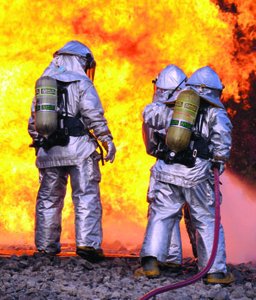
Table: Specific Heat Capacities of Common Substances
Substance | Specific Heat Capacity (J/(g·°C)) |
|---|---|
Liquid water, H2O(l) | 4.18 |
Ice, H2O(s) | 2.03 |
Aluminum, Al(s) | 0.900 |
Iron, Fe(s) | 0.444 |
Solid carbon (graphite), C(s) | 0.710 |
Liquid methanol, CH3OH(l) | 2.92 |
Solid silicon dioxide (sand), SiO2(s) | 0.835 |
Calorimetry and Thermal Energy Transfer
Principles of Calorimetry
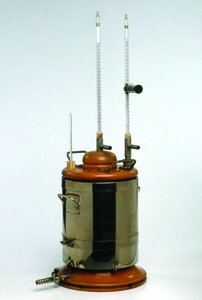
Calorimetry is the experimental process of measuring the thermal energy change in a chemical or physical change. A calorimeter is a device used for this purpose, typically consisting of an insulated chamber, a thermometer, and a stirrer. The insulation minimizes energy loss to the surroundings, ensuring accurate measurements.
Key Point 1: Calorimeters can be simple (e.g., coffee-cup calorimeter) or complex (e.g., bomb calorimeter).
Key Point 2: Coffee-cup calorimeters are used for reactions at constant pressure, while bomb calorimeters are used for reactions at constant volume, especially those involving gases.
Example: Measuring the energy released during combustion or neutralization reactions.
Calorimetry Calculations
The total thermal energy absorbed or released by a system is represented by q. The value of q depends on the mass (m), specific heat capacity (c), and temperature change (ΔT) of the substance:
Where .
Sign of q: If q is negative, the process is exothermic (energy released). If q is positive, the process is endothermic (energy absorbed).
Example: Mixing hot metal with water in a calorimeter and measuring the temperature change to calculate energy transfer.
Enthalpy and Enthalpy Change
Definition of Enthalpy (H) and Enthalpy Change (ΔH)
Enthalpy (H) is the total thermal energy in a substance. The enthalpy change (ΔH) is the energy released or absorbed during a chemical or physical change at constant pressure:
ΔH > 0: Endothermic reaction (energy absorbed)
ΔH < 0: Exothermic reaction (energy released)
Example: The reaction of magnesium with hydrochloric acid is exothermic, as indicated by a temperature increase in the calorimeter.
Molar Enthalpy Change (ΔHr)
The molar enthalpy change is the energy change associated with 1 mole of a substance undergoing a change. The SI unit is J/mol. For any amount n (in moles):
Types of molar enthalpy changes: Solution (ΔHsol), combustion (ΔHc), vaporization (ΔHvap), formation (ΔHf), neutralization (ΔHneut).
Example: Calculating the energy required to vaporize a given mass of ethanol using its molar enthalpy of vaporization.
Table: Molar Enthalpies of Reaction
Type of Molar Enthalpy Change | Example Equation |
|---|---|
Solution (ΔHsol) | NaBr(s) → Na+(aq) + Br−(aq) |
Combustion (ΔHc) | CH4(g) + 2 O2(g) → CO2(g) + 2 H2O(l) |
Vaporization (ΔHvap) | CH3OH(l) → CH3OH(g) |
Formation (ΔHf) | C(s) + 2 H2(g) + 1/2 O2(g) → CH3OH(l) |
Neutralization (ΔHneut) | NaOH(aq) + 1/2 H2SO4(aq) → 1/2 Na2SO4(aq) + H2O(l) |
Thermochemical Equations and Potential Energy Diagrams
Thermochemical Equations
A thermochemical equation is a chemical equation that includes the enthalpy change of the reaction. The energy term (ex. -802kj) can be written as part of the equation or as a ΔH value (enthalpy term) after the equation. The sign and placement of the energy term indicate whether the reaction is exothermic or endothermic.
Exothermic Example: or
Endothermic Example: or
Potential Energy Diagrams
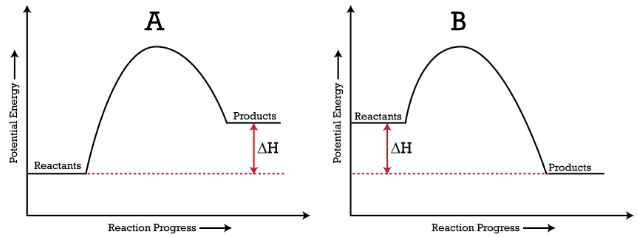
Potential energy diagrams graphically represent the energy changes during a reaction. The y-axis shows potential energy, and the x-axis shows reaction progress. For exothermic reactions, products have lower energy than reactants; for endothermic reactions, products have higher energy.
Exothermic Diagram: Downward slope from reactants to products (energy released).
Endothermic Diagram: Upward slope from reactants to products (energy absorbed).

Summary of Key Concepts
Specific heat capacity determines how much energy is needed to change a substance's temperature.
Calorimeters measure energy changes in chemical and physical processes.
Enthalpy change (ΔH) is the energy released or absorbed at constant pressure.
Molar enthalpy change relates energy change to the amount of substance.
Thermochemical equations and potential energy diagrams communicate the direction and magnitude of energy changes in reactions.