 Back
BackCh. 8 - Introduction to Solutions and Aqueous Reactions: Comprehensive Study Notes
Study Guide - Smart Notes
 Tailored notes based on your materials, expanded with key definitions, examples, and context.
Introduction to Solutions and Aqueous Reactions
Concept of Solutions
Solutions are homogeneous mixtures composed of two or more substances, where the composition is uniform throughout. The main components of a solution are the solute and the solvent.
Solute: The substance dissolved in the solvent, usually present in a lesser amount.
Solvent: The substance present in the greater amount, which dissolves the solute.
Concentration: A measure of the amount of solute in a given quantity of solution.
Types of Mixtures: Solutions, Suspensions, and Colloids
Mixtures can be classified based on the size of their solute particles and their behavior in the solvent.
Solutions: Particle size less than 1 nm; particles do not settle.
Suspensions: Heterogeneous mixtures with large solute particles (greater than 500 nm) that settle over time. Example: Salad dressing.
Colloids: Mixtures with intermediate particle sizes (1–500 nm); particles do not settle. Example: Milk.
Example: If 10.0 g NaCl is dissolved in 500.0 mL water, NaCl is the solute, water is the solvent, and together they form a solution.
Identifying Solutions, Suspensions, and Colloids
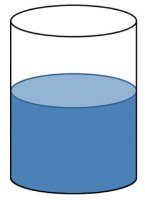
Visual identification can be made based on clarity and particle behavior.
Molarity and Solution Calculations
Concept of Molarity
Molarity (M) is a common unit of concentration, defined as the number of moles of solute per liter of solution.
Formula:
Example: Calculate the molarity of a solution prepared by dissolving 23.7 g NaOH in enough water to make 2.50 L of solution.
Using Molarity to Calculate Unknowns
Molarity can be used as a conversion factor in stoichiometric calculations.
For example, 5.8 M NaCl means 5.8 moles NaCl per 1.0 L of solution.
Example: How many grams of Na3PO4 (MW: 163.94 g/mol) are present in 300.0 mL of a 0.550 M Na3PO4 solution?
Osmolarity
Concept of Osmolarity
Osmolarity measures the total concentration of ions in solution.
Formula:
Can be calculated directly or from the molarity of a compound by multiplying by the number of ions produced per formula unit.
Example: What is the concentration of hydroxide ions in a 0.350 M solution of Ga(OH)3?
Dilutions
Concept of Dilutions
A stock solution is a concentrated solution that is diluted for laboratory use. Dilution involves adding more solvent to decrease the concentration.
Dilution Formula:
and are the molarity and volume before dilution; and are after dilution.
is always greater than .
is the final volume after adding solvent.
Solubility Rules
Concept of Solubility
Solubility is the ability of a solute to dissolve in a solvent. Solubility rules help predict whether a compound will be soluble or insoluble in water.
Soluble: Dissolves in water.
Insoluble: Does not dissolve in water.

Solubility Rules Table
Solubility rules are summarized in tables for quick reference.
Group | Exceptions | Explanation |
|---|---|---|
GANA CASH | SHhhh! Keep quiet about the cash. | Soluble ionic solutes; exceptions are insoluble. |
COPS | Oh Snap! It’s the cops! | Insoluble ionic solutes; exceptions are soluble. |
Electrolytes
Concept of Electrolytes
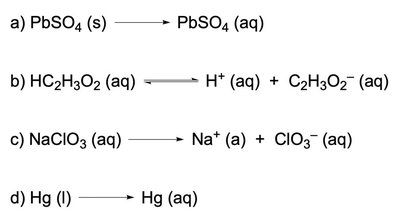
Electrolytes are compounds that conduct electricity when dissolved or melted, due to the formation of ions.
Strong Electrolytes: Completely dissociate into ions (strong acids, strong bases, soluble ionic compounds).
Weak Electrolytes: Partially dissociate into ions (weak acids, weak bases).
Non-Electrolytes: Do not dissociate into ions (molecular/covalent compounds like water, sugars, alcohols).
Molecular, Complete Ionic, and Net Ionic Equations
Molecular Equations
A molecular equation shows reactants and products as intact compounds, not as ions.
Types: Neutralization, gas evolution, precipitation.
Steps: Break into ions, swap partners, check for formation of solid, gas, or water, balance equation.
Complete Ionic Equations
Shows all soluble compounds as dissociated ions. Solids, liquids, and gases are not broken up.
Coefficients are distributed to ions.
Net Ionic Equations
Shows only the ions and molecules directly involved in the reaction, omitting spectator ions.
Spectator ions are present in both reactants and products but do not participate in the reaction.
Oxidation Numbers and Redox Reactions
Calculating Oxidation Numbers
Oxidation number is an element’s ability to gain or lose electrons in a compound or alone.
Atoms in their natural state have an oxidation number of zero.
Ions: Oxidation number equals the ion’s charge.
Rules are used to assign oxidation numbers in compounds.
Redox Reactions
Redox reactions involve the transfer of electrons between reactants.
Oxidation: Loss of electrons; oxidation number increases.
Reduction: Gain of electrons; oxidation number decreases.
Oxidizing agent: Causes oxidation, is itself reduced.
Reducing agent: Causes reduction, is itself oxidized.

Balancing Redox Reactions
Acidic Solutions
Balancing redox reactions in acidic solutions involves breaking the reaction into half-reactions and balancing atoms, oxygen (with H2O), hydrogen (with H+), and charge (with electrons).
Combine half-reactions and cancel intermediates.
Basic Solutions
Balancing in basic solutions follows the same steps as acidic, with an additional step: add OH– to neutralize H+ and form water.
Activity Series and Single Displacement Reactions
Concept of Activity Series
The activity series is a chart that ranks elements by their ability to displace others in single displacement reactions.
An element higher in the series can displace one below it.
Used to predict whether a reaction will occur.

Summary Table: Types of Mixtures
Type | Particle Size | Settling | Example |
|---|---|---|---|
Solution | < 1 nm | No | Salt water |
Colloid | 1–500 nm | No | Milk |
Suspension | > 500 nm | Yes | Salad dressing |
Summary Table: Solubility Rules (GANA CASH & COPS)
Mnemonic | Soluble Compounds | Exceptions |
|---|---|---|
GANA CASH | Group 1, Ammonium, Nitrates, Acetates, Chlorates, Sulfates, Halides | CBS HAPpy (Ca, Ba, Sr, Hg, Ag, Pb) |
COPS | Carbonates, Oxides, Phosphates, Sulfides, Hydroxides | Soluble with Group 1, NH4+ |
