 Back
BackChapter 1: Chemistry and Matter – Foundations of General Chemistry
Study Guide - Smart Notes
 Tailored notes based on your materials, expanded with key definitions, examples, and context.
Chemistry: The Central Science
Definition and Scope of Chemistry
Chemistry is the study of the nature, properties, and transformations of matter. It is often called the central science because it connects and overlaps with many other scientific disciplines, including biology, physics, environmental science, and medicine.
Matter: Anything that has mass and occupies space; includes all substances you can see, touch, taste, or smell.
Scientific Method: The systematic process of observation, hypothesis formation, and experimentation used to expand scientific knowledge.
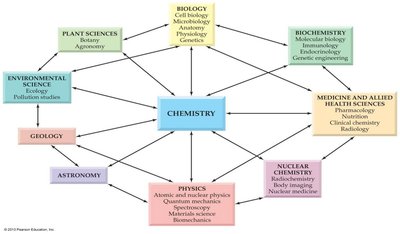
Additional info: Chemistry's central role is illustrated by its connections to fields such as biochemistry, physics, geology, and environmental science, highlighting its foundational importance in understanding the natural world.
Why Study Chemistry?
Chemistry is present in everyday life, from the ingredients in toothpaste and shampoo to the reactions that occur when baking or burning fuel. Understanding chemistry helps explain the composition and behavior of substances around us.
Examples: Fluoride in toothpaste, sodium lauryl sulfate in shampoo, vitamins in cereal.
Chemical reactions in daily life: Bread rising (CO2 production), baking reactions, combustion of gasoline, and the reaction causing onions to make you cry (formation of sulfuric acid in tears).
Physical and Chemical Properties of Matter
Physical Properties
Physical properties can be observed or measured without changing the composition of matter. They are used to describe and identify substances.
Examples: Appearance, texture, color, odor, melting point, boiling point, density, solubility, polarity.
Chemical Properties
Chemical properties describe a substance's potential to undergo chemical change due to its composition. These properties are observed when a substance interacts with other substances, resulting in a chemical reaction.
Examples: Flammability of hydrogen, reactivity of metals with acids.
Table: Some Properties of Water, Sugar, and Baking Soda
Water | Sugar (Sucrose) | Baking Soda (Sodium Bicarbonate) | |
|---|---|---|---|
Physical Properties | Colorless liquid, odorless, melting point: 0°C, boiling point: 100°C | White crystals, odorless, decomposes at 160°C | White powder, odorless, decomposes at 270°C |
Chemical Properties | 11.2% hydrogen, 88.8% oxygen, does not burn | 6.4% hydrogen, 42.1% carbon, 51.5% oxygen, burns in air | 27.4% sodium, 1.2% hydrogen, 14.3% carbon, 57.1% oxygen, does not burn |
Additional info: The table compares both physical and chemical properties, illustrating how substances can be distinguished by these characteristics.
States of Matter
Classification of Matter by Physical State
Matter exists in three primary states: solid, liquid, and gas. Each state is defined by its shape and volume characteristics.
Solid: Definite shape and volume.
Liquid: Definite volume, shape determined by container.
Gas: Neither definite shape nor volume; expands to fill container.
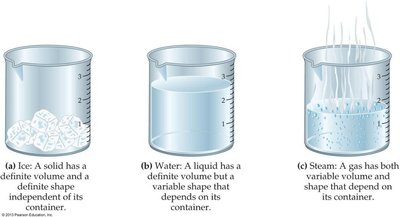
Example: Butane has a melting point of –138.4°C and a boiling point of –0.5°C. At room temperature (25°C), butane is a gas.
Physical and Chemical Changes
Physical Changes
A physical change occurs without altering the molecular composition of a substance. The same element or compound is present before and after the change.
Examples: Dissolving salt in water, phase changes (melting, boiling, freezing).
Chemical Changes
A chemical change results in the formation of one or more new substances with different compositions and properties from the original substances. This involves the rearrangement of atoms and the making or breaking of chemical bonds.
Example: Passing an electric current through water produces hydrogen and oxygen gases.
Example: Nickel reacts with hydrochloric acid to form a green solution and release gas.
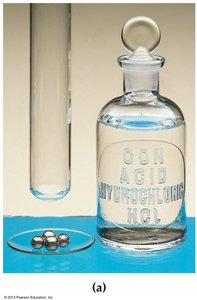
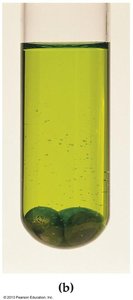
Additional info: The images above show the visual evidence of a chemical reaction: color change, dissolution of nickel, and gas evolution.
Evidence of Chemical Reactions
Gas produced (bubbles appear)
Change in color
Formation of a precipitate
Heat or flame produced
Emission of light
Examples: Physical vs. Chemical Change
Physical change: Boiling water to form steam (no new substance formed).
Chemical change: Burning gasoline, decomposing water, neutralizing acid with base (new substances formed).
Physical Properties of Water
Key Physical Properties
Color: Colorless
Appearance: Clear liquid at room temperature
Odor: Odorless
Melting point: 0°C
Boiling point: 100°C
Density: About 1 g/mL
Solubility: Many polar and ionic compounds are soluble in water
Polarity: Water is a polar molecule
