Back
Chapter 1: Introduction to Matter, Energy, and Measurement – General Chemistry Study Notes
Study Guide - Smart Notes
 Tailored notes based on your materials, expanded with key definitions, examples, and context.
Introduction to Chemistry
Definition and Importance
Chemistry is the scientific study of matter, its properties, and the changes it undergoes. It is central to understanding many fields, including energy, biochemistry, technology, and medicine. Chemists investigate the composition, structure, and transformations of substances, providing foundational knowledge for advancements in science and industry.

Matter and Its Classification
Definition of Matter
Matter is anything that has mass and occupies space. All physical objects and substances are composed of matter.
Methods of Classification
Matter can be classified by its state (solid, liquid, gas) and its composition (element, compound, mixture).
States of Matter
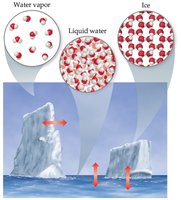
The three primary states of matter are:
Solid: Definite shape and volume
Liquid: Definite volume, variable shape
Gas: Variable shape and volume
Water is a common example, existing as ice (solid), liquid water, and water vapor (gas).
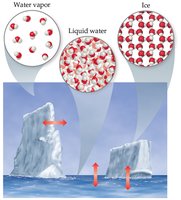
Classification Based on Composition
Matter is further classified as:
Pure substances: Elements and compounds with fixed composition
Mixtures: Combinations of substances with variable composition
Mixtures can be homogeneous (uniform throughout, also called solutions) or heterogeneous (not uniform).
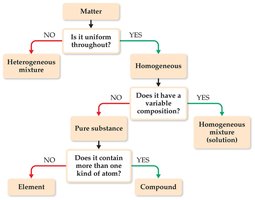
Elements and Compounds
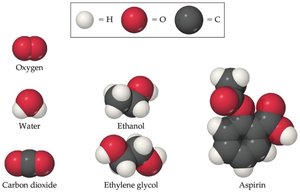
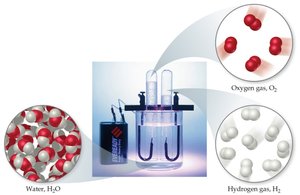
Elements are substances that cannot be decomposed into simpler substances. Each element consists of a unique type of atom. Compounds are substances composed of two or more elements chemically combined in fixed proportions. Atoms are the fundamental building blocks of matter, and molecules are groups of atoms bonded together.
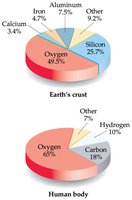
Elemental Composition of Earth and Human Body
There are 118 named elements. Oxygen is the most abundant element in both the Earth's crust and the human body.
Representing Elements
Chemists use symbols (one or two letters) to represent elements. The first letter is always capitalized. Some symbols are derived from Latin or Greek names.
Law of Constant Composition
Compounds have a definite composition, meaning the relative number of atoms of each element is the same in any sample. This is known as the Law of Constant Composition (or Law of Definite Proportions).

Mixtures
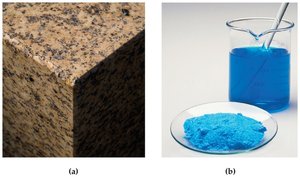
Mixtures exhibit the properties of their components and can be separated by physical means. They are classified as:
Homogeneous mixtures: Uniform composition (solutions)
Heterogeneous mixtures: Non-uniform composition
Properties of Matter
Physical and Chemical Properties
Physical properties can be observed without changing the substance (e.g., color, odor, density, melting point, boiling point, hardness).
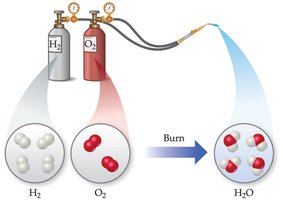
Chemical properties are observed when a substance undergoes a chemical change (e.g., flammability, reactivity).
Intensive vs. Extensive Properties
Intensive properties: Independent of the amount of substance (e.g., density, boiling point, color)
Extensive properties: Depend on the amount of substance (e.g., mass, volume, energy)
Physical and Chemical Changes
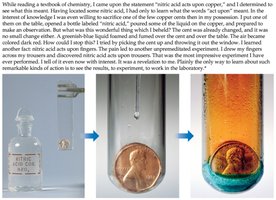
Physical changes do not alter the composition of a substance (e.g., changes of state, temperature, volume). Chemical changes result in new substances (e.g., combustion, oxidation, decomposition).
Separation of Mixtures
Filtration
Filtration separates solid substances from liquids and solutions based on particle size.

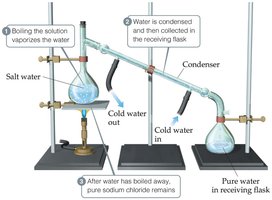
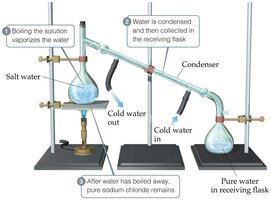
Distillation
Distillation separates components of a homogeneous mixture based on differences in boiling points.
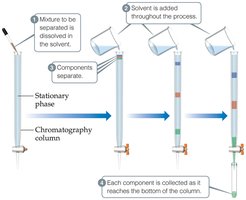
Chromatography
Chromatography separates substances based on their ability to adhere to a solid surface, such as dyes to paper or components in a column.
Energy and Its Forms
Definition of Energy
Energy is the capacity to do work or transfer heat. Work is energy transferred when a force causes displacement. Heat is energy used to increase temperature. Force is any push or pull on an object.
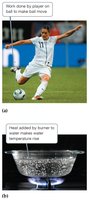
Kinetic and Potential Energy
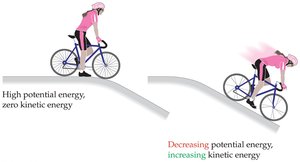
Kinetic energy: Energy of motion, depends on mass and velocity
Potential energy: Energy due to position relative to other objects
The kinetic energy () of an object is given by: where is mass and is velocity.
Measurement in Chemistry
Units of Measurement (SI and Metric System)
The International System of Units (SI) uses different base units for each quantity. Common units include:
Mass: kilogram (kg), gram (g)
Length: meter (m)
Time: second (s)
Temperature: Kelvin (K), Celsius (°C)
Amount of substance: mole (mol)
Volume: liter (L), milliliter (mL)
Metric System Prefixes
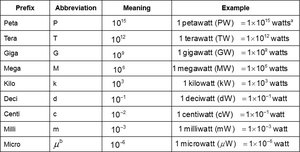
Prefixes are used to express multiples or fractions of base units. Common prefixes include kilo (k), centi (c), milli (m), micro (μ), nano (n), etc.
Prefix | Abbreviation | Meaning | Example |
|---|---|---|---|
Peta | P | 1015 | 1 petawatt (PW) = 1×10¹⁵ watts |
Tera | T | 1012 | 1 terawatt (TW) = 1×10¹² watts |
Giga | G | 109 | 1 gigawatt (GW) = 1×10⁹ watts |
Mega | M | 106 | 1 megawatt (MW) = 1×10⁶ watts |
Kilo | k | 103 | 1 kilowatt (kW) = 1×10³ watts |
Deci | d | 10-1 | 1 deciwatt (dW) = 1×10⁻¹ watt |
Cent | c | 10-2 | 1 centiwatt (cW) = 1×10⁻² watt |
Milli | m | 10-3 | 1 milliwatt (mW) = 1×10⁻³ watt |
Micro | μ | 10-6 | 1 microwatt (μW) = 1×10⁻⁶ watt |
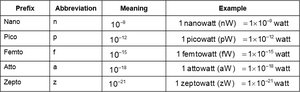
Prefix | Abbreviation | Meaning | Example |
|---|---|---|---|
Nano | n | 10-9 | 1 nanowatt (nW) = 1×10⁻⁹ watt |
Pico | p | 10-12 | 1 picowatt (pW) = 1×10-12 watt |
Femto | f | 10-15 | 1 femtowatt (fW) = 1×10-15 watt |
Atto | a | 10-18 | 1 attowatt (aW) = 1×10-18 watt |
Zepto | z | 10-21 | 1 zeptowatt (zW) = 1×10-21 watt |
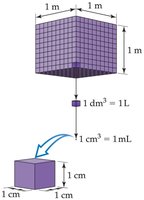
Volume Measurement
Volume is a derived unit from length. Common units are liter (L) and milliliter (mL). 1 L = 1 dm3, 1 mL = 1 cm3.
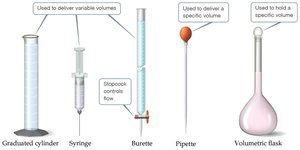
Glassware for Measuring Volume
Common laboratory glassware includes graduated cylinders, syringes, burettes, pipettes, and volumetric flasks, each designed for specific volume measurements.
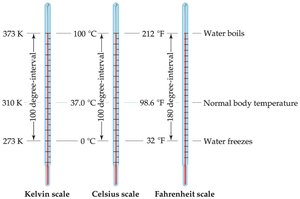
Temperature Measurement
Temperature determines the direction of heat flow. The Celsius and Kelvin scales are most used in science. The Kelvin scale is the SI unit, with absolute zero as its minimum. Conversion between Celsius and Kelvin: .
Energy Units
Joule and Calorie
The SI unit of energy is the joule (J). 1 J is the energy possessed by a 2 kg object moving at 1 m/s. The kilojoule (kJ) is commonly used in chemistry. Historically, the calorie was used: 1 cal = 4.184 J. The nutritional Calorie (Cal) is 1 kcal = 1000 cal.
Density
Definition and Units
Density is a physical property defined as mass per unit volume. Common units are g/mL or g/cm3.
The formula for density is:
Numbers and Measurement in Chemistry
Exact vs. Inexact Numbers
Exact numbers are counted or defined (e.g., 12 eggs in a dozen). Inexact numbers are measured and subject to uncertainty.
Uncertainty in Measurement
All measurements have some degree of inaccuracy due to instrument limitations and human error. The last digit measured is considered reliable but not exact.
Accuracy vs. Precision
Accuracy: How close a measurement is to the true value
Precision: How close repeated measurements are to each other

Significant Figures
All digits of a measured quantity, including uncertain ones, are called significant figures. Rules for significant figures:
All nonzero digits are significant
Zeroes between nonzero digits are significant
Zeroes at the beginning are not significant
Zeroes at the end are significant if there is a decimal point
When performing calculations, the result should be rounded to reflect the least certain measurement.
Dimensional Analysis
Dimensional analysis is used to convert units by applying conversion factors. For example, to convert meters to inches:
Use to convert meters to centimeters
Use to convert centimeters to inches

Copyright Notice
This work is protected by copyright laws and is intended for educational use only.