 Back
BackChapter 1: Keys to the Study of Chemistry – Matter, Measurement, and Problem Solving
Study Guide - Smart Notes
 Tailored notes based on your materials, expanded with key definitions, examples, and context.
Keys to the Study of Chemistry
Introduction to Chemistry
Chemistry is the scientific study of matter, its properties, the changes it undergoes, and the energy associated with those changes. Understanding chemistry is foundational for exploring the physical world and forms the basis for many scientific and technological advancements.
Some Fundamental Definitions
Matter and Its Properties
Matter: Anything that has mass and occupies space. Examples include books, water, air, and living organisms.
Composition: The types and amounts of simpler substances that make up a sample of matter.
Properties: The characteristics that give each substance a unique identity.
Physical Properties: Properties observed without changing the substance’s composition (e.g., color, melting point, boiling point, density).
Chemical Properties: Properties observed when a substance interacts with or transforms into another substance (e.g., flammability, reactivity with acids).



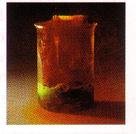

Physical and Chemical Changes
Physical Change: A change in form or physical state without altering composition (e.g., melting, freezing, dissolving).
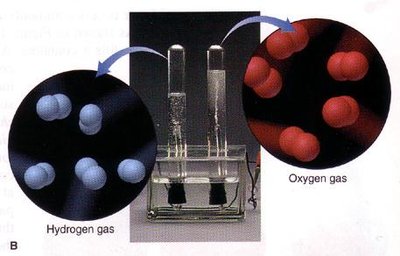
Chemical Change (Chemical Reaction): A process in which one or more substances are converted into new substances with different compositions and properties.
Signs of Chemical Change:
Evolution of a gas
Change in color
Formation of a precipitate
Change in temperature (indicating a change in composition)
States of Matter
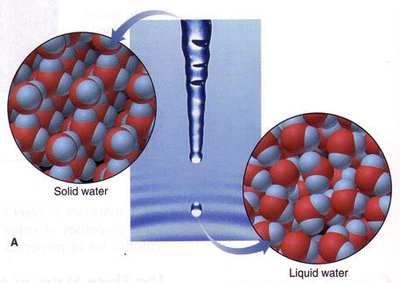
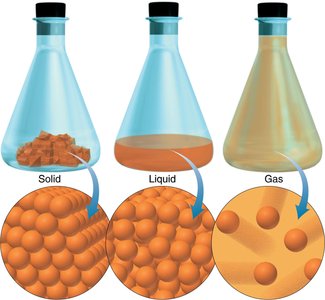
Matter exists in three primary physical states: solid, liquid, and gas. Each state is characterized by the arrangement and movement of its particles.
Solid: Definite shape and volume; particles are closely packed in a fixed arrangement.
Liquid: Definite volume but no definite shape; particles are close but can move past one another.
Gas: No definite shape or volume; particles are far apart and move freely.
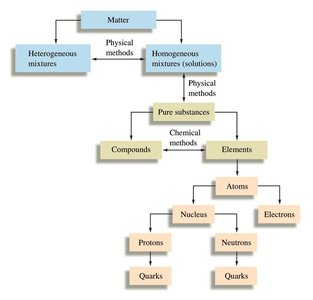
Classification of Matter
Matter can be classified based on its composition and uniformity:
Mixtures: Physical combinations of two or more substances.
Heterogeneous Mixtures: Non-uniform composition (e.g., salad, granite).
Homogeneous Mixtures (Solutions): Uniform composition throughout (e.g., saltwater, air).
Pure Substances: Have a fixed composition and distinct properties.
Elements: Cannot be broken down into simpler substances by chemical means.
Compounds: Consist of two or more elements chemically combined in fixed proportions.
Chemical Arts and the Origins of Modern Chemistry
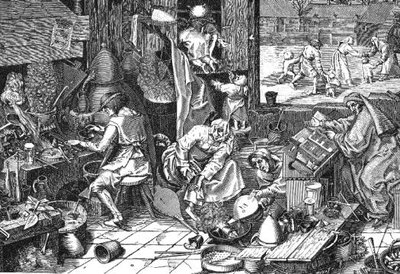
Historical Roots
The development of chemistry was influenced by ancient practices such as alchemy, medicine, and technology. Alchemy, in particular, contributed experimental techniques and apparatus that laid the groundwork for modern chemistry.


The Scientific Approach: Developing a Model
Steps in the Scientific Method
Observations: Gathering data from natural phenomena and measured events. Consistent observations may be stated as natural laws.
Hypothesis: A tentative explanation for observations.
Experiment: A controlled procedure to test a hypothesis, measuring one variable at a time.
Model (Theory): A set of conceptual assumptions that explains experimental data and predicts related phenomena.
Further Experiment: Additional tests to validate or revise the model.
Chemical Problem Solving
Systematic Approach to Problem Solving
Problem Statement: Clearly define what is being asked.
Plan: Identify knowns and unknowns, outline steps, and prepare a visual summary if helpful.
Solution: Carry out the steps logically.
Check: Review the answer for reasonableness and accuracy.
Measurement in Scientific Study
SI Base Units
The International System of Units (SI) is the standard for scientific measurements. The seven base units are:
Physical Quantity | Unit Name | Unit Abbreviation |
|---|---|---|
Mass | kilogram | kg |
Length | meter | m |
Time | second | s |
Temperature | kelvin | K |
Electric current | ampere | A |
Amount of substance | mole | mol |
Luminous intensity | candela | cd |
SI Prefixes
Prefixes are used to indicate multiples or fractions of units:
Prefix | Symbol | Factor |
|---|---|---|
kilo | k | |
centi | c | |
milli | m | |
micro | \mu | |
nano | n | |
pico | p |
Common SI-English Equivalents
Some useful conversions:
1 inch = 2.54 cm (exactly)
1 lb = 0.4536 kg
1 qt = 0.9464 L
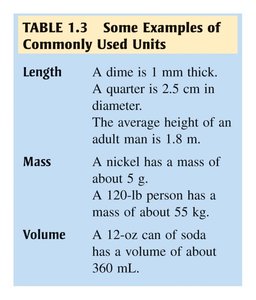
Examples of Commonly Used Units
Uncertainty in Measurement: Significant Figures
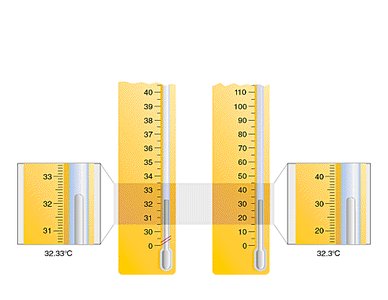
Significant Figures
All nonzero digits are significant.
Zeros between nonzero digits are significant.
Leading zeros are not significant.
Trailing zeros are significant if there is a decimal point.
Exact numbers (from definitions or counting) have infinite significant figures.
Rules for Calculations
Addition/Subtraction: The result has the same number of decimal places as the measurement with the fewest decimal places.
Multiplication/Division: The result has the same number of significant figures as the measurement with the fewest significant figures.
Rounding Off Numbers
If the digit removed is more than 5, increase the preceding number by 1.
If the digit removed is less than 5, leave the preceding number unchanged.
If the digit removed is 5, round to the nearest even number.
Carry extra digits through calculations and round only the final answer.
Precision and Accuracy in Measurements
Definitions
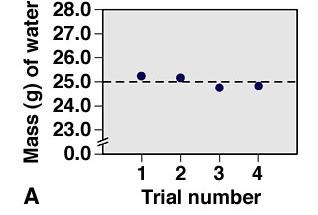
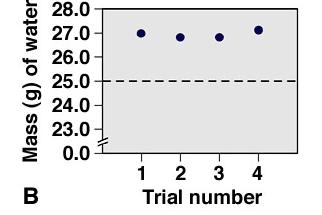
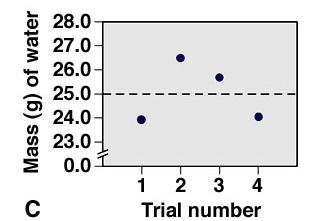
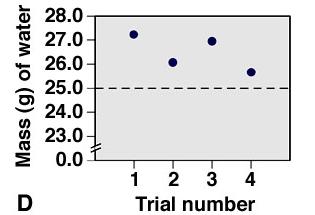
Precision: The reproducibility of measurements (how close repeated measurements are to each other).
Accuracy: How close a measurement is to the true or accepted value.
Random Error: Causes measurements to fluctuate around the true value.
Systematic Error: Causes measurements to be consistently higher or lower than the true value.
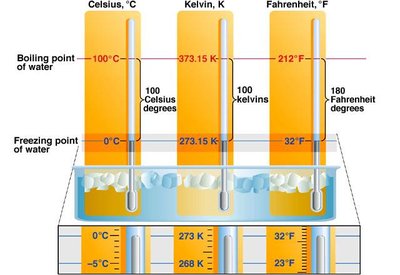
Temperature Scales and Interconversions
Temperature Scales
Kelvin (K): Absolute temperature scale; starts at absolute zero.
Celsius (°C): Water freezes at 0°C and boils at 100°C.
Fahrenheit (°F): Water freezes at 32°F and boils at 212°F.
Conversion formulas:
Density
Definition and Calculation
Density relates the mass of an object to its volume and is a key physical property for identifying substances.
Formula:
Common units: g/cm3 for solids and liquids, g/L for gases.
Substance | Physical State | Density (g/cm3) |
|---|---|---|
Hydrogen | Gas | 0.0000899 |
Oxygen | Gas | 0.00133 |
Water | Liquid | 0.998 |
Table salt | Solid | 2.16 |
Aluminum | Solid | 2.70 |
Lead | Solid | 11.3 |
Gold | Solid | 19.3 |
Summary
Chemistry is the study of matter, its properties, and the changes it undergoes.
Understanding measurements, significant figures, and the scientific method is essential for scientific inquiry.
Physical and chemical properties and changes distinguish substances and their transformations.
SI units and proper handling of measurements ensure accuracy and precision in scientific work.
