 Back
BackChapter 1: Matter, Measurement & Problem Solving – Study Notes
Study Guide - Smart Notes
 Tailored notes based on your materials, expanded with key definitions, examples, and context.
Chapter 1: Matter, Measurement & Problem Solving
Matter and Its Classification
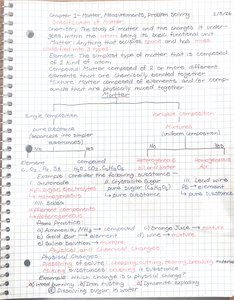
Matter is anything that occupies space and has mass. Chemistry is the study of matter and the changes it undergoes. Understanding the classification of matter is fundamental to general chemistry.
Element: A pure substance composed of only one type of atom. Example: Oxygen (O2).
Compound: A pure substance composed of two or more different types of atoms chemically bonded. Example: Water (H2O).
Mixture: Matter composed of two or more substances physically mixed together, not chemically bonded.
Classification of Matter:
Pure Substances: Elements and compounds.
Mixtures: Can be homogeneous (uniform composition) or heterogeneous (non-uniform composition).
Physical and Chemical Changes
Understanding the difference between physical and chemical changes is essential for identifying processes in chemistry.
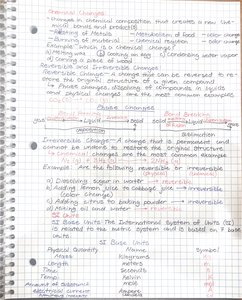
Physical Change: Changes that do not alter the chemical composition of a substance. Examples: melting, boiling, dissolving.
Chemical Change: Changes that alter the chemical composition, resulting in new substances. Examples: rusting of iron, metabolism of food.
Irreversible vs. Reversible Changes:
Irreversible Change: Cannot be reversed to recover the original substance. Example: burning paper.
Reversible Change: Can be reversed. Example: melting ice.
Measurement and Units
Measurement is a key aspect of chemistry, requiring the use of standardized units and careful attention to precision.
Physical Quantity: Measurable property (e.g., mass, length, time).
SI Base Units: Standard units for scientific measurement.
Physical Quantity | Name | Symbol |
|---|---|---|
Length | Meter | m |
Mass | Kilogram | kg |
Time | Second | s |
Amount of Substance | Mole | mol |
Temperature | Kelvin | K |
Significant Figures
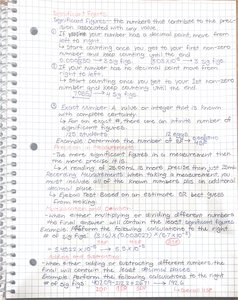
Significant figures are the digits in a measurement that are known with certainty plus one digit that is estimated. They are crucial for expressing the precision of measurements and calculations.
Rules for Counting Significant Figures:
Non-zero digits are always significant.
Zeros between non-zero digits are significant.
Leading zeros are not significant.
Trailing zeros are significant only if there is a decimal point.
Exact Numbers: Values known with complete certainty (e.g., counting numbers, defined quantities).
Examples:
Number: 0.00450 has 3 significant figures.
Number: 1200 has 2 significant figures (unless specified otherwise).
Calculations with Significant Figures:
Addition/Subtraction: The result should have the same number of decimal places as the measurement with the fewest decimal places.
Multiplication/Division: The result should have the same number of significant figures as the measurement with the fewest significant figures.
Example Calculation:
Adding 1.23 + 2.1 = 3.3 (rounded to 1 decimal place)
Multiplying 2.5 × 3.42 = 8.6 (rounded to 2 significant figures)
Formula for Significant Figures:
Summary Table: Classification of Matter
Type | Description | Example |
|---|---|---|
Element | Pure substance, one type of atom | Oxygen (O2) |
Compound | Pure substance, two or more types of atoms | Water (H2O) |
Homogeneous Mixture | Uniform composition | Salt water |
Heterogeneous Mixture | Non-uniform composition | Sand and iron filings |
Additional info: Academic context and examples were expanded for clarity and completeness. Tables were recreated for classification and SI units. Images were included only where diagrams and examples directly reinforce the explanation.
