 Back
BackChapter 1: Structure Determines Properties – Foundations of Atomic and Molecular Structure
Study Guide - Smart Notes
 Tailored notes based on your materials, expanded with key definitions, examples, and context.
Atoms, Electrons, and Orbitals
Particles and Symbols of the Atom
Atoms are composed of three fundamental subatomic particles: protons, neutrons, and electrons. Each has distinct properties that determine the atom's behavior and identity.
Proton: Mass = 1.67 × 10⁻²⁷ kg, Charge = +1.60 × 10⁻¹⁹ C
Neutron: Mass = 1.67 × 10⁻²⁷ kg, Charge = 0 C
Electron: Mass = 9.11 × 10⁻³¹ kg, Charge = –1.60 × 10⁻¹⁹ C
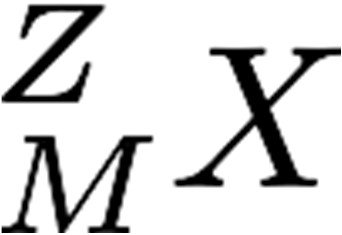
Atomic Number (Z): Number of protons in the nucleus, defines the element.
Mass Number (M): Total number of protons and neutrons in the nucleus.
Electrons as Waves and Quantum Numbers
Electrons in atoms exhibit both particle and wave-like behavior. Their distribution and energy are described by quantum mechanics, specifically the wavefunction (ψ), which defines an orbital.
Wavefunction (ψ): Describes the probability density of finding an electron in a region of space.
Quantum Numbers:
Principal (n): Energy level (shell)
Orbital (l): Shape of the orbital (s, p, d, f)
Magnetic (ml): Orientation of the orbital
Spin (s): Electron spin (+1/2 or –1/2)
Pauli Exclusion Principle: No two electrons in an atom can have the same set of four quantum numbers.
The s and p Atomic Orbitals
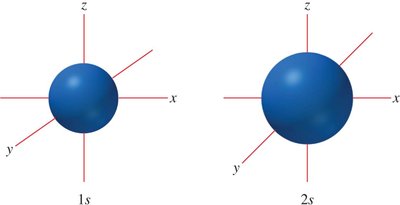
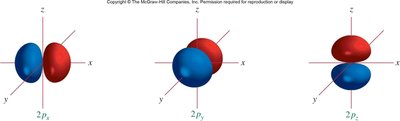
s orbitals are spherically symmetric and begin at n = 1. p orbitals are dumbbell-shaped, begin at n = 2, and are oriented along the x, y, and z axes. Each type of orbital has unique energy and spatial properties.
s orbitals: One per shell, lower in energy within a shell, spherical shape.
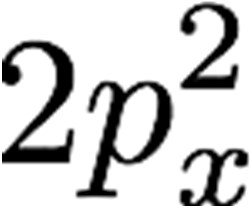
p orbitals: Three per shell (px, py, pz), dumbbell-shaped, contain a node at the nucleus.
Atomic Electron Configurations
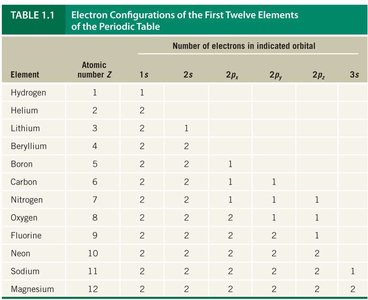
Electron configurations describe the arrangement of electrons in an atom's orbitals. The order of filling is determined by the Aufbau principle, Hund's rule, and the Pauli exclusion principle.
Aufbau Principle: Electrons fill the lowest energy orbitals first.
Hund's Rule: Electrons occupy degenerate orbitals singly before pairing.
Element | Atomic Number Z | 1s | 2s | 2px | 2py | 2pz | 3s |
|---|---|---|---|---|---|---|---|
Hydrogen | 1 | 1 | |||||
Helium | 2 | 2 | |||||
Lithium | 3 | 2 | 1 | ||||
Beryllium | 4 | 2 | 2 | ||||
Boron | 5 | 2 | 2 | 1 | |||
Carbon | 6 | 2 | 2 | 1 | 1 | ||
Nitrogen | 7 | 2 | 2 | 1 | 1 | 1 | |
Oxygen | 8 | 2 | 2 | 2 | 1 | 1 | |
Fluorine | 9 | 2 | 2 | 2 | 2 | 1 | |
Neon | 10 | 2 | 2 | 2 | 2 | 2 | |
Sodium | 11 | 2 | 2 | 2 | 2 | 2 | 1 |
Magnesium | 12 | 2 | 2 | 2 | 2 | 2 | 2 |
Ionic Bonds
Coulomb’s Law and Ionic Bonding
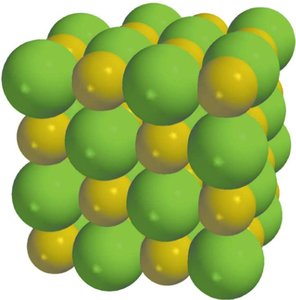
Ionic bonds form through the electrostatic attraction between oppositely charged ions. These ions are typically formed by the transfer of electrons from metals to nonmetals.
Coulomb’s Law: The force of attraction between two charges is proportional to the product of their charges and inversely proportional to the square of the distance between them.
Ionic Compounds: Form crystalline lattices, have high melting points, and are soluble in polar solvents.
Ionic Bonding and Electron Transfer
Ionic bonding can be visualized as the transfer of an electron from a metal (e.g., sodium) to a nonmetal (e.g., chlorine), resulting in the formation of ions and the subsequent formation of an ionic solid.
Example:
Formation of NaCl:


Covalent Bonds, Lewis Formulas, and the Octet Rule
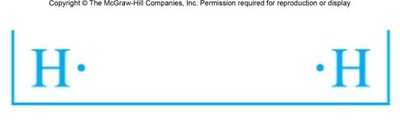
Covalent Bonding in H2 and F2
Covalent bonds involve the sharing of electrons between nonmetal atoms. The octet rule states that atoms tend to share electrons to achieve a full valence shell, typically eight electrons for second-row elements.
H2: Each hydrogen shares one electron to achieve the configuration of helium.
F2: Each fluorine shares one electron to achieve the configuration of neon.

The Lewis Model of Covalent Bonding
Lewis structures represent valence electrons as dots or lines. Shared pairs (lines) indicate covalent bonds, while unshared pairs (dots) are lone pairs. The octet rule guides the arrangement of electrons in stable molecules.
Lewis Symbols: Dots for electrons, lines for shared pairs.
Lone Pairs: Nonbonding electrons localized on a single atom.

Multiple Bonds
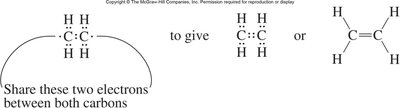
Atoms can share more than one pair of electrons to satisfy the octet rule, resulting in double or triple bonds.
Double Bond: Four electrons shared (e.g., ethylene, C2H4).
Triple Bond: Six electrons shared (e.g., ethyne, C2H2).

Polar Covalent Bonds, Electronegativity, and Bond Dipoles
Electronegativity
Electronegativity is the ability of an atom to attract electrons in a chemical bond. Differences in electronegativity between atoms lead to bond polarity.
Trend: Increases across a period (left to right) and up a group (bottom to top) in the periodic table.
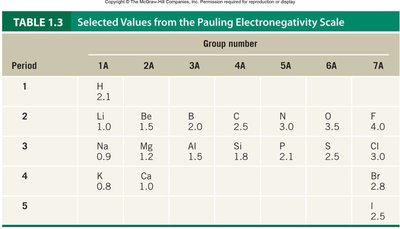
Polar Covalent Bonds and Dipole Moments
When two atoms with different electronegativities form a bond, electrons are shared unequally, resulting in a polar covalent bond and a bond dipole moment.
Dipole Moment (μ): A measure of bond polarity, points from positive to negative end.

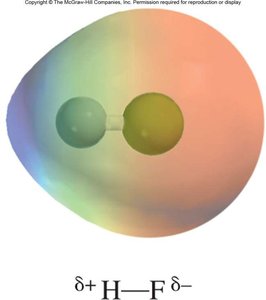
Electrostatic Potential Maps
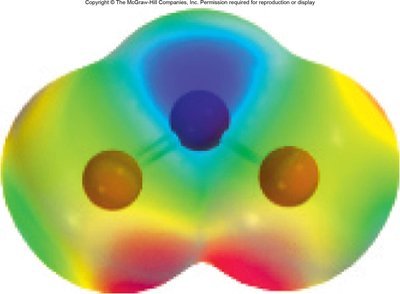
Electrostatic potential maps visually represent the distribution of electron density in molecules, highlighting regions of partial positive and negative charge.
Red: Electron-rich (negative)
Blue: Electron-poor (positive)
Formal Charge
Calculating Formal Charge
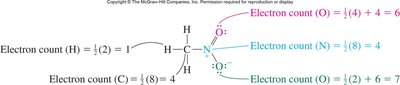
Formal charge helps determine the most stable Lewis structure for a molecule. It is calculated as:
Formal Charge (FC):
VEC: Valence electron count of the neutral atom (from periodic table)
FEC: Formal electron count (unshared electrons + half of bonding electrons)
Importance of Formal Charge
Structures with formal charges of zero are generally more stable.
If charges are present, negative charges should be on more electronegative atoms.
Structural Formulas of Organic Compounds: Isomers
Constitutional Isomers
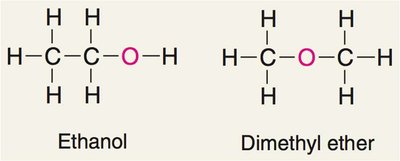
Constitutional isomers have the same molecular formula but different connectivity of atoms, resulting in different physical and chemical properties.
Example: Ethanol and dimethyl ether (C2H6O)
Levels of Organic Structure
Molecular Formula: Shows composition
Structural Formula: Shows connectivity
Configuration: Shows spatial arrangement
Condensed and Bond-line Formulas
Condensed formulas list atoms in order of connectivity, while bond-line formulas omit carbon and hydrogen labels for simplicity. Expanding a bond-line formula involves adding all implied atoms and lone pairs to satisfy the octet rule.
Resonance and Curved Arrows
Resonance Structures
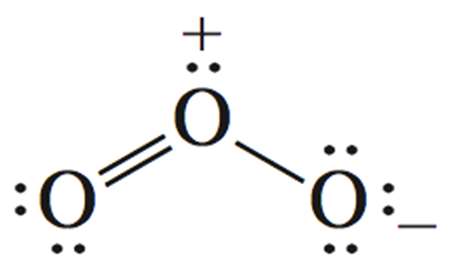
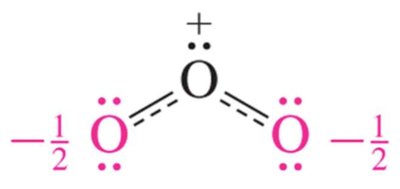
Some molecules cannot be adequately represented by a single Lewis structure. Resonance structures depict delocalized electrons, and the true structure is a hybrid of all valid forms.
Rules: Atoms' positions remain the same; total electrons and net charge are conserved; second-row elements do not exceed the octet.
Importance of Resonance
Resonance stabilizes molecules by delocalizing charge.
Resonance forms can reveal reactive sites in molecules.
Sulfur and Phosphorus-Containing Compounds and the Octet Rule
Expanded Octets
Third-row elements like phosphorus and sulfur can have more than eight electrons (expanded octets) due to available d orbitals. Examples include PCl5, phosphates, and sulfates.
Molecular Geometries
Valence Shell Electron Pair Repulsion (VSEPR) Theory
VSEPR theory predicts molecular shapes based on the repulsion between electron groups (bonding and lone pairs) around a central atom. Electron groups arrange themselves to minimize repulsion, determining the geometry.
Electron Groups: Lone pairs and bonding pairs (multiple bonds count as one group)
Unshared pairs: More repulsive than bonding pairs
Applying Geometry and Polarization
The overall molecular dipole moment is the vector sum of individual bond dipoles. Symmetrical molecules with polar bonds can be nonpolar overall if dipoles cancel.
Molecular Dipole Moments
Nonpolar and Polar Molecules
Nonpolar: Symmetrical molecules or those with nonpolar bonds (e.g., CCl4)
Polar: Asymmetrical molecules with polar bonds (e.g., CH2Cl2)
Curved Arrows, Arrow Pushing, and Chemical Reactions
Curved Arrows as Electron Bookkeeping
Curved arrows are used to show the movement of electrons during chemical reactions. A full-headed arrow represents the movement of an electron pair from a source (nucleophile) to a sink (electrophile).
Multiple arrows may be used for complex steps, such as proton transfers or bond rearrangements.
Acids and Bases: The Brønsted-Lowry View
Brønsted-Lowry Acids and Bases
Acids are proton donors, and bases are proton acceptors. Conjugate acid-base pairs differ by one proton.
Acid Dissociation Constant (Ka): Measures acid strength; larger Ka means stronger acid.
pKa: ; lower pKa means stronger acid.
How Structure Affects Acid Strength
Structural Factors Influencing Acidity
Strength of the H–A bond (weaker bond, stronger acid)
Electronegativity of A (more electronegative, stronger acid)
Inductive effects (nearby electronegative atoms increase acidity)
Resonance stabilization of the conjugate base (more resonance, stronger acid)
Acid-Base Equilibria
Favoring the Weak
Acid-base equilibria favor the side with the weaker acid (higher pKa). The direction of equilibrium can be predicted using pKa values.
Acids and Bases: The Lewis View
Lewis Theory of Acids and Bases
Lewis acids accept electron pairs, while Lewis bases donate electron pairs. All Brønsted acids and bases are also Lewis acids and bases, but the Lewis definition is broader and includes many more reactions.
Example: BF3 (Lewis acid) + OEt2 (Lewis base) form a coordinate covalent bond.
Additional info: This chapter provides foundational concepts for understanding atomic structure, bonding, molecular geometry, and acid-base chemistry, all of which are essential for further study in general and organic chemistry.
