 Back
BackChapter 10: Chemical Bonding II – Molecular Shapes and Valence Bond Theory
Study Guide - Smart Notes
 Tailored notes based on your materials, expanded with key definitions, examples, and context.
Chapter 10: Chemical Bonding II – Molecular Shapes and Valence Bond Theory
Introduction
This chapter explores the principles that determine the three-dimensional shapes of molecules and the theoretical framework for understanding covalent bonding. The focus is on the Valence Shell Electron Pair Repulsion (VSEPR) model, molecular geometry, bond angles, molecular polarity, and valence bond theory, including hybridization.
VSEPR Model and Molecular Shapes
Valence Shell Electron Pair Repulsion Theory (VSEPR)
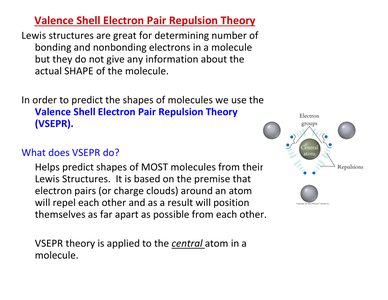
The VSEPR model is used to predict the shapes of molecules based on the repulsion between electron pairs (bonding and nonbonding) around a central atom. Lewis structures indicate the number of bonding and nonbonding electrons but do not provide information about molecular shape. VSEPR theory fills this gap by considering electron pair repulsions.
Key Principle: Electron pairs (bonding or lone pairs) around a central atom arrange themselves as far apart as possible to minimize repulsion.
Application: VSEPR theory is applied to the central atom in a molecule.
Rules for Predicting Electron-Pair Geometry
All valence-shell electron groups around the central atom are counted equally, regardless of whether they are bonding or nonbonding (lone pairs).
Double or triple bonds are treated as a single group of electrons when predicting molecular shapes.
Steps for Determining Molecular Geometry
Draw a correct Lewis diagram.
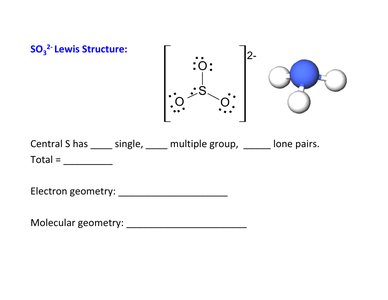
For each atom whose geometry you want to determine, sum up the number of nonbonding pairs, single bonds, and multiple bonds.
Once you have established the number of electron groups, you have determined the electron geometry.
Examples: SO2 and H2O
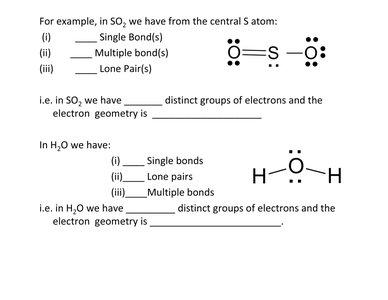
For SO2: Count single bonds, multiple bonds, and lone pairs on the central S atom to determine the number of electron groups and the electron geometry.
For H2O: Count single bonds and lone pairs on the central O atom.
Electron Geometry vs. Molecular Geometry
Electron geometry describes the arrangement of all electron groups (bonding and lone pairs) around the central atom. Molecular geometry describes the arrangement of only the atoms (not lone pairs) in space. The two geometries differ when there are lone pairs on the central atom.
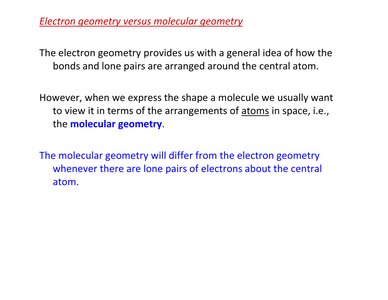
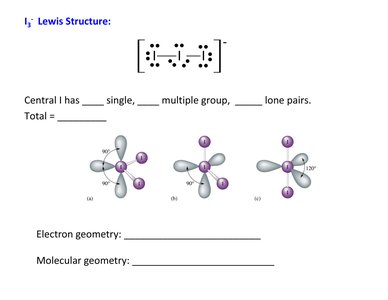
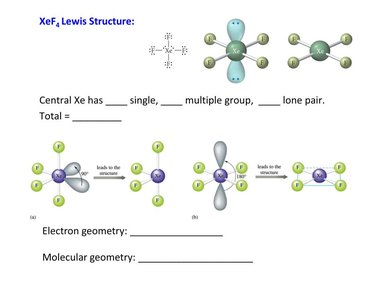
Practice: SO32−, I3−, XeF4
Draw the Lewis structure, count electron groups, and determine both electron and molecular geometry for each species.
Special Geometries: Trigonal Bipyramidal and Octahedral
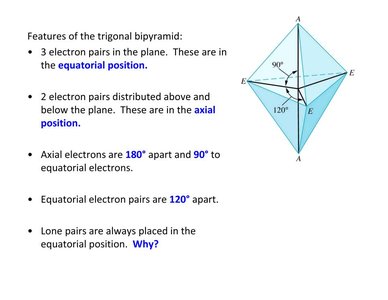
Trigonal Bipyramidal: 3 electron pairs in the equatorial plane (120° apart), 2 in the axial positions (90° to equatorial, 180° apart). Lone pairs occupy equatorial positions to minimize repulsion.
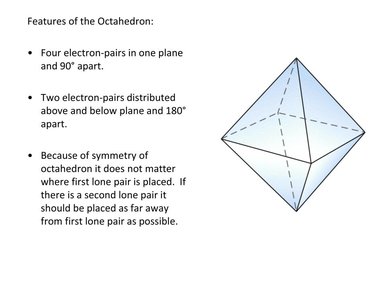
Octahedral: 4 electron pairs in one plane (90° apart), 2 above and below (180° apart). Lone pairs are placed as far apart as possible due to symmetry.
Molecules with More Than One Central Atom
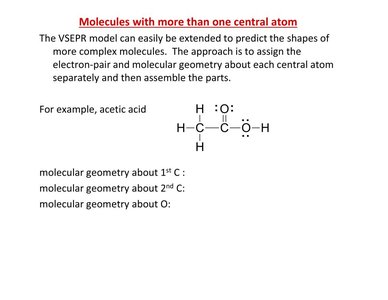
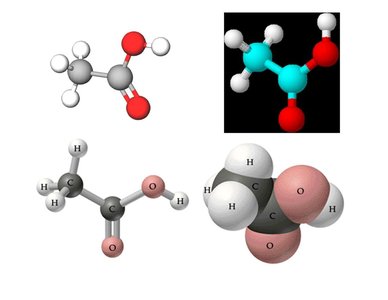
The VSEPR model can be extended to complex molecules by assigning electron-pair and molecular geometry to each central atom separately, then assembling the parts. For example, in acetic acid, determine the geometry about each carbon and the oxygen atom.
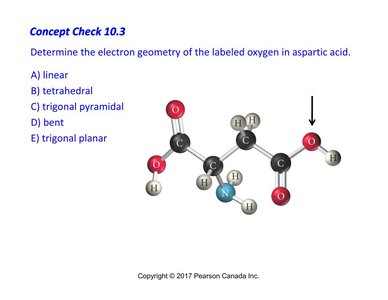
Concept Check: Electron Geometry in Aspartic Acid
Practice identifying the electron geometry of a labeled atom in a complex molecule, such as aspartic acid.
Bond Angles
Factors Affecting Bond Angles
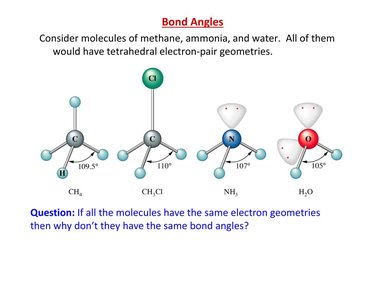
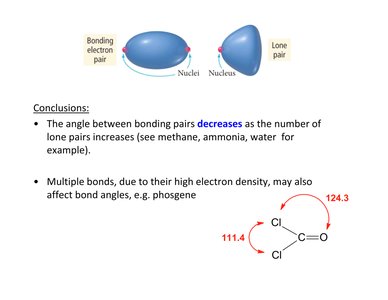
Bond angles are influenced by the number of lone pairs and the presence of multiple bonds. Even if molecules have the same electron geometry, their bond angles may differ due to these factors.
The angle between bonding pairs decreases as the number of lone pairs increases.
Multiple bonds, due to higher electron density, can also affect bond angles.
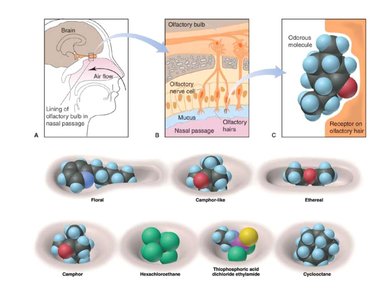
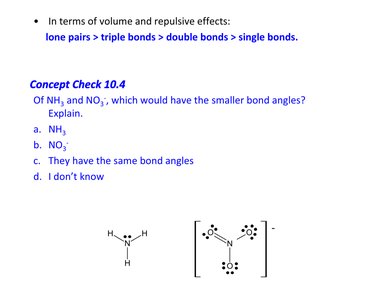
Repulsive effects (in order): lone pairs > triple bonds > double bonds > single bonds.
Polarity of Molecules
Bond Polarity and Molecular Polarity
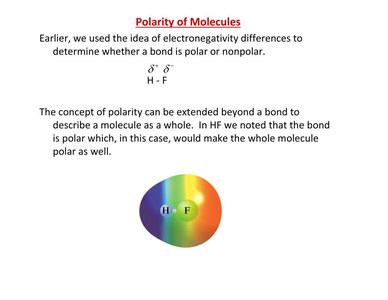
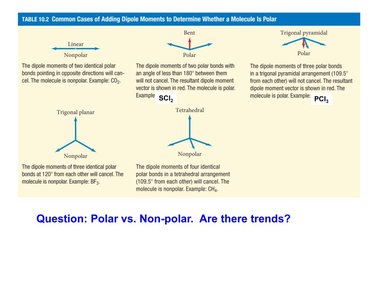
Polarity arises from differences in electronegativity between atoms. A molecule is polar if it has a net dipole moment, meaning one end is slightly positive and the other slightly negative.
Polar molecules align themselves in electric fields, with respect to each other, and with respect to other ions present.
Dipole Moments of Polyatomic Molecules
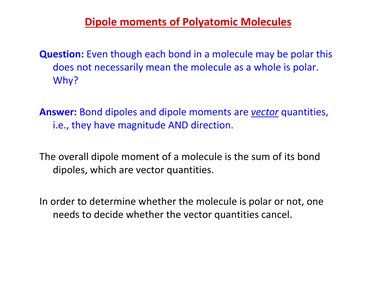
Bond dipoles are vector quantities (magnitude and direction). The overall dipole moment is the vector sum of all bond dipoles. A molecule is polar if the vector sum does not cancel out.
Examples: CO2, H2O, NH3, CCl4, XeF4
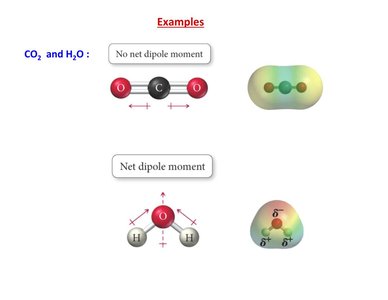
CO2: Linear, bond dipoles cancel, nonpolar.
H2O: Bent, bond dipoles do not cancel, polar.
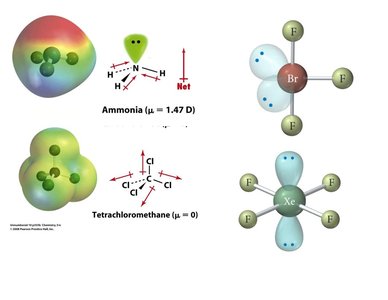
NH3: Trigonal pyramidal, net dipole moment, polar.
CCl4: Tetrahedral, bond dipoles cancel, nonpolar.
XeF4: Square planar, bond dipoles cancel, nonpolar.
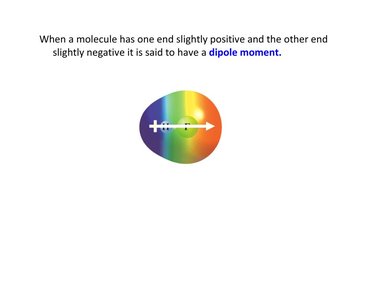
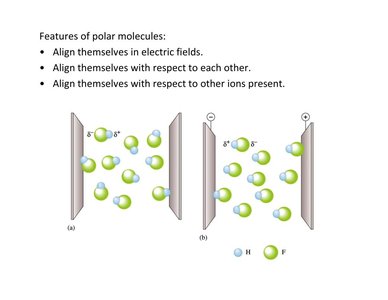
Table: Common Cases of Adding Dipole Moments
Geometry | Nonpolar | Polar |
|---|---|---|
Linear | Two identical polar bonds pointing in opposite directions cancel (e.g., CO2). | Two polar bonds at an angle less than 180° do not cancel (e.g., SCN-). |
Trigonal planar | Three identical polar bonds at 120° cancel (e.g., BF3). | Three polar bonds at angles less than 120° do not cancel (e.g., SO2). |
Tetrahedral | Four identical polar bonds at 109.5° cancel (e.g., CCl4). | Four polar bonds at angles less than 109.5° do not cancel (e.g., CHCl3). |
Trigonal pyramidal | — | Three polar bonds in a trigonal pyramidal arrangement (107.5°) do not cancel (e.g., PCl3). |
Valence Bond Theory
Basic Principles
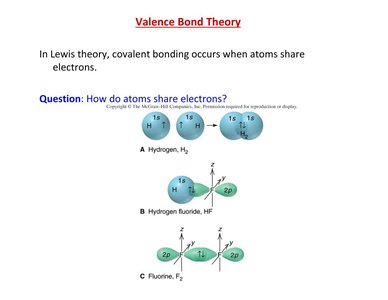
Valence bond theory describes covalent bonding as the sharing of electrons through the overlap of atomic orbitals. The shared region of space is called the atomic overlap. Two electrons (usually one from each atom) of opposite spin occupy the overlap region, forming a covalent bond. The optimal bond length corresponds to maximum overlap with minimum energy.
A covalent bond forms when the orbitals on two atoms overlap.
The shared region is called the atomic overlap.
There are two electrons of opposite spin in the overlap.
Bond length is determined by the distance of maximum overlap and minimum energy.
Example: H2S
Lewis structure and electron configuration for H and S are used to explain bonding.
Bonding involves overlap of S 3p and H 1s orbitals.
Hybrid Orbitals
Hybridization explains observed molecular geometries that cannot be accounted for by simple s and p orbital overlap. For example, methane (CH4) has a tetrahedral shape, which requires a bonding scheme involving hybrid orbitals.
Summary
VSEPR theory predicts molecular shapes based on electron pair repulsions.
Bond angles are affected by lone pairs and multiple bonds.
Molecular polarity depends on both bond polarity and molecular geometry.
Valence bond theory and hybridization explain covalent bonding and molecular shapes.
