 Back
BackChapter 10: Gases – Properties, Laws, and Real Behavior
Study Guide - Smart Notes
 Tailored notes based on your materials, expanded with key definitions, examples, and context.
Gases: Properties and Characteristics
Physical Properties of Gases
Gases are a fundamental state of matter characterized by their ability to expand and fill any container, high compressibility, and low density. Most common gases are composed of nonmetallic elements with simple formulas and low molar masses. Gases form homogeneous mixtures regardless of their chemical identity.
Expansion: Gases expand to fill their containers.
Compressibility: Gases are highly compressible compared to liquids and solids.
Density: Gases have much lower densities than liquids or solids.
Mixing: Two or more gases form homogeneous mixtures.
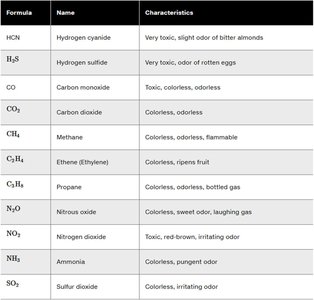
Brownian Motion
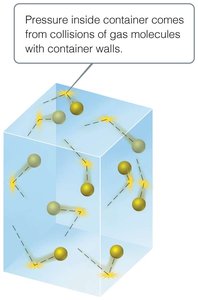
Gas molecules move chaotically, colliding with each other and the walls of their container. This random motion is known as Brownian motion and is responsible for the pressure exerted by gases.

Pressure and Its Measurement
Definition of Pressure
Pressure (P) is defined as the force (F) applied per unit area (A):
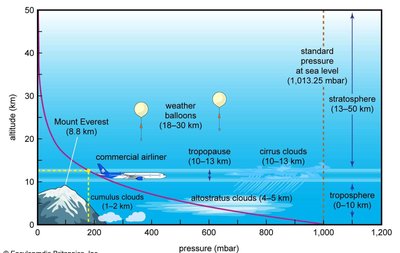
Atmospheric pressure is the weight of air per unit area at Earth's surface.
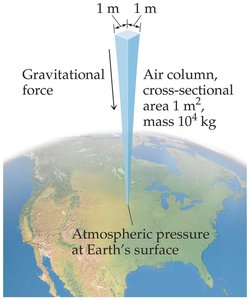
Units of Pressure
Pascals (Pa): SI unit, 1 Pa = 1 N/m2
Bar: 1 bar = 105 Pa = 100 kPa
mm Hg or Torr: Based on the height difference in a mercury column
Atmosphere (atm): 1 atm = 760 torr = 101.325 kPa
Measuring Pressure: Barometers and Manometers
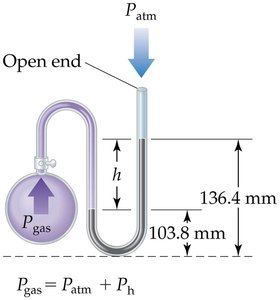
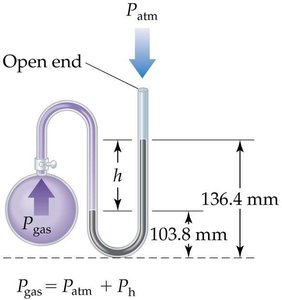
A barometer measures atmospheric pressure using a column of mercury. A manometer measures the pressure of a gas in a vessel relative to atmospheric pressure.
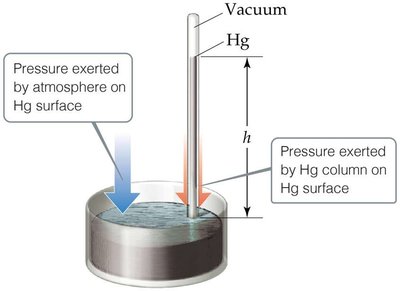
Standard Pressure and STP
Standard atmospheric pressure (STP) is defined as 1 atm (101.325 kPa, 760 mmHg) at 0°C.
Sample Pressure Calculations
Pressure due to a column of fluid is calculated as:

Manometer Calculations
The pressure of a gas in a flask can be determined using the difference in mercury heights in a manometer:

The Gas Laws
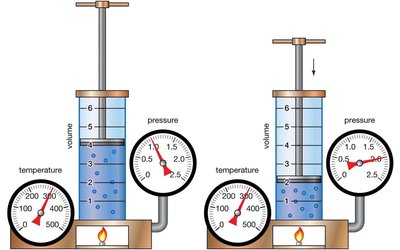
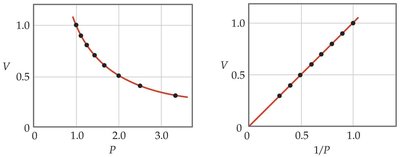
Boyle’s Law: Pressure-Volume Relationship
At constant temperature, the volume of a fixed quantity of gas is inversely proportional to its pressure:
Graph of V vs. P is a curve; V vs. 1/P is linear.

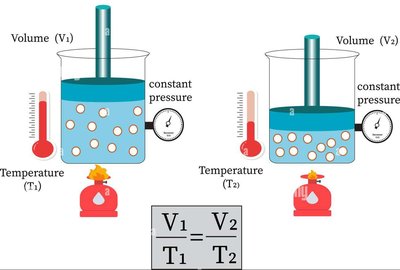
Charles’s Law: Temperature-Volume Relationship
At constant pressure, the volume of a fixed amount of gas is directly proportional to its absolute temperature (in Kelvin):
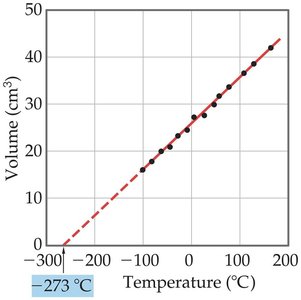
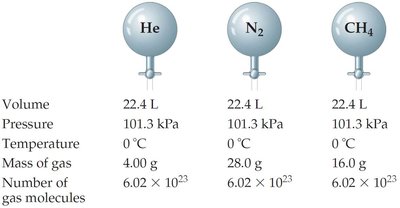
Avogadro’s Law: Quantity-Volume Relationship
At constant temperature and pressure, the volume of a gas is directly proportional to the number of moles (n):
The Ideal Gas Equation
Derivation and Formulation
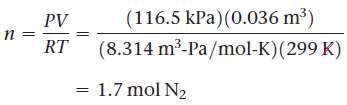
Combining Boyle’s, Charles’s, and Avogadro’s laws gives the ideal gas equation:
P: Pressure (atm, Pa, etc.)
V: Volume (L, m3)
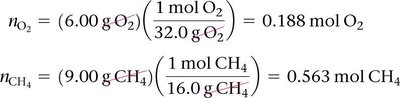
n: Moles of gas
R: Universal gas constant
T: Temperature (K)
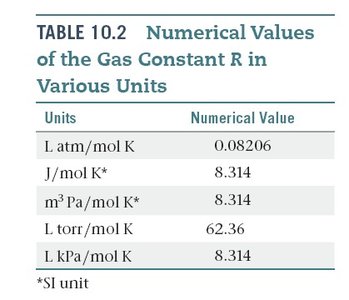




Gas Constant R
Units | Numerical Value |
|---|---|
L atm/mol K | 0.08206 |
J/mol K | 8.314 |
m3 Pa/mol K | 8.314 |
L torr/mol K | 62.36 |
L kPa/mol K | 8.314 |
Applications of the Ideal Gas Equation
Density and Molar Mass of Gases
The density (d) of a gas can be derived from the ideal gas equation:
Where M is the molar mass. If the mass, volume, and temperature are known, the molar mass can be found:
Volumes of Gases in Chemical Reactions
Stoichiometry involving gases uses the ideal gas law to relate the volume of gases to the number of moles in a reaction. The coefficients in a balanced equation indicate the relative amounts of reactants and products.
Gas Mixtures and Partial Pressures
Dalton’s Law of Partial Pressures
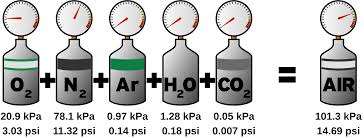
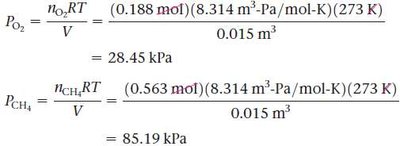
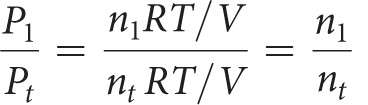
The total pressure of a mixture of gases equals the sum of the pressures each would exert if present alone:
Partial Pressures and Mole Fractions
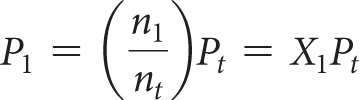
The partial pressure of a gas in a mixture is proportional to its mole fraction:
Where is the mole fraction.
Kinetic-Molecular Theory of Gases
Main Tenets
Gases consist of large numbers of molecules in continuous, random motion.
The combined volume of all molecules is negligible compared to the total volume.
Attractive and repulsive forces between molecules are negligible.
Energy can be transferred during collisions, but the average kinetic energy remains constant at constant temperature.
The average kinetic energy is proportional to the absolute temperature.
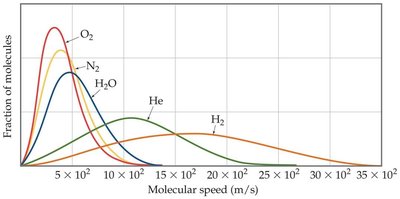
Molecular Speeds and Temperature
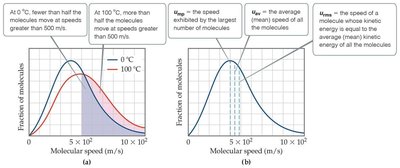
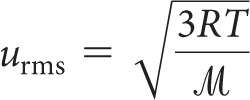
At a given temperature, molecules have a distribution of speeds. The root-mean-square (rms) speed is related to the average kinetic energy:
Effusion and Diffusion
Effusion
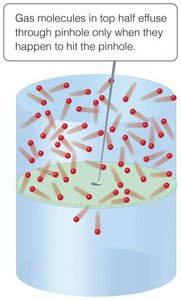
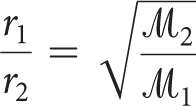
Effusion is the process by which gas molecules escape through a tiny hole into an evacuated space. Graham’s Law relates the rates of effusion of two gases to their molar masses:
Real Gases and Deviations from Ideal Behavior
Deviations from Ideal Gas Law
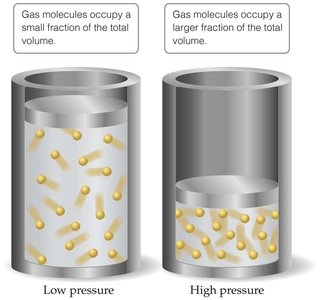
Real gases deviate from ideal behavior at high pressures and low temperatures due to intermolecular forces and the finite volume of molecules. The ideal gas law assumes negligible volume and no intermolecular forces, which breaks down under these conditions.
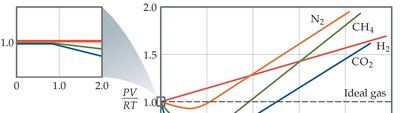
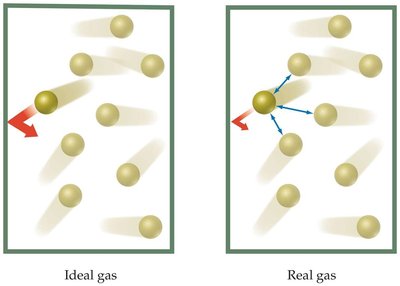
Van der Waals Equation
The van der Waals equation corrects the ideal gas law for intermolecular attractions (a) and molecular volume (b):
Substance | a (L2·kPa/mol2) | b (L/mol) |
|---|---|---|
He | 3.46 | 0.02370 |
Ne | 21.4 | 0.0171 |
Ar | 135 | 0.0322 |
N2 | 141 | 0.0391 |
O2 | 138 | 0.0318 |
CO2 | 364 | 0.0429 |
NH3 | 423 | 0.0371 |
CH4 | 228 | 0.0428 |
CCl4 | 2067 | 0.1383 |

