 Back
Chapter 10: Gases – Properties, Laws, and Applications
Study Guide - Smart Notes
 Tailored notes based on your materials, expanded with key definitions, examples, and context.
Gases
Properties of Gases
Gases exhibit unique physical properties that distinguish them from solids and liquids. Understanding these properties is fundamental to the study of gas behavior in chemistry.
Variable Shape and Volume: Gases take the shape and volume of their container.
Uniform Expansion: Gases expand evenly throughout any available space.
Uniform Compression: Gases compress evenly when pressure is applied.
Low Density: Gases have much lower density compared to solids and liquids.
Uniform Mixing: Gases mix evenly with other gases in the same container.
Atmospheric Pressure
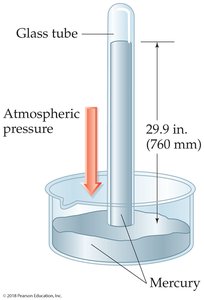
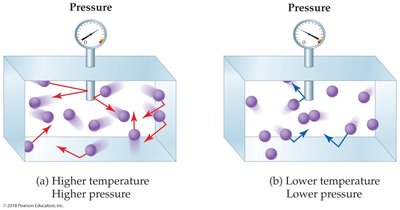
Atmospheric pressure is the force exerted by air molecules in the environment. It is measured by the impact of gas molecules striking the walls of their container. Higher temperatures increase the frequency and force of these collisions, raising the pressure.
Barometer: Invented by Evangelista Torricelli in 1643, the barometer measures atmospheric pressure.
Standard Atmospheric Pressure: Defined as 29.9 inches of mercury (Hg) or 760 torr.
Units of Pressure
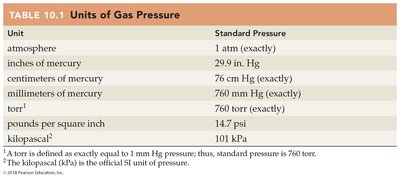
Pressure can be expressed in several units. Standard pressure at sea level is 29.9 inches of mercury. The following table summarizes common units of gas pressure:
Unit | Standard Pressure |
|---|---|
atmosphere | 1 atm (exactly) |
inches of mercury | 29.9 in. Hg |
centimeters of mercury | 76 cm Hg (exactly) |
millimeters of mercury | 760 mm Hg (exactly) |
torr | 760 torr (exactly) |
pounds per square inch | 14.7 psi |
kilopascal | 101 kPa |
Variables Affecting Gas Pressure
Three main variables affect the pressure of a gas:
Volume of the container
Temperature of the gas
Number of gas molecules
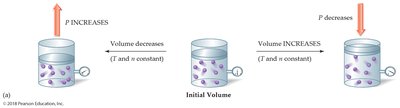
Volume Versus Pressure
Pressure and volume are inversely related when temperature and the number of molecules are constant. Decreasing volume increases pressure, while increasing volume decreases pressure.
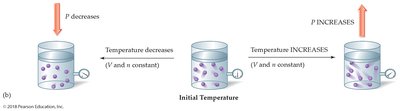
Temperature Versus Pressure
Pressure and temperature are directly related when volume and the number of molecules are constant. Increasing temperature increases pressure, while decreasing temperature decreases pressure.
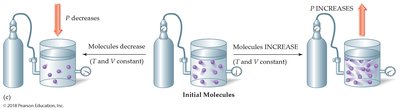
Molecules Versus Pressure
The number of gas molecules is directly proportional to pressure when volume and temperature are constant. Increasing the number of molecules increases pressure, while decreasing the number decreases pressure.
Individual Gas Laws
Several fundamental gas laws describe the relationships between pressure, volume, and temperature:
Boyle’s Law: At constant temperature, the volume of a gas is inversely proportional to its pressure.
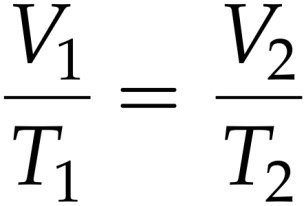
Charles’s Law: At constant pressure, the volume of a gas is directly proportional to its temperature in Kelvin.
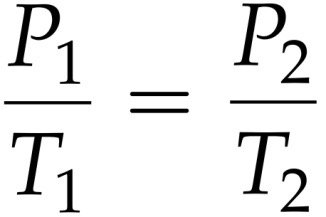
Gay-Lussac’s Law: At constant volume and mass, the pressure of a gas is directly proportional to its temperature in Kelvin.
Combined Gas Law
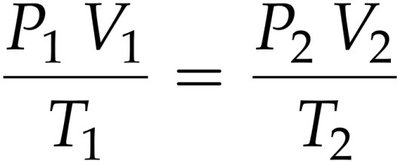
The combined gas law integrates Boyle’s, Charles’s, and Gay-Lussac’s laws for a fixed amount of gas:
Equation:
Application: Used to solve problems involving changes in pressure, volume, and temperature.
Kinetic–Molecular Theory of Gases
The kinetic–molecular theory explains the behavior of gases at the molecular level:
Gases consist of tiny molecules in rapid, random motion.
Gas molecules have no attraction for one another.
Collisions between molecules are elastic (no energy loss).
The average kinetic energy of gas molecules is proportional to the Kelvin temperature:
Ideal Gas Law
The ideal gas law relates pressure, volume, temperature, and the number of moles of gas:
Equation:
R: The ideal gas constant,
Application: Used to calculate any one variable if the others are known.
Dalton’s Law of Partial Pressures
Dalton’s law states that the total pressure of a mixture of gases is the sum of the partial pressures of each individual gas:
Equation:
Partial Pressure: The pressure exerted by each gas in a mixture.
Application: Used to determine the total pressure in a mixture or the pressure of a single component.
Example Applications
Gas Pressure Conversion: Converting between units such as atm, mm Hg, psi, and kPa using standard pressure values.
Gas Pressure Changes: Predicting how changes in temperature, volume, or number of molecules affect gas pressure.
Combined Gas Law Problems: Calculating new volumes, pressures, or temperatures for a gas sample under changing conditions.
Dalton’s Law Problems: Determining total atmospheric pressure from partial pressures of individual gases.
Summary Table: Units of Gas Pressure
Unit | Standard Pressure |
|---|---|
Atmosphere (atm) | 1 atm |
Inches of Mercury (in. Hg) | 29.9 in. Hg |
Millimeters of Mercury (mm Hg) | 760 mm Hg |
Torr | 760 torr |
Pounds per Square Inch (psi) | 14.7 psi |
Kilopascal (kPa) | 101 kPa |
Key Equations
Boyle’s Law:
Charles’s Law:
Gay-Lussac’s Law:
Combined Gas Law:
Ideal Gas Law:
Dalton’s Law:
Example: Gas Pressure Conversion
Given a barometric pressure of 27.5 in. Hg, convert to:
atm:
mm Hg:
psi:
kPa:
Example: Dalton’s Law of Partial Pressures
If a sample contains nitrogen (587 mm Hg), oxygen (158 mm Hg), and argon (7 mm Hg), the total pressure is:
Example: Ideal Gas Law Calculation
How many moles of hydrogen gas occupy a volume of 0.500 L at STP?
STP:
Example: Kinetic Energy Comparison
For two 5.00-L samples of ammonia (NH3) and nitrogen dioxide (NO2) at 25°C:
Kinetic Energy: Both gases have the same average kinetic energy at the same temperature.
Speed: NH3 molecules move faster because they have lower molar mass.
Summary
This chapter covers the essential properties, laws, and theoretical concepts of gases, providing a foundation for understanding their behavior in chemical and physical processes.
