 Back
Chapter 10: Gases – Properties, Laws, and Applications
Study Guide - Smart Notes
 Tailored notes based on your materials, expanded with key definitions, examples, and context.
Gases: Physical Characteristics and Properties
Overview of Gaseous State
Gases are a fundamental state of matter characterized by their ability to expand and fill any container, high compressibility, and low density. Most gases are composed of nonmetallic elements with simple molecular formulas and low molar masses. Unlike solids and liquids, gases form homogeneous mixtures regardless of their identities.
Expansion: Gases expand to fill their containers completely.
Compressibility: Gases can be compressed much more than solids or liquids.
Low Density: The density of gases is much lower than that of solids and liquids.
Mixing: Two or more gases mix homogeneously in any proportion.
Common Gaseous Compounds
Many compounds exist as gases at room temperature. Examples include hydrogen cyanide (HCN), hydrogen sulfide (H2S), carbon monoxide (CO), carbon dioxide (CO2), methane (CH4), ethene (C2H4), propane (C3H8), nitrous oxide (N2O), nitrogen dioxide (NO2), ammonia (NH3), and sulfur dioxide (SO2).
Pressure and Its Measurement
Definition of Pressure
Pressure (P) is defined as the force (F) applied per unit area (A):
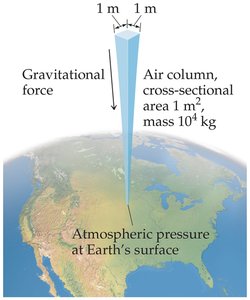
All gases exert pressure on the surfaces they contact. Atmospheric pressure is the weight of the air per unit area at Earth's surface.
Units of Pressure
Pascals (Pa): SI unit,
Bar:
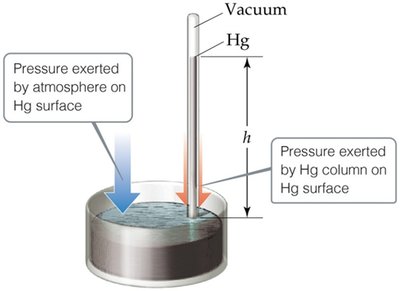
Millimeters of Mercury (mmHg) or Torr: Based on the height difference in a mercury column.
Atmosphere (atm):
Manometers
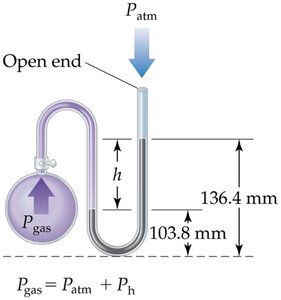
A manometer measures the pressure of a gas in a vessel relative to atmospheric pressure. The difference in mercury column heights corresponds to the pressure difference.
The Gas Laws
Variables Defining Gaseous State
Four variables define the state of a gas:
Temperature (T)
Pressure (P)
Volume (V)
Amount of gas (n, in moles)
The relationships among these variables are described by the gas laws.
Boyle’s Law: Pressure–Volume Relationship
At constant temperature, the volume of a fixed amount of gas is inversely proportional to its pressure:
A plot of V versus 1/P yields a straight line.
Charles’s Law: Volume–Temperature Relationship
At constant pressure, the volume of a fixed amount of gas is directly proportional to its absolute temperature (in Kelvin):
Avogadro’s Law: Volume–Amount Relationship
At constant temperature and pressure, the volume of a gas is directly proportional to the number of moles:
At STP (0°C, 1 atm), one mole of any ideal gas occupies 22.4 L.
The Ideal Gas Law
Combining Boyle’s, Charles’s, and Avogadro’s laws yields the ideal gas equation:
Where R is the ideal gas constant. Common values for R:
Unit | Value |
|---|---|
L·atm/(mol·K) | 0.08206 |
J/(mol·K) | 8.314 |
cal/(mol·K) | 1.987 |
L·torr/(mol·K) | 62.36 |
Gas Law Applications and Problem Solving
Tabulate known and unknown variables.
Convert all quantities to consistent units (e.g., pressure in atm, volume in L, temperature in K).
Select the appropriate equation and solve for the unknown.
Use dimensional analysis for unit conversions.
Gas Densities and Molar Mass
Density of a Gas
The density (d) of a gas can be derived from the ideal gas law:
Where M is the molar mass, P is pressure, R is the gas constant, and T is temperature in Kelvin.
Molar Mass Determination
The molar mass (M) of a gas can be calculated if the mass (m), pressure (P), volume (V), and temperature (T) are known:
Gas Mixtures and Partial Pressures
Dalton’s Law of Partial Pressures
In a mixture of non-reacting gases, the total pressure is the sum of the partial pressures of each component:
The partial pressure of each gas is proportional to its mole fraction in the mixture:
Where is the mole fraction.
Kinetic-Molecular Theory of Gases
Postulates of Kinetic-Molecular Theory
Gases consist of large numbers of molecules in continuous, random motion.
The combined volume of all molecules is negligible compared to the container volume.
Attractive and repulsive forces between molecules are negligible.
Energy can be transferred during collisions, but the average kinetic energy remains constant at constant temperature.
The average kinetic energy is proportional to the absolute temperature.
Molecular Speeds and Distributions
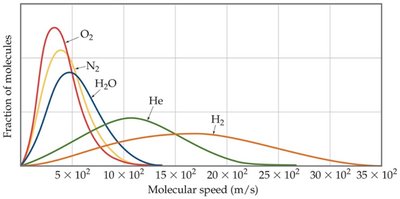
At a given temperature, molecules have a distribution of speeds. The root-mean-square (rms) speed is given by:
Where M is the molar mass in kg/mol.
Effusion and Diffusion
Effusion
Effusion is the process by which gas molecules escape through a tiny hole into a vacuum.
Diffusion
Diffusion is the spread of one substance throughout a space or another substance.
Graham’s Law of Effusion
The rate of effusion of a gas is inversely proportional to the square root of its molar mass:
Real Gases: Deviations from Ideal Behavior
Non-Ideal Gas Behavior
Real gases deviate from ideal behavior at high pressures and low temperatures due to intermolecular forces and the finite volume of molecules. The ideal gas law is most accurate at low pressure and high temperature.
Van der Waals Equation
The van der Waals equation corrects for non-ideal behavior by accounting for molecular volume and intermolecular attractions:
Where a corrects for attractive forces and b corrects for the volume occupied by gas molecules. The values of a and b are specific to each gas.
Gas | a (L2·atm/mol2) | b (L/mol) |
|---|---|---|
He | 0.0341 | 0.0237 |
N2 | 1.39 | 0.0391 |
O2 | 1.36 | 0.0318 |
CO2 | 3.59 | 0.0427 |
NH3 | 4.17 | 0.0371 |
CH4 | 2.25 | 0.0428 |
Summary Table: Key Gas Laws and Equations
Law | Equation | Variables Held Constant |
|---|---|---|
Boyle’s Law | n, T | |
Charles’s Law | n, P | |
Avogadro’s Law | P, T | |
Ideal Gas Law | — | |
Dalton’s Law | — | |
Graham’s Law | — | |
Van der Waals | — |
Additional info: This guide covers all major concepts from Chapter 10: Gases, including physical properties, pressure measurement, gas laws, kinetic-molecular theory, real gas behavior, and relevant equations. Practice problems and further examples can be found in the textbook for mastery of calculations and conceptual understanding.
